Within Haunted Lincolnshire
What Haunts Lincolnshire's Roads and Fens?
Black dogs, phantom animals and lonely roadside figures show how Lincolnshire's landscape shapes its supernatural folklore.
On this page
- Black dogs and older animal folklore
- Fen roads, isolation and modern apparitions
- Collectors, newspapers and local retellings
Page outline Jump by section
Introduction
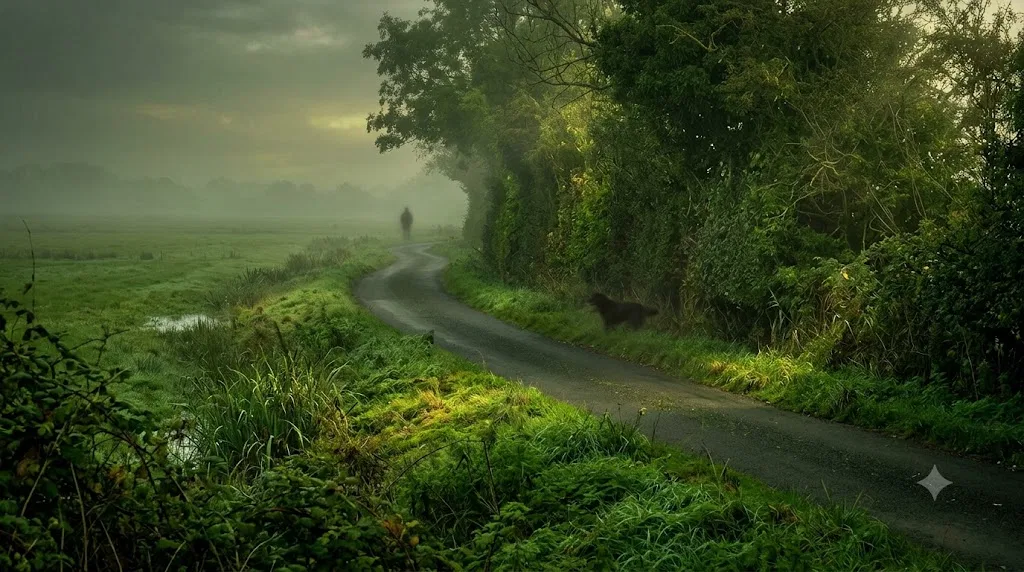
Lincolnshire’s roadside folklore is strongest where the county feels most open, lonely and exposed: fen lanes, river edges, old byways, churchyards, former airfields and long straight roads where a traveller has time to imagine something keeping pace beside them. The best-known figures are not always house ghosts. They are black dogs, white calves, phantom hares, flickering fen lights and modern roadside apparitions such as the Metheringham Lass. Together, they show how Lincolnshire’s haunted reputation is shaped by movement: walking home after dark, riding along a lane, driving across a former runway, or crossing flat wet country where a light or animal may be difficult to judge.
These stories should be read as folklore and reported experience, not proof of supernatural beings. Their value lies in what they attach to place. In Lincolnshire, apparitions often warn, follow, guard or mislead people on the edge of safety. That makes the county’s road-and-fen lore different from a conventional haunted-building story: the haunting is not contained inside a room, but spread across landscape, weather, memory and travel.
Why Lincolnshire’s Roads Make Good Ghost Stories
The county’s geography helps explain the tone of its supernatural traditions. Natural England describes the Fens as a large, low-lying, flat landscape of drainage ditches, dykes and rivers, with wide horizons, enormous skies and a strong sense of isolation and tranquillity. Much land depends on pumped drainage and sluices, and the straight artificial watercourses can run for long distances through open country.[Natural England]publications.naturalengland.org.ukNatural England NCA Profile: 46. The FensNatural England NCA Profile: 46. The Fens
That is exactly the kind of setting in which older folklore about deceptive lights, following animals and dangerous crossings makes emotional sense. A traveller in the dark fen world might see a light over water, hear an animal on the road, or mistake a reflection for a human figure. The story then gives the experience a memorable shape: a dog that walks beside you, a calf that lures you towards water, a woman who flags down a car and vanishes.
Lincolnshire’s other landscapes matter too. The Wolds, Lincoln Cliff and river systems give black-dog traditions a different feel from the broad fen stories. The Lincolnshire Folk Tales Project notes that Ethel Rudkin’s collected black-dog accounts were concentrated largely between the Lincoln Cliff and the River Trent in northern Lincolnshire, close to the rivers Till, Ancholme and Eau, while also extending to the coast, Fens and all three historic Parts of the county.[Lincolnshire Folk Tales Project]lincolnshirefolktalesproject.comOpen source on lincolnshirefolktalesproject.com. In other words, the creature belongs not to one village alone, but to a network of roads, fields, river corridors and thresholds.
Black Dogs and Older Animal Folklore
The black dog is the central creature in Lincolnshire’s road folklore. In wider English tradition, black dogs are often ominous, connected with death, danger, lonely roads, churchyards or old boundaries. Lincolnshire keeps that darker pattern but also softens it in striking ways. The Lincolnshire Folk Tales Project summarises the county’s version as Black Dog, Black Shuck or Hairy Jack, noting that East Anglian versions are often called Black Shuck while Lincolnshire examples are frequently linked with the name Hairy Jack.[Lincolnshire Folk Tales Project]lincolnshirefolktalesproject.comOpen source on lincolnshirefolktalesproject.com.
Ethel Rudkin is the key collector here. Her 1938 essay on the Black Dog in Lincolnshire is repeatedly treated as one of the most important regional accounts of the motif. The Folk Tales Project records that Rudkin opened by saying that the Black Dog still walked in Lincolnshire and that she herself had seen it; it also notes her view that the creature was focused on the Humber Estuary’s river systems and, unusually, could be “a kindly beast”.[Lincolnshire Folk Tales Project]lincolnshirefolktalesproject.comOpen source on lincolnshirefolktalesproject.com.
That matters because it changes how a reader should understand the legend. Lincolnshire’s black dog is not simply a hellhound imported from a generic ghost book. In some local retellings, it is frightening; in others, it is companionable or protective. One ballad quoted in the Folk Tales Project, from Muriel M. Andrew of Sturton-by-Stow, has a frightened man on Bonnewells Lane feel less afraid when he thinks of the Dog as a possible protector.[Lincolnshire Folk Tales Project]lincolnshirefolktalesproject.comOpen source on lincolnshirefolktalesproject.com. This is a very Lincolnshire twist: the creature that might terrify a stranger may also belong to the local moral landscape, keeping watch on the road.
Older printed folklore gives the animal-haunting tradition a harder edge. In the 1908 Folklore Society volume Examples of Printed Folk-Lore Concerning Lincolnshire, spectre-dogs are described as “coal-black” with glaring saucer-eyes, counted among the county’s boggards. The same passage names the Northorpe Bargest, linked to the churchyard near Kirton-in-Lindsey, and Hairy Jack, connected with Grayingham or perhaps Willoughton Cliff.[Internet Archive]archive.orgInternet Archive Full text of "County folkloreInternet Archive Full text of "County folklore
The Northorpe account is especially useful because it shows black-dog folklore overlapping with beliefs about witchcraft and shape-shifting. The same source says a black dog haunted Northorpe churchyard under the name Bargest, and adds a nearby story about an old man reputed to be a wizard who was said to turn himself into a dog and bite cattle.[Internet Archive]archive.orgInternet Archive Full text of "County folkloreInternet Archive Full text of "County folklore The tale is not evidence for transformation, but it is evidence of how rural suspicion, livestock harm and apparition lore could fuse into one memorable local story.
Black dogs were not the only uncanny animals. The 1908 collection also records a white calf at Lackey Causey, on the road between Wrawby and Brigg, said to come from beneath a tunnel over a streamlet and entice people into the water. Another white calf was associated with Tupholme Priory, while ghostly hares and rabbits were said not to be infrequent in Lincolnshire and were especially connected with misfortune.[Internet Archive]archive.orgInternet Archive Full text of "County folkloreInternet Archive Full text of "County folklore
These animal figures are important because they make Lincolnshire’s folklore feel less like a list of named ghosts and more like a system of warnings. The black dog follows the lane; the calf draws the traveller towards water; the hare or rabbit marks misfortune. In a county of dykes, drains, dark verges and working farmland, the supernatural animal often turns ordinary hazards into a story that can be remembered and retold.
Fen Roads, Lights and the Fear of Being Led Astray
Fen folklore is often about misdirection. A light appears where there should be no light. A figure is seen on the edge of the road. A traveller leaves the safe path and moves towards water, mud or open ground. The point is not simply that people once believed in spirits; it is that the landscape made disorientation dangerous.
The will-o’-the-wisp tradition is the classic example. Rudkin wrote specifically on the will-o’-the-wisp in Folklore in 1938, and later scholarship has connected Lincolnshire Carrs belief with “will o’ the wykes”, small flickering lights associated with wetland stories and sometimes explained in natural terms as marsh-gas phenomena.[siefhome.org]siefhome.orgOpen source on siefhome.org. The scientific explanation does not cancel the folklore. It helps show why the story survived: a real visual puzzle in a wet landscape became a narrative about warning, temptation and danger.
This pattern also explains why Lincolnshire’s road apparitions often behave like tests. They appear to people in transit, frequently at night or in poor visibility. They ask for help, run into the road, keep pace with a traveller or vanish at the moment someone tries to investigate. Such stories thrive because roads are liminal places: neither home nor destination, safe enough to use but risky enough to make the imagination alert.
The fen setting also keeps the stories morally ambiguous. A deceptive light may be a natural phenomenon, a folk warning, a spirit, or simply a memory of how easily people once drowned or lost their way in drained and semi-drained landscapes. Natural England’s description of the Fens as low, flat and crossed by watercourses explains why water, visibility and isolation sit at the heart of these tales.[Natural England]publications.naturalengland.org.ukNatural England NCA Profile: 46. The FensNatural England NCA Profile: 46. The Fens

The Metheringham Lass and the Modern Road Ghost
The most famous modern roadside apparition in Lincolnshire is the Metheringham Lass. The story is usually attached to a road beside the former RAF Metheringham, where a young woman is said to flag down motorists at night, claiming that her boyfriend has fallen from a motorcycle. When the driver stops or tries to help, she vanishes; some versions add the smell of lavender followed by decay, or describe a green mac, grey headscarf and a skull-like face beneath it.[Lincolnshire Folk Tales Project]lincolnshirefolktalesproject.comOpen source on lincolnshirefolktalesproject.com.
This is a Lincolnshire form of the phantom-hitchhiker legend, a twentieth-century and modern ghost-story pattern in which a roadside figure asks for help or transport and then disappears. What makes the Metheringham version distinctive is its airfield setting. RAF Metheringham was built during the Second World War; the visitor centre’s history records that construction began in 1942, with about 600 acres of farmland and woods cleared, and that 106 Squadron operated from the site during the Battle of Berlin period.[Metheringham Airfield Visitor Centre]metheringhamairfield.co.ukMetheringham Airfield Visitor Centre Airfield HistoryMetheringham Airfield Visitor Centre Airfield History
The verified history of the airfield gives the legend emotional weight, but the specific backstory often attached to the Lass is much less secure. The Lincolnshire Folk Tales Project explains that Bruce Barrymore Halpenny’s Ghost Stations is the main source for the tale of a nineteen-year-old Catherine Bystock killed in 1945 in a motorcycle crash involving her Flight Sergeant boyfriend, but it also states plainly that there is no evidence to support that sad backstory.[Lincolnshire Folk Tales Project]lincolnshirefolktalesproject.comOpen source on lincolnshirefolktalesproject.com.
That distinction is crucial. The airfield, wartime labour, danger and loss are real. The apparition and named romance belong to folklore, reported sightings and later retellings. The story has remained current because it is so easy to place: a lonely lane, the remains of a runway, a memorial landscape, a driver suddenly confronted by a figure asking for help.
In 2022, Retford Ghost Hunters claimed to have captured the Metheringham Lass on camera, and the claim was picked up by local and international media.[Lincolnshire Live]lincolnshirelive.co.ukghost hunters say theyve caught 6589100ghost hunters say theyve caught 6589100 The publicity shows how an older-style road ghost now circulates through livestreams, screenshots and news sites. It does not make the sighting reliable evidence, but it does show the legend still functioning: people visit, look, record, argue and retell.
The same Folk Tales Project page notes another modern Lincolnshire roadside pattern on the A15, north of the Ruskington turn-off, where callers to This Morning in 1998 reportedly described a pale apparition running into the road with a raised hand, prompting further reports from people who claimed similar sightings over many years.[Lincolnshire Folk Tales Project]lincolnshirefolktalesproject.comOpen source on lincolnshirefolktalesproject.com. This is exactly how road folklore grows. One reported figure becomes a shared point of recognition, and the road itself becomes part of the story.
Collectors, Newspapers and Local Retellings
Lincolnshire’s road-and-creature folklore survives because different kinds of source preserve different layers of the tradition. Antiquarian and folklore collections record older rural motifs. Rudkin’s work captures twentieth-century testimony and local belief. Newspapers and media reports show which apparitions still attract public attention.
The 1908 Folklore Society collection is valuable because it records a world of boggards, phantom animals and rural beliefs before modern ghost tourism shaped the stories into visitor-friendly form. Its accounts of Northorpe’s Bargest, Hairy Jack, the Wrawby-to-Brigg white calf and ghostly hares are fragmentary, but their very sparseness feels authentic to printed folklore: place, creature, warning, remembered witness.[Internet Archive]archive.orgInternet Archive Full text of "County folkloreInternet Archive Full text of "County folklore
Rudkin’s contribution is different. She treated black-dog traditions as a living Lincolnshire phenomenon rather than a dead superstition, collecting reports across the county and interpreting the dog’s local personality. The Lincolnshire Folk Tales Project highlights her unusual emphasis on the dog as sometimes protective, not merely malevolent, and notes that later folklorist Theo Brown referred to Rudkin’s article as famous.[Lincolnshire Folk Tales Project]lincolnshirefolktalesproject.comOpen source on lincolnshirefolktalesproject.com.
Modern retellings add another layer. The Lincolnshire Folk Tales Project itself is a useful contemporary bridge because it does not simply repeat spooky claims; it identifies source traditions, points out unverified backstories and explains which stories are strong enough as folklore to map or discuss. Its Metheringham Lass entry, for example, openly separates the enduring legend from the unsupported Catherine Bystock narrative.[Lincolnshire Folk Tales Project]lincolnshirefolktalesproject.comOpen source on lincolnshirefolktalesproject.com.
Local journalism keeps these stories visible to a broad audience, but it must be read carefully. Reports of the Metheringham Lass often repeat the tragic backstory because it gives the apparition emotional force. The stronger folklore reading is more cautious: the road is haunted in local imagination because it joins wartime memory, lonely driving, a vanishing-helper motif and the physical remains of an airfield.
How Credible Are Lincolnshire’s Roadside Apparitions?
The evidence for Lincolnshire’s creatures and roadside apparitions is strongest as folklore, not as proof of ghosts. That does not make the stories meaningless. It simply means they should be judged by the standards of tradition, memory and place rather than courtroom evidence.
A useful credibility scale looks like this:
- Strongly documented setting: RAF Metheringham, the Fens, Northorpe, Wrawby, Brigg, Tupholme Priory and the Lincolnshire river corridors are real places with traceable histories or landscapes.
- Strongly documented folklore: Black dogs, Hairy Jack, Bargest, white calves, ghostly hares and will-o’-the-wisp traditions are preserved in folklore collections and later scholarship.
- Weakly documented individual backstories: Named tragic identities, such as Catherine Bystock in the Metheringham Lass story, may be powerful but can lack supporting evidence.
- Anecdotal sightings: Modern road apparitions depend heavily on witness reports, media retellings and paranormal-investigation claims, which are interesting as contemporary folklore but not conclusive proof.
Sceptical explanations do not have to be dismissive. On Lincolnshire roads, misperception is plausible: headlights, mist, animal movement, roadside water, fatigue, memory, expectation and local storytelling can all shape what people think they have seen. In fen country especially, the combination of flat horizons, water, darkness and distance can make ordinary sights feel uncanny.
Yet the stories endure because they answer real human feelings. The black dog embodies the fear of being followed, but also the wish to be protected. The white calf warns against leaving the road. The will-o’-the-wisp turns dangerous wet ground into a visible moral lesson. The Metheringham Lass brings wartime loss, youth, romance and sudden death into the age of the motorcar.
Why These Stories Still Belong to Lincolnshire
Lincolnshire’s roadside apparitions are not just portable ghost motifs dropped onto a map. They have adapted to the county’s own surfaces: lanes along rivers, old churchyards, fen drains, Wolds byways, former bomber stations and open roads between villages. That is why a black dog in Lincolnshire can feel different from a black dog elsewhere, and why a phantom hitchhiker at Metheringham carries more local force than the same tale told without the airfield.
The county’s creature lore also keeps the haunted map from becoming too building-centred. Lincoln Castle, Gainsborough Old Hall or Thornton Abbey may hold the better-known site legends, but the roads and fens preserve something older and more mobile. In these stories, haunting is not only where people lived or died. It is where they travelled, hesitated, looked twice, and later told someone what they thought they had seen.
The most honest reading is therefore both atmospheric and careful. Lincolnshire’s black dogs, phantom animals and roadside women are not confirmed supernatural facts. They are local traditions attached to danger, isolation, memory and landscape. Their power lies in the way they make ordinary travel feel charged: the hedge at the edge of the lane, the glint over water, the road across a former runway, and the possibility that something has been walking beside the traveller all along.
Amazon book picks
Further Reading
Books and field guides related to What Haunts Lincolnshire's Roads and Fens?. Use these as the next step if you want deeper reading beyond the article.

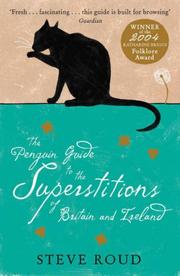
The Penguin Guide to the Superstitions of Britain and Ireland
Covers black dogs, omens and traditional beliefs.

eBay marketplace picks
Marketplace Samples
Live-tested eBay searches with available results related to this page.

Endnotes
1.
Source: archive.org
Title: Internet Archive Full text of “County folklore”
Link:https://archive.org/stream/countyfolklore05folkuoft/countyfolklore05folkuoft_djvu.txt
2.
Source: siefhome.org
Link:https://www.siefhome.org/downloads/wg/ry/RY4%282009%29-The%20RY%20and%20Gender.pdf
3.
Source: archive.org
Link:https://archive.org/details/countyfolklore05folkuoft
4.
Source: archive.org
Link:https://archive.org/details/in.gov.ignca.20564
5.
Source: archive.org
Link:https://archive.org/stream/examplesprinted00peacgoog/examplesprinted00peacgoog_djvu.txt
6.
Source: archive.org
Link:https://archive.org/download/crossref-pre-1909-scholarly-works/10.1080%252F0015587x.1899.9720480.zip/10.1080%252F0015587x.1901.9719622.pdf
7.
Source: archive.org
Link:https://archive.org/details/countyfolklore02folkuoft
8.
Source: archive.org
Title: folklore20folkuoft djvu.txt
Link:https://archive.org/download/folklore20folkuoft/folklore20folkuoft_djvu.txt
9.
Source: archive.org
Link:https://archive.org/stream/folklore23folkuoft/folklore23folkuoft_djvu.txt
10.
Source: publications.naturalengland.org.uk
Title: Natural England NCA Profile: 46. The Fens
Link:https://publications.naturalengland.org.uk/publication/6229624
11.
Source: lincolnshirefolktalesproject.com
Link:https://lincolnshirefolktalesproject.com/2024/02/20/black-dog-also-black-shuck-or-hairy-jack/
12.
Source: lincolnshirefolktalesproject.com
Link:https://lincolnshirefolktalesproject.com/2024/02/20/the-metheringham-lass/
13.
Source: metheringhamairfield.co.uk
Title: Metheringham Airfield Visitor Centre Airfield History
Link:https://www.metheringhamairfield.co.uk/airfield-history.html
14.
Source: lincolnshirelive.co.uk
Title: ghost hunters say theyve caught 6589100
Link:https://www.lincolnshirelive.co.uk/news/local-news/ghost-hunters-say-theyve-caught-6589100
15.
Source: Wikipedia
Title: Black Shuck
Link:https://en.wikipedia.org/wiki/Black_Shuck
16.
Source: Wikipedia
Title: Ethel Rudkin
Link:https://en.wikipedia.org/wiki/Ethel_Rudkin
17.
Source: Wikipedia
Title: Metheringham Lass
Link:https://en.wikipedia.org/wiki/Metheringham_Lass
18.
Source: Wikipedia
Title: The Fens
Link:https://en.wikipedia.org/wiki/The_Fens
19.
Source: Wikipedia
Title: RAF Metheringham
Link:https://en.wikipedia.org/wiki/RAF_Metheringham
20.
Source: lincolnshirefolktalesproject.com
Title: the village behind the folklore
Link:https://lincolnshirefolktalesproject.com/2025/06/30/the-village-behind-the-folklore/
21.
Source: lincolnshirefolktalesproject.com
Title: select bibliography
Link:https://lincolnshirefolktalesproject.com/select-bibliography/
22.
Source: lincolnshirelive.co.uk
Title: metheringham lass ghost who said 6358355
Link:https://www.lincolnshirelive.co.uk/news/local-news/metheringham-lass-ghost-who-said-6358355
23.
Source: insearchofholywellsandhealingsprings.wordpress.com
Link:https://insearchofholywellsandhealingsprings.wordpress.com/tag/archive/
24.
Source: mythical-beasts.fandom.com
Title: Hairy Jack
Link:https://mythical-beasts.fandom.com/wiki/Hairy_Jack
25.
Source: metheringhamairfield.co.uk
Title: Metheringham Airfield Visitor Centre
Link:https://www.metheringhamairfield.co.uk/
26.
Source: metheringhamairfield.co.uk
Title: About Us
Link:https://www.metheringhamairfield.co.uk/about-us.html
27.
Source: facebook.com
Link:https://www.facebook.com/ukairfields/posts/metheringham-airfield-visitor-centre-a-wonderful-place-in-lincolnshire-to-visit-/1781418076749321/
28.
Source: nationalcharacterareas.co.uk
Title: The Fens
Link:https://nationalcharacterareas.co.uk/the-fens/summary/
29.
Source: boggartstones.co.uk
Title: the black dog
Link:https://www.boggartstones.co.uk/2021/10/the-black-dog.html
30.
Source: bishopsgate.org.uk
Link:https://www.bishopsgate.org.uk/collections/metheringham-airfield-visitor-centre/
31.
Source: naturalengland-defra.opendata.arcgis.com
Link:https://naturalengland-defra.opendata.arcgis.com/datasets/Defra%3A%3Anational-character-areas-england/about
32.
Source: visitlincolnshire.com
Link:https://www.visitlincolnshire.com/things-to-do/metheringham-airfield-visitor-centre/
Additional References
33.
Source: youtube.com
Title: MORE Haunted Lincolnshire: Ghost Stories from WWII Abandoned Airfields
Link:https://www.youtube.com/watch?v=GaM3qvgxXBg
Source snippet
Tales From the Village Green, Episode 43: The Ruskington Horror (A15, North Kesteven)...
34.
Source: youtube.com
Title: 10 Extremely Haunted Places in Lincolnshire
Link:https://www.youtube.com/watch?v=Fin0q3hIfZU
Source snippet
HAUNTED Airbases of the UK - Secrets of RAF Metheringham and the Tale of the Metheringham Lass...
35.
Source: n-kesteven.gov.uk
Link:https://www.n-kesteven.gov.uk/sites/default/files/2023-03/ENV004a%20Natural%20England%20Landscape%20Character%20Area%20The%20Wolds.pdf
36.
Source: tripadvisor.co.uk
Link:https://www.tripadvisor.co.uk/Attraction_Review-g3820309-d7261494-Reviews-Metheringham_Airfield_Visitor_Centre-Metheringham_Lincoln_Lincolnshire_England.html
37.
Source: facebook.com
Link:https://www.facebook.com/groups/norfolk.history.tales.myths/posts/7298990530116590/
38.
Source: invisibleworks.co.uk
Link:https://www.invisibleworks.co.uk/fenland-dogs/
39.
Source: cambridge-news.co.uk
Link:https://www.cambridge-news.co.uk/news/local-news/black-shuck-haunted-ghost-story-20848831
40.
Source: bestiary.us
Link:https://www.bestiary.us/books/county-folklore-volv-lincolnshire-collected-mrs-gutch-and-mabel-peacock
41.
Source: oxfordreference.com
Link:https://www.oxfordreference.com/display/10.1093/oi/authority.20110803100432502?d=%2F10.1093%2Foi%2Fauthority.20110803100432502&p=emailAoGjJtcrgH0Kk
42.
Source: bibliotek.dk
Link:https://bibliotek.dk/en/materiale/examples-of-printed-folk-lore-concerning-lincolnshire_e-gutch/work-of%3A800010-katalog%3A99122486604605763?tid=MKD6j1781748145108115371537
Topic Tree