Within Haunted Meirionnydd
Why Nannau's Haunted Oak Still Matters
The hollow oak of Nannau turns a Glyndwr-era killing into Merionethshire's strongest and most memorable ghost tradition.
On this page
- Hywel Sele, Owain Glyndwr and the killing story
- Ceubren yr Ellyll as a haunted landmark
- Folklore, estate memory and historical caution
Page outline Jump by section
Introduction
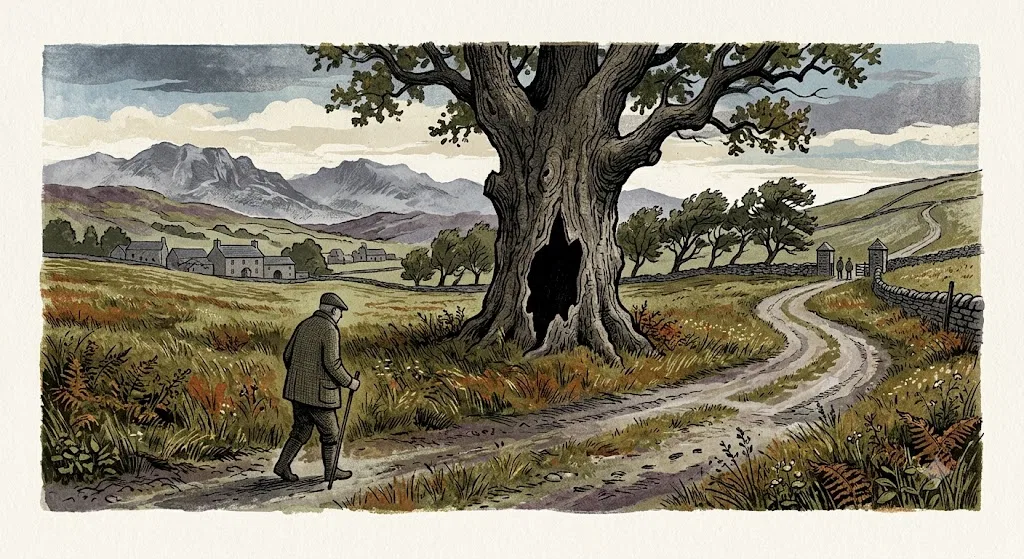
Nannau’s haunted oak is Merionethshire’s most memorable ghost tradition because it gives the county’s folklore a precise place, a named victim and a political wound from the age of Owain Glyndŵr. The story says that Hywel Sele of Nannau tried to shoot Glyndŵr during a hunt, that Glyndŵr survived because he wore armour beneath his clothes, and that Sele’s body was hidden inside a hollow oak on the estate near Dolgellau. The tree became known as Ceubren yr Ellyll, usually explained in English as the haunted oak, the hollow oak of the demon, or the spirit’s blasted tree. The Royal Commission on the Ancient and Historical Monuments of Wales treats the tale as one of Nannau’s most famous stories, while also using careful wording such as “alleged” and “said to have”, which is the right tone for a legend preserved through estate memory rather than courtroom proof.[Royal Commission Wales]rcahmw.gov.ukNannau…
What makes the Nannau oak unusually strong as a haunted-place story is that it was not just a vague rumour attached to an old tree. The oak was described by antiquarian travellers, drawn by artists, remembered in poetry, marked after its fall, and even turned into commemorative objects. Its original trunk was destroyed in the early nineteenth century, but the story still clings to the landscape of Nannau: a high old estate above Dolgellau, now within Gwynedd, but historically part of Merionethshire’s haunted geography.[Nannau]nannau.walesDepictions of Derwen Ceubren yr Ellyll | NannauDepictions of Derwen Ceubren yr Ellyll | Nannau…
Hywel Sele, Owain Glyndŵr and the killing story
The core legend belongs to the early fifteenth century, when Owain Glyndŵr’s revolt against English rule tore through Wales. Hywel Sele, connected by kinship to Glyndŵr, is remembered in the Nannau tradition as a man on the other side of the political divide. In the best-known version, the two men were hunting at Nannau after some form of reconciliation. Sele drew his bow as if to shoot a deer, then turned the weapon on Glyndŵr. The arrow failed to kill him because Glyndŵr wore chain mail beneath his shirt. Glyndŵr then killed Sele and concealed the body in the hollow oak.[Royal Commission Wales]rcahmw.gov.ukNannau…
The story is powerful because it compresses a civil conflict into one tense woodland scene. It is not a generic murder tale: it is about kinship, betrayal, hidden violence and the uncomfortable memory of Welsh families divided by the Glyndŵr rising. Nannau was not an anonymous forest clearing either. The Royal Commission places the house about three miles from Dolgellau, around 700 feet above sea level, surrounded by ancient trees and picturesque estate buildings; it also notes that Nannau was once one of the largest estates in Merionethshire.[Royal Commission Wales]rcahmw.gov.ukNannau…
There are reasons to handle the episode cautiously. The legend gives a vivid narrative, but vividness is not the same as secure evidence. The Royal Commission’s phrasing is careful, and later estate-history material calls the murder story “highly romantic”, noting that it especially appealed to eighteenth- and nineteenth-century tourists who retold it. That does not mean nothing happened at Nannau. It means the version most readers know has passed through centuries of family tradition, antiquarian writing, local pride and Gothic taste.[Nannau]nannau.walesThe Nannau Estate | NannauThe Nannau Estate | Nannau…
The uncertainty actually helps explain why the story lasted. A fully documented political killing might belong mainly to historians; an unresolved killing hidden in a tree belongs equally to folklore. The oak became a physical answer to a disturbing question: where did the missing man go? In the legend, the tree is not scenery. It is the secret-keeper.

Ceubren yr Ellyll as a haunted landmark
The haunted oak’s name is central to its force. Ceubren yr Ellyll is commonly rendered as the haunted oak, the hollow tree of the ghost, or the hollow oak of the demon. Different English versions vary, but they all point to the same idea: this was a tree made uncanny by a body, a betrayal and the fear that the dead had not been properly at rest. The Royal Commission says that after Sele’s body was supposedly placed inside the hollow oak, “many ghost stories” were told of the tree’s powers until it was struck by lightning in 1813.[Royal Commission Wales]rcahmw.gov.ukNannau…
Antiquarian and estate traditions add the details that made the oak famous beyond Nannau. A Nannau estate page drawing on Thomas Pennant’s account says the skeleton of a large man was found in the hollow tree forty years after the killing, and that a sundial with a brass plate later marked the place where the “spirit’s blasted tree” had stood. The same source gives the oak’s circumference as about twenty-eight feet and says it fell during a storm in July 1813.[Nannau]nannau.walesDerwen Ceubren yr Ellyll by Thomas Pennant | NannauDerwen Ceubren yr Ellyll by Thomas Pennant | Nannau…
The fall of the tree did not end the haunting tradition. In fact, it gave the story a dramatic second life. A page collecting depictions of the oak records that Sir Richard Colt Hoare sketched the tree from nature on 27 July 1813, and that the aged tree fell that same night. That coincidence gave the oak exactly the kind of eerie timing that folklore remembers: the artist captures the doomed tree, then the tree collapses.[Nannau]nannau.walesDepictions of Derwen Ceubren yr Ellyll | NannauDepictions of Derwen Ceubren yr Ellyll | Nannau…
The story also crossed into literary culture. Walter Scott’s Marmion refers to “the Spirit’s Blasted Tree” in a passage about ominous legends and old fears. Scott’s line mattered because it lifted a Merionethshire estate legend into the wider Romantic imagination, where ruined castles, blasted trees, betrayed nobles and haunted landscapes were already potent material.[Project Gutenberg]gutenberg.orgProject Gutenberg MarmionProject Gutenberg Marmion
Why the oak became more than a ghost story
Nannau’s oak became famous because the legend was reinforced by objects, images and estate ritual. This is the part of the tradition that makes it stronger than many local ghost stories. The haunted tree was not only spoken about; it was drawn, printed, marked, collected and materially preserved.
One of the clearest examples comes from Amgueddfa Cymru, which records that six special toasting cups were made for the 1824 coming-of-age celebrations at Nannau using wood from Derwen Ceubren yr Ellyll. Those cups were connected to Sir Robert Williames Vaughan’s family celebrations, and the museum describes them as cherished Vaughan objects now in its collection. The haunted oak therefore moved from frightening landmark to elite family memory: its wood sat on tables, entered collections and became a tangible relic of the story.[Museum Wales]museum.walesWales Remembering the white ox of Nannau | Museum WalesWales Remembering the white ox of Nannau | Museum Wales
That transformation is important. A ghost story usually survives by retelling. The Nannau oak survived by retelling and by being turned into things people could see or handle. Prints and engravings circulated the image of the tree; a brass plate marked its place; cups made from its wood carried the tale into the social life of the estate. The result was a legend that felt unusually anchored. Even after the original oak was gone, the material culture around it kept saying: this tree existed, this place mattered, this story belongs here.[Nannau]nannau.walesDepictions of Derwen Ceubren yr Ellyll | NannauDepictions of Derwen Ceubren yr Ellyll | Nannau…
The estate setting also deepened the atmosphere. Nannau is described in historic landscape material as a high site north-east of Dolgellau on the west flank of Foel Offrwm, with an earlier deer park, late eighteenth-century designed landscape, ancient woodland fragments, rides, walled gardens and varied built features. The landscape was already theatrical: high ground, old trees, lodges, arches, walks and long estate views. A hollow oak associated with murder could hardly have asked for a more memorable stage.[Nannau]nannau.walesThe Nannau Estate | NannauThe Nannau Estate | Nannau…
Folklore, estate memory and historical caution
The safest way to read the Nannau oak is not as a proven haunting, but as a layered tradition. At the centre is a possible political killing or remembered feud from the Glyndŵr period. Around that centre grew a family legend, a tourist tale, a haunted-tree motif, a Romantic literary reference and a set of physical memorials. Each layer made the story more durable, but each also moved it further from anything that could be tested like a modern witness statement.
Several details should make readers cautious. The story’s most dramatic elements are exactly the ones folklore loves: a treacherous shot during a hunt, hidden armour, a body sealed inside a tree, a skeleton discovered decades later, and a lightning-struck oak. Later accounts differ in dates and emphasis, and the sources that popularised the tale often belong to antiquarian, literary or estate traditions rather than contemporary fifteenth-century documentation. The Nannau estate description itself notes that the tale appealed to eighteenth- and nineteenth-century tourists, which is a useful warning against treating every detail as plain fact.[Nannau]nannau.walesThe Nannau Estate | NannauThe Nannau Estate | Nannau…
Yet scepticism should not flatten the story into “just a myth”. Folklore can preserve social memory even when it reshapes events. The Hywel Sele legend remembers a real historical atmosphere: the Glyndŵr revolt, divided loyalties, the danger of kinship in wartime, and the authority of landed families in Merionethshire. It also shows how an estate could turn a troubling story into identity. Nannau’s haunted oak became a sign of antiquity, tragedy and local distinction.
For haunted-history readers, the key question is not whether a ghost can be proved to have walked around the tree. The better question is why generations treated that tree as fearsome. The answer lies in the combination of place, politics and physical presence. A huge hollow oak is already uncanny. Put a missing man inside it, attach the story to Glyndŵr, strike it with lightning, draw it on the day it falls, and preserve its timber in commemorative cups, and the result is one of the strongest haunted landmarks in Merionethshire.
Why Nannau’s haunted oak still matters
Nannau’s haunted oak still matters because it is the county’s clearest example of a ghost tradition with deep local roots and unusually visible traces. Many haunted places depend on late retellings with little connection to recorded landscape or named people. Nannau gives the reader more to work with: a specific estate near Dolgellau, a named victim, a nationally famous rebel leader, antiquarian descriptions, artistic depictions, a marked site, surviving museum objects and a continuing place in local heritage.[Royal Commission Wales]rcahmw.gov.ukNannau…
It also shows how Merionethshire’s haunted history often works. The county’s strongest eerie stories are not simply about apparitions appearing on command. They are about landscapes where history feels unresolved. At Nannau, the haunting belongs to a hollow in a tree and to a silence after violence: a body hidden, a household bereaved, a political rising remembered in family form. The ghostly power comes from concealment as much as from any apparition.
For visitors and readers, the modern landscape should be approached with that balance in mind. Nannau is not a theme-park ghost site, and the original haunted oak no longer stands. What remains is a historically charged estate landscape, with features such as Hywel Sele Lodge, the old deer park setting and the wider Nannau parkland helping to keep the legend legible on the ground. Hywel Sele Lodge itself is described as a Tudor-Gothic style folly lodge forming the northern entrance to the deer park, built in the late eighteenth or early nineteenth century by Sir Robert Williames Vaughan.[Nannau]nannau.walesHywel Sele (Howel Sele) Lodge | NannauHywel Sele (Howel Sele) Lodge | Nannau
That later Gothic estate architecture matters because it shows how the legend was framed for memory. The Nannau story began, if it began at all, in medieval violence; it became famous in an age that loved picturesque ruins, blasted trees and haunted antiquity. The result is not a simple ghost report but a haunted landmark shaped by centuries of retelling. For Merionethshire, that is precisely why the oak endures: it turns one local tradition into a compact emblem of the county’s darker folklore, where landscape, memory and unease are impossible to separate.

Amazon book picks
Further Reading
Books and field guides related to Why Nannau's Haunted Oak Still Matters. Use these as the next step if you want deeper reading beyond the article.


The Mabinogion
Provides historical and legendary context around Owain Glyndŵr traditions.
eBay marketplace picks
Marketplace Samples
Live-tested eBay searches with available results related to this page.




Endnotes
1.
Source: rcahmw.gov.uk
Title: Royal Commission Wales
Link:https://rcahmw.gov.uk/nannau/
Source snippet
Nannau...
2.
Source: nannau.wales
Title: Depictions of Derwen Ceubren yr Ellyll | Nannau
Link:https://nannau.wales/oak/depictions-of-derwen-ceubren-yr-ellyll/
Source snippet
Depictions of Derwen Ceubren yr Ellyll | Nannau...
3.
Source: nannau.wales
Title: The Nannau Estate | Nannau
Link:https://nannau.wales/land/the-nannau-estate/
Source snippet
The Nannau Estate | Nannau...
4.
Source: nannau.wales
Title: Derwen Ceubren yr Ellyll by Thomas Pennant | Nannau
Link:https://nannau.wales/oak/thomas-pennant/
Source snippet
Derwen Ceubren yr Ellyll by Thomas Pennant | Nannau...
5.
Source: gutenberg.org
Title: Project Gutenberg Marmion
Link:https://www.gutenberg.org/files/5077/5077-h/5077-h.htm
6.
Source: museum.wales
Title: Wales Remembering the white ox of Nannau | Museum Wales
Link:https://museum.wales/blog/1232/Remembering-the-white-ox-of-Nannau/
7.
Source: nannau.wales
Title: Hywel Sele (Howel Sele) Lodge | Nannau
Link:https://nannau.wales/buildings/hywel-sele-lodge/
8.
Source: nannau.wales
Title: The Arch at Hywel Sele Lodge
Link:https://nannau.wales/structures/arches/the-arch-at-hywel-sele-lodge/
9.
Source: nannau.wales
Link:https://nannau.wales/oak/the-spirits-blasted-tree-poem/
10.
Source: nannau.wales
Title: Cadi & The Cursed Oak Book
Link:https://nannau.wales/book/cadi-and-the-cursed-oak/
11.
Source: nannau.wales
Title: Derwen Ceubren yr Ellyll
Link:https://nannau.wales/category/oak/
12.
Source: nannau.wales
Title: The Deer Park
Link:https://nannau.wales/land/the-deer-park/
13.
Source: nannau.wales
Link:https://nannau.wales/land/nannau-deer-park-video/
14.
Source: dolgellau.wales
Title: Nannau Deer Park Walk
Link:https://dolgellau.wales/walks/nannau-deer-park-walk.php
15.
Source: dolgellau.uk
Title: Hywel Sele Lodge
Link:https://dolgellau.uk/information/hywel-sele-lodge/
16.
Source: youtube.com
Title: WITHIN THE WALLS: NANNAU (Mini Documentary)
Link:http://www.youtube.com/watch?v=Wl_ynl3sMHI
Source snippet
Nannau Hall - The Haunting Of Hill House...
17.
Source: youtube.com
Title: Nannau Hall
Link:http://www.youtube.com/watch?v=2lCZHuL0Q8o
Source snippet
Nannau Haunted Oak Hywel Sele Haunted History of ~The Nannau Estate in Wales lO Davis...
18.
Source: Wikipedia
Title: Hywel Sele
Link:https://en.wikipedia.org/wiki/Hywel_Sele
19.
Source: Wikipedia
Title: Nannau Hall
Link:https://en.wikipedia.org/wiki/Nannau_Hall
20.
Source: dioni.co.uk
Link:https://www.dioni.co.uk/cottage/hywel-sele-lodge/
21.
Source: airbnb.com
Link:https://www.airbnb.com/rooms/1558284088639863309
22.
Source: britainexpress.com
Link:https://www.britainexpress.com/attractions.htm?attraction=763
23.
Source: blog.lostartpress.com
Link:https://blog.lostartpress.com/category/the-nannau-oak/page/2/
24.
Source: poemhunter.com
Link:https://www.poemhunter.com/poem/marmion-introduction-to-canto-vi/
25.
Source: en.wikisource.org
Link:https://en.wikisource.org/wiki/Marmion/Notes
26.
Source: gov.wales
Link:https://www.gov.wales/national-museum-wales
Additional References
27.
Source: artuk.org
Link:https://artuk.org/visit/collection/amgueddfa-cymru-national-museum-wales-1615
28.
Source: dioni.co.uk
Link:https://www.dioni.co.uk/cottage/deer-park-lodge/
29.
Source: facebook.com
Link:https://www.facebook.com/groups/35809823308/posts/10161970711243309/
30.
Source: facebook.com
Link:https://www.facebook.com/groups/975168676933642/posts/1238604277256746/
31.
Source: reddit.com
Link:https://www.reddit.com/r/cymru/comments/1bx6x7n/derwen_ceubren_yr_ellyll_the_hollow_tree_of_the/
32.
Source: online-literature.com
Link:https://www.online-literature.com/walter_scott/marmion/6/
33.
Source: facebook.com
Link:https://www.facebook.com/thehiddenandforgotten/posts/the-welsh-mansion-%EF%B8%8Fnannau-hall-was-built-on-the-site-of-a-12th-century-mansion-w/547365467429666/
34.
Source: kids.kiddle.co
Link:https://kids.kiddle.co/Hywel_Sele
35.
Source: web.seducoahuila.gob.mx
Link:https://web.seducoahuila.gob.mx/biblioweb/upload/marmion_by_sir_walter_scott.pdf
36.
Source: youtube.com
Link:https://www.youtube.com/watch?v=uVaYZfr4Y6A
Topic Tree