Within Haunted Armagh
Can an Observatory Have a Ghost?
The Rev Dr William Davenport story shows how a scientific landmark can turn a difficult biography into a quiet spectral tradition.
On this page
- William Davenport and the historical record
- How the quiet ghost story is told
- Science, silence and night time folklore
Page outline Jump by section
Introduction
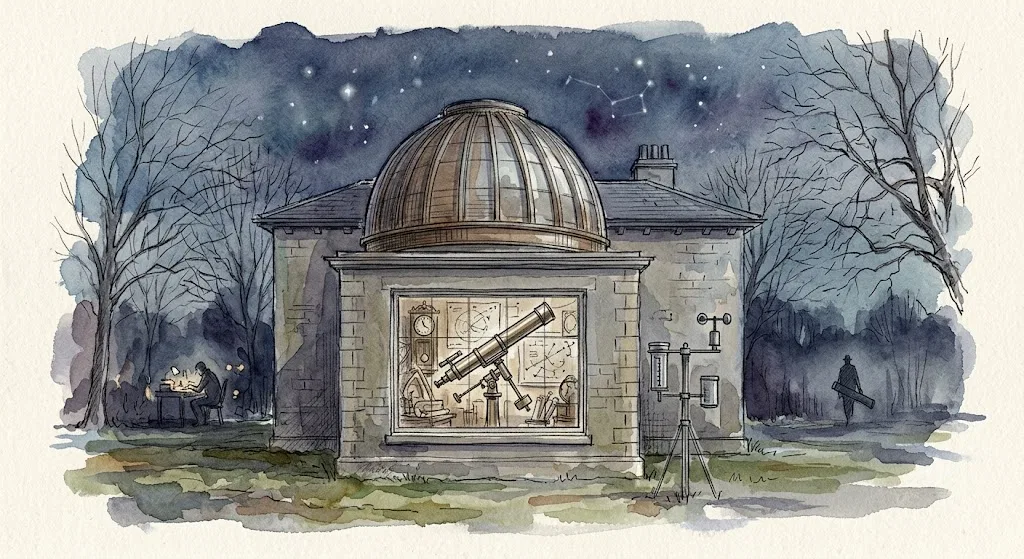
Can an observatory have a ghost? In County Armagh, the answer is best framed as folklore rather than fact: Armagh Observatory has a small, unusually quiet ghost tradition attached to the Rev Dr William Davenport, its second director, who died by suicide in 1823. The story is not a noisy castle legend or a prison apparition. It is a restrained institutional memory: a sober, silent figure said to walk the Observatory and look upwards, tied to a real scientific landmark and a documented tragic death. Its credibility lies not in proof of a haunting, but in the way the tale was preserved by local antiquarian writing, later astronomical reminiscence, and modern local reporting.[Armagh Observatory and Planetarium]armagh.spaceObservatory and Planetarium William DavenportObservatory and Planetarium William Davenport
Armagh Observatory stands on College Hill in the city of Armagh, within historic County Armagh, and remains an active research and heritage site rather than a ruin. That setting matters. This is a ghost story shaped by night work, silence, instruments, old rooms and the loneliness of scientific observation, not by the usual Gothic scenery of chains, dungeons or battlefields.[Armagh Observatory and Planetarium]armagh.spaceOpen source on armagh.space.
William Davenport and the historical record
The strongest part of the Armagh Observatory ghost story is not the apparition itself, but the identity at its centre. William Davenport is not an invented haunted-house name. Armagh Observatory and Planetarium’s own heritage material identifies him as Rev Dr William Davenport, born in 1772, in office at the Observatory from 1815 to 1823. He was the son of Dublin solicitor Edmund Davenport and Eliza Davenport, entered Trinity College Dublin in 1787, became a Fellow in 1795, and was appointed Erasmus Smith’s Professor of Natural and Experimental Philosophy in 1807. He also held divinity and Royal Irish Academy roles.[Armagh Observatory and Planetarium]armagh.spaceObservatory and Planetarium William DavenportObservatory and Planetarium William Davenport
Davenport’s Armagh years appear to have been difficult rather than celebrated. The Observatory’s biography says he headed the Observatory and was incumbent of Clonfeacle from 1815 until his death in 1823, when he took his own life in his office at the Observatory. It also notes that later chroniclers often regarded his directorship as unsuccessful, partly because few observations and astronomical publications were directly associated with him. The same source adds an important caution: he was working with limited funding and still held his Trinity College professorship until 1822, which kept him substantially tied to Dublin.[Armagh Observatory and Planetarium]armagh.spaceObservatory and Planetarium William DavenportObservatory and Planetarium William Davenport
That complicated record is important for a fair reading of the folklore. A weak directorship, a clerical-scientific identity, divided duties, funding problems and a death in the building create the conditions from which a haunting tradition can grow. But they do not prove a haunting. They show how a real biography can become a vessel for later stories about unfinished presence, melancholy and institutional unease.
The wider Observatory history gives Davenport’s story a sharper edge. Armagh Observatory was founded in 1789 by Archbishop Richard Robinson and established with a permanent status unusual among Irish observatories of its era. The archived history by John Butler and Michael Hoskin says its achievements depended heavily on the quality of each director, then describes Davenport’s period bluntly as an “ineffectual reign” ending in suicide in 1823, before the long and energetic directorship of Thomas Romney Robinson.[Wasabi Technologies]s3.eu-west-1.wasabisys.comWasabi Technologies Archives of Armagh ObservatoryWasabi Technologies Archives of Armagh Observatory
That wording is historically useful but humanly harsh. For folklore readers, it explains why Davenport’s ghost is remembered less as a grand scientific spirit than as a sad, displaced figure. He stands between two stronger institutional stories: the founding energy of Hamilton and Archbishop Robinson, and the later achievements of Thomas Romney Robinson. The ghost tradition seems to fill that uncomfortable gap.
How the quiet ghost story is told
The best-known description of the Observatory ghost comes through T. G. F. Paterson, the Armagh historian and first curator of Armagh County Museum, as reported in modern local coverage. Paterson wrote in Armachiana that both Armagh Observatory and Dunsink Observatory were credited with ghosts, and that in each case the reputed spirit was said to be the second astronomer. He then undercut the drama by admitting that he had not seen the Armagh ghost and did not know anyone who had.[Armagh I]armaghi.comOpen source on armaghi.com.
That admission is one of the reasons the story is interesting. Paterson was not presenting the ghost as a personal certainty. He was recording a tradition while signalling scepticism. In folklore terms, this makes the account more credible as a piece of local tradition, not more credible as evidence of a supernatural event. The story’s value lies in its circulation and restraint.
Paterson’s version is also memorable because it refuses the usual haunted-house theatre. The ghost, he said, was a “quiet kind of ghost”. It was not associated with rattling chains, severed heads or theatrical groans, but with a figure in sober dress, looking at the heavens and refusing conversation.[Armagh I]armaghi.comOpen source on armaghi.com.
That detail fits the place unusually well. An observatory ghost who looks upward is almost too neat, yet it is also exactly the kind of image that allows a local legend to survive. Davenport becomes not merely a dead director, but a spectral astronomer: still walking, still watching, still silent. The story’s power comes from appropriateness rather than shock.
Modern accounts repeat that restrained pattern. Armagh I’s 2025 article presents the Observatory haunting as one of Armagh’s lesser-known spectral traditions, distinct from better-known local legends such as the Green Lady of Vicar’s Hill. The Paranormal Database similarly lists the Armagh Observatory manifestation under Rev Dr William Davenport, describing him as walking the site in sober attire, ignoring people as he looks to the sky.[Armagh I]armaghi.comOpen source on armaghi.com.
The weakness is equally clear: the date and circumstances of sightings are vague. The Paranormal Database gives the time as unknown, and Paterson’s reported wording does not supply a named witness. That does not make the tradition worthless, but it places it firmly in the category of local folklore rather than documented psychical evidence.[Paranormal Database]paranormaldatabase.comParanormal Database The Paranormal DatabaseParanormal Database The Paranormal Database
The Lindsay episode and why it matters
The most intriguing later layer concerns Dr Eric Mervyn Lindsay, director of Armagh Observatory from 1937 to 1974. He was a major figure in twentieth-century Irish astronomy, and Armagh Observatory’s own historical account links him to the southern-hemisphere ambitions that led to the Armagh-Dunsink-Harvard telescope project.[Armagh Observatory and Planetarium]armagh.spaceObservatory and Planetarium HistoryObservatory and Planetarium History
The ghost story attached to Lindsay is not a classic sighting. It is described as an experience of a presence during late-night work in the Observatory. Spirited Isle, drawing on a colleague’s later recollection, says Lindsay was working alone when he became aware of an oppressive presence in the room and left; the account adds that he did not thereafter work in the building beyond 11.30pm.[Spirited Isle]spiritedisle.ieSpirited Isle Armagh Observatory | Explore Haunted IrelandSpirited Isle Armagh Observatory | Explore Haunted Ireland
A 2007 personal view of Lindsay by J. C. McConnell, indexed by the SAO/NASA Astrophysics Data System, is significant because it places the anecdote within astronomical reminiscence rather than only within ghost-tour culture. The indexed text asks whether the experience might have been the ghost of Reverend William Davenport, while also stressing Lindsay’s reputation as someone not easily unnerved.[Astrophysics Data System]adsabs.harvard.eduOpen source on harvard.edu.
Even here, the careful reading is not “a scientist proved the ghost”. Lindsay apparently did not publish a formal ghost claim, and the story comes through recollection. Its importance is subtler: it shows the folklore crossing from local antiquarian tradition into the private memory of Observatory staff. That is exactly how credible folklore often behaves. It does not become proof, but it becomes attached to a community that knows the building intimately.
The Lindsay episode also changes the atmosphere of the story. Paterson’s version gives us a walking figure; the Lindsay tradition gives us a late-night pressure in a working room. Both are quiet. Neither depends on spectacle. Together, they make Armagh Observatory’s haunting feel less like a staged attraction and more like an institutional whisper.
Science, silence and night-time folklore
Armagh Observatory is not a typical haunted ruin. It is a Georgian scientific institution, a visitor attraction, a heritage landscape and an active research setting. Its grounds span around 20 acres and are open to the public, while the Observatory building itself, with historic telescopes, is normally admired from outside or visited on scheduled tours because it remains a working facility.[Armagh Observatory and Planetarium]armagh.spaceOpen source on armagh.space.
This living scientific context makes the folklore more interesting, not less. Observatories are designed around darkness, precision and isolation. People work at odd hours. Rooms are quiet. Instruments require concentration. A person alone at night, scanning plates, checking records or moving through an old building, is already in a state where small sounds and bodily sensations can feel amplified.
There is also a powerful contrast between the Observatory’s measurable records and its unmeasurable story. Armagh has one of the longest continuous weather records in the British Isles, with meteorological measurements beginning in December 1794 and daily readings running from July 1795. The institution publicly celebrated 230 years of daily weather observations in 2025.[Armagh Planetarium]armaghplanet.comOpen source on armaghplanet.com.
That contrast is the heart of the page. The same place that preserved weather data with extraordinary discipline also preserved, much more informally, a story about a silent dead director. One record belongs to science; the other belongs to memory. Neither cancels the other. In fact, the ghost story gains its character from being told against the background of clocks, instruments, domes, weather logs and star catalogues.
The physical heritage also helps explain why the story clings to the site. The UNESCO astronomy heritage portal notes Armagh’s historic instruments, meridian marks, meteorological equipment and listed status, including the Grade A Observatory building and listed Robinson Memorial Dome. Such places naturally gather stories because they remain legible: visitors and staff can still connect names, rooms and objects to long-dead workers.[Astronomical Heritage]web.astronomicalheritage.netAstronomical Heritage UNESCO Portal to the Heritage of AstronomyAstronomical Heritage UNESCO Portal to the Heritage of Astronomy
How credible is the Observatory ghost?
The Armagh Observatory ghost is credible as folklore, but weak as evidence for a haunting. That distinction is essential.
The historically secure points are strong. William Davenport existed, directed the Observatory from 1815 to 1823, held significant academic and clerical posts, and died by suicide in his Observatory office. The Observatory’s own heritage account and the archived historical paper both support the core biographical frame.[Armagh Observatory and Planetarium]armagh.spaceObservatory and Planetarium William DavenportObservatory and Planetarium William Davenport
The folklore record is moderate. Paterson’s Armachiana account, as reported by Armagh I, gives a named local historian preserving the tradition and openly acknowledging that he had not personally seen the ghost. This is better than an anonymous internet tale, but it is still a report of a tradition rather than a primary witness statement.[Armagh I]armaghi.comOpen source on armaghi.com.
The experiential evidence is suggestive but limited. The Lindsay anecdote is valuable because it is associated with a named Observatory director and appears in astronomical reminiscence as well as haunted-place retellings. Yet it remains second-hand in the versions available online, and it describes an unexplained presence rather than a clear apparition.[Astrophysics Data System]adsabs.harvard.eduOpen source on harvard.edu.
A sensible credibility scale would place the story like this:
- Historical anchor: strong, because Davenport and his death are documented.
- Local tradition: fair, because Paterson preserved it and later sources repeat a consistent quiet-ghost motif.
- Named experience: limited but interesting, because Lindsay’s episode is remembered through others rather than presented as a formal claim.
- Supernatural proof: absent, because no source establishes that the reported experiences were caused by a ghost.
This is exactly why the story belongs in a County Armagh haunted-history project. It is not the county’s loudest legend, but it is one of its most revealing: a ghost story that asks readers to think about grief, reputation, professional failure, institutional silence and the strange emotional life of scientific buildings.
What makes Armagh Observatory different from a castle or prison haunting?
County Armagh has more obviously Gothic haunted settings, including gaol stories, country-house legends and old urban folklore. The Observatory stands apart because its ghost is not built around punishment, aristocratic scandal or battlefield trauma. It is built around work.
The haunted figure is not a murdered bride, a grey lady or a rattling prisoner. He is remembered as a former director in sober clothes, still attached to the sky. That image is almost anti-sensational. It invites pity more than fear. It also reflects the particular social world of early nineteenth-century Armagh, where Church of Ireland authority, education, science and civic ambition overlapped in one hilltop institution.
The story also carries a risk of unfairness. Davenport’s directorship has often been judged unsuccessful, but the Observatory’s own biography points out that he faced poor funding and competing responsibilities in Dublin. Folklore can flatten a difficult life into a symbol: the failed director, the tragic cleric, the silent watcher. A careful retelling should preserve the sadness without turning him into a Halloween prop.[Armagh Observatory and Planetarium]armagh.spaceObservatory and Planetarium William DavenportObservatory and Planetarium William Davenport
That restraint is part of the appeal. Armagh Observatory’s ghost is not a claim that science failed to explain the supernatural. It is a reminder that scientific places are still human places. They contain ambition, disappointment, routine, death, memory and stories told quietly after dark.
The lasting shape of the legend
The Davenport tradition survives because it has three qualities many stronger-sounding ghost stories lack: a real person, a fitting place and a consistent mood. The person is documented. The place is still there. The mood has remained quiet across retellings.
Modern readers should not treat the story as confirmed paranormal fact. The available evidence does not justify that. But dismissing it as mere nonsense would also miss what makes it valuable. As folklore, it records how Armagh has made sense of a troubling death inside one of its proudest Enlightenment buildings.
The most honest version is also the most atmospheric: somewhere in the history of Armagh Observatory, a gifted but troubled clergyman-scientist died in the building he had struggled to lead. Later generations remembered a silent figure in sober dress, looking upward and refusing to speak. Whether ghost, metaphor or local memory, it is one of County Armagh’s most distinctive haunted traditions.
Amazon book picks
Further Reading
Books and field guides related to Can an Observatory Have a Ghost?. Use these as the next step if you want deeper reading beyond the article.
The Mammoth Book of Haunted House Stories
Fits the observatory as an atmospheric historic building.
Ghost Hunters
Connects scientific institutions with investigations of supernatural claims.
The lore of Ireland
Explains the cultural setting in which observatory ghost tales survive.
Irish ghost stories of Sheridan Le Fanu
First published 1973. Subjects: Ghost stories.
eBay marketplace picks
Marketplace Samples
Live-tested eBay searches with available results related to this page.


Endnotes
1.
Source: armagh.space
Title: Observatory and Planetarium William Davenport
Link:https://armagh.space/notable_figure/william-davenport
2.
Source: armaghi.com
Link:https://armaghi.com/news/armagh-news/meet-the-armagh-observatorys-quiet-ghost-who-gazes-at-the-heavens-refusing-to-talk/284131
3.
Source: armagh.space
Link:https://armagh.space/
4.
Source: armagh.space
Title: Observatory and Planetarium History
Link:https://armagh.space/heritage/armagh-observatory/history
5.
Source: adsabs.harvard.edu
Link:https://adsabs.harvard.edu/full/2007JAHH…10..190M
6.
Source: armagh.space
Link:https://armagh.space/heritage/armagh-observatory/notable-figures
7.
Source: youtube.com
Title: Exploring the Abandoned [Armagh Gaol]({{ ‘armagh-gaol/’ | relative_url }}) – A Haunting Look Inside
Link:https://www.youtube.com/watch?v=0MGzYGdKD_Q
Source snippet
Armagh Observatory and Planetarium Redevelopment - Expand Your Curiosity...
8.
Source: youtube.com
Title: Armagh Observatory and Planetarium Redevelopment
Link:https://www.youtube.com/watch?v=Hau62vafpAo
Source snippet
Is this a ghost on Vicars Hill in Armagh?...
9.
Source: youtube.com
Title: Is this a ghost on Vicars Hill in Armagh?
Link:https://www.youtube.com/watch?v=WO6Z-7fFJQY
Source snippet
Armagh Planetarium and Observatory with Armagh Astropark - Armagh Northern Ireland - Astronomy...
10.
Source: youtube.com
Title: Armagh Planetarium and Observatory with Armagh Astropark
Link:https://www.youtube.com/watch?v=hawp6wGrz6w
Source snippet
Armagh Observatory...
11.
Source: youtube.com
Title: Armagh Observatory
Link:https://www.youtube.com/watch?v=7IRUAW1Akyg
12.
Source: s3.eu-west-1.wasabisys.com
Title: Wasabi Technologies Archives of Armagh Observatory
Link:https://s3.eu-west-1.wasabisys.com/armagh.space/site/wp-content/uploads/2021/12/19133037/Archives-of-Armagh-Observatory.pdf
13.
Source: paranormaldatabase.com
Title: Paranormal Database The Paranormal Database
Link:https://www.paranormaldatabase.com/ireland/armagh.php
14.
Source: spiritedisle.ie
Title: Spirited Isle Armagh Observatory | Explore Haunted Ireland
Link:https://spiritedisle.ie/explore/listing/armagh-observatory/
15.
Source: armaghplanet.com
Link:https://armaghplanet.com/armagh-observatory-planetarium-marks-230-years-of-weather-records.html
16.
Source: web.astronomicalheritage.net
Title: Astronomical Heritage UNESCO Portal to the Heritage of Astronomy
Link:https://web.astronomicalheritage.net/show-entity?identity=161&idsubentity=1
17.
Source: Wikipedia
Title: Armagh Observatory
Link:https://en.wikipedia.org/wiki/Armagh_Observatory
18.
Source: armaghplanet.com
Title: the beginnings of armagh observatory a brief history
Link:https://armaghplanet.com/the-beginnings-of-armagh-observatory-a-brief-history.html
Additional References
19.
Source: facebook.com
Link:https://www.facebook.com/armaghspace/videos/a-bold-new-chapter-is-beginning-for-the-armagh-observatory-and-planetarium-creat/26755671827383965/
20.
Source: facebook.com
Link:https://www.facebook.com/visitarmagh/posts/armagh-observatory-is-the-oldest-scientific-institution-in-northern-ireland-and-/1365711498925382/
21.
Source: facebook.com
Link:https://www.facebook.com/media/set/?set=a.10151637820996142.1073741909.312509946141&type=3
22.
Source: climate.armagh.ac.uk
Link:https://climate.armagh.ac.uk/
23.
Source: iho.ie
Link:https://www.iho.ie/index.php?iho_field=specific&iho_function=2&iho_other_parameter=country&iho_searchterm=Northern+Ireland
24.
Source: Wikipedia
Title: List of Grade A listed buildings in County Armagh
Link:https://en.wikipedia.org/wiki/List_of_Grade_A_listed_buildings_in_County_Armagh
25.
Source: archive.org
Title: Jun 24 1998, The Times, #66236, UK (en) djvu.txt
Link:https://archive.org/stream/NewsUK1998UKEnglish/Jun%2024%201998%2C%20The%20Times%2C%20%2366236%2C%20UK%20%28en%29_djvu.txt
26.
Source: yumpu.com
Title: annual report 2011 armagh observatory
Link:https://www.yumpu.com/en/document/view/31472450/annual-report-2011-armagh-observatory
27.
Source: upload.wikimedia.org
Title: Armagh clergy and parishes
Link:https://upload.wikimedia.org/wikipedia/commons/6/61/Armagh_clergy_and_parishes.pdf
28.
Source: ras.ac.uk
Title: book journal catalogue367a
Link:https://www.ras.ac.uk/library/book-journal-catalogue367a
Topic Tree