Within Haunted Caithness
Where Ghost Stories Become Fairy Lore
Caithness's ancient brochs and mounds carry fairy lore that feels stranger and older than ordinary haunted-house tales.
On this page
- Why brochs attract supernatural stories
- Bruan and the hidden world motif
- How Norse and local memory shape the tales
Page outline Jump by section
Introduction
Caithness’s broch and fairy-mound stories belong to an older, stranger layer of haunted history than the county’s castle ghosts. Here the supernatural is not usually a white lady in a corridor, but a hidden world under an Iron Age mound: music heard from stone, a door where no door should be, a dancer who vanishes for a year, and a landscape where ancient ruins are treated as thresholds rather than simply ruins. The best-known Caithness example is Bruan Broch, near Lybster and Clyth, where a tale preserved from local folklore turns a grass-covered broch into the “fairy mound of Bruan”. Archaeology can confirm the mound, its Iron Age importance and its surrounding settlement traces; it cannot confirm the fairies. The value of the story lies in how it shows Caithness blending prehistoric remains, Norse-shaped place memory, Christian-era caution and local storytelling into something more unsettling than an ordinary haunted-house tale.[historicenvironment.scot]portal.historicenvironment.scotHistoric Environment Scotland Bruan, broch 85m SW of Tulloch Lea (SM529Historic Environment Scotland Bruan, broch 85m SW of Tulloch Lea (SM529
Why Brochs Attract Supernatural Stories
Brochs are ideal engines for folklore because they look like places with a lost purpose. Historic Environment Scotland describes brochs as Iron Age towers unique to Scotland, built mainly in the North Highlands and Islands, with double walls, galleries and internal stairways that once made them formidable pieces of drystone engineering. Even when ruined, they often survive as thick, grassy, stone-packed mounds rather than as neat, readable buildings. That half-visible condition matters: a visitor can see there is something buried there, but not easily understand what.[Historic Environment Scotland Blog]blog.historicenvironment.scotHistoric Environment Scotland Blog Building A BrochHistoric Environment Scotland Blog Building A Broch
Caithness intensifies this effect because it has more brochs than anywhere else in Scotland, according to the Caithness Broch Project, a local charity devoted to conserving and promoting the county’s broch landscape. The same project frames Caithness as a place where these prehistoric towers are not occasional curiosities but part of the county’s identity. When ancient structures are numerous, close to roads, near farms and embedded in everyday routes, they become natural containers for local explanation: who built them, what lies inside them, why a mound should sound hollow, and why it might not be wise to pass one at night.[Caithness Broch Project]thebrochproject.co.ukOpen source on thebrochproject.co.uk.
That does not mean every broch has a famous ghost or fairy tale. Many are primarily archaeological sites, and the strongest records concern structure, dating, excavation and preservation rather than apparitions. But the physical form of a broch lends itself to hidden-world stories. A collapsed tower can become a mound; a wall passage can become a secret entrance; an intramural cell can become a fairy chamber in popular imagination. In Caithness, the supernatural charge comes less from a single spectacular haunting and more from the repeated meeting of three things: ancient stone, uncertain memory and a landscape still full of named remains.

Bruan and the Hidden-World Motif
Bruan Broch is the key Caithness case because it gives the theme a clear story. Historic Environment Scotland records Bruan, 85 metres south-west of Tulloch Lea, as a scheduled broch: a complex stone-built roundhouse dating to the Iron Age, visible today as a grass-covered stony mound with surviving walling, an artificial platform, a ditch and an outer bank. The scheduled description places it near the coast at about 80 metres above sea level and stresses its national importance for understanding Iron Age society in Caithness.[Historic Environment Scotland]portal.historicenvironment.scotHistoric Environment Scotland Bruan, broch 85m SW of Tulloch Lea (SM529Historic Environment Scotland Bruan, broch 85m SW of Tulloch Lea (SM529
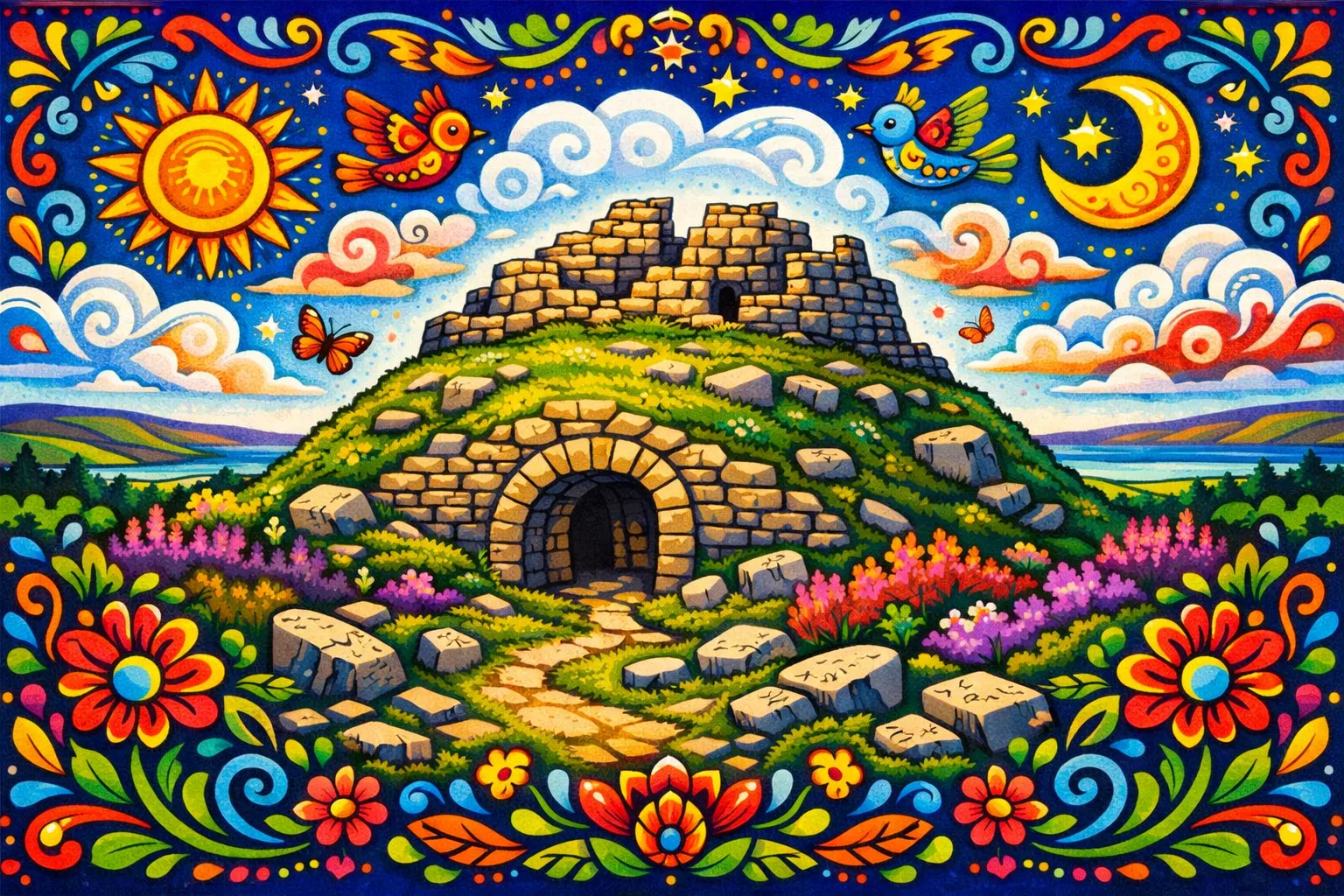
The folklore turns that same archaeological mound into an entrance to another world. A modern British Folklore retelling, drawing on the 1937 account of the Reverend George Sutherland, says that two men were passing the broch in Latheron parish at New Year while carrying whisky for the celebrations. They heard music, found the broch open, and saw fairies dancing inside. One man entered to join them; the other stayed outside. When the cautious man later returned, the broch was shut, with no sign of door, dancers or disturbance. The missing man was recovered only when the scene repeated on the anniversary, and the rescuer used an iron object to keep the door from closing.[britishfolklore.com]britishfolklore.comBruan BrochBruan Broch
The Caithness Broch Project’s own discussion of broch-related stories preserves the same basic shape: New Year revelry, bagpipes from the ruin, “tiny people” dancing, a man entering, and a one-year disappearance experienced by him as only minutes. That time-slip is what makes the Bruan tale feel older and stranger than a standard ghost story. The haunting is not a repeated apparition seen by witnesses in a room; it is a temporary failure of ordinary time at a particular ancient place.[Caithness Broch Project]thebrochproject.co.ukCaithness Broch Project On Brochs and StoriesCaithness Broch Project On Brochs and Stories
The details are also socially meaningful. New Year is a threshold in the calendar, whisky suggests loosened judgement, music draws the men off course, and the open door appears only when the hidden people are active. The tale warns against curiosity, drink and stepping too far into festivity, but it also treats the broch as a living boundary. The man is not killed in a conventional horror-story sense. He is displaced. He spends, in his own experience, almost no time at all inside the mound, while the outside world loses him for a year. That is why Bruan belongs on a haunted-history map even though it is not a “ghost” story in the narrow sense.
What Archaeology Adds to the Bruan Legend
The archaeological record does not prove the supernatural element, but it does make the setting more vivid and more credible as a place that invited such a story. Bruan is not an invented haunted site; it is a real scheduled monument with visible remains and recognised research potential. Historic Environment Scotland notes that the mound is about 3 metres high and 14 metres in diameter, with a surrounding ditch and bank surviving best to the west, north and north-east. It also identifies the likelihood of surviving structural features such as intramural cells, the very kind of hidden architecture that can feed later imagination.[Historic Environment Scotland]portal.historicenvironment.scotHistoric Environment Scotland Bruan, broch 85m SW of Tulloch Lea (SM529Historic Environment Scotland Bruan, broch 85m SW of Tulloch Lea (SM529
A 2017 trial-trenching report for the Broch of Bruan, commissioned by the Caithness Broch Project, adds another layer. It places the broch near Lybster, less than 500 metres from the coastal cliffs, in a modern landscape of fields, grazing, rough pasture, small farms and crofts. It also describes Bruan as a substantial grassed-over mound, around 4 metres high and 42 metres overall in diameter, with a bank, ditch and possible extra-mural settlement evidence. The report’s cautious conclusion is that observed features may represent buildings linked to settlement around the broch, though the exact date and nature of those structures require further proof.[Highland Historic Environment Record]her.highland.gov.ukOpen source on highland.gov.uk.
That matters for folklore because fairy mounds often arise where later communities inherit ancient architecture without a living explanation of its builders. A broch that was once a major Iron Age structure may later become, to crofters and travellers, a strange green mound with stonework showing through the turf. Bruan’s legend can therefore be read as an imaginative answer to a real landscape question: what kind of people lived inside these old stone places, and where did they go?
The sober answer is that Bruan belongs to the Iron Age broch tradition. The folkloric answer is that the old occupants never quite left; they withdrew inside the mound and still held music, dance and dangerous hospitality there. The power of the tale comes from the tension between those answers.
How Norse and Local Memory Shape the Tales
Caithness folklore is not only Highland fairy lore placed on ancient ruins. It sits in a county with strong Norse historical and place-name layers, and that affects how older sites are remembered. W. F. H. Nicolaisen’s study of Scandinavian and Gaelic place-names in Caithness argues that the area contains a marked Norse-Gaelic cultural seam and that place-name evidence does not support a simple picture of Caithness as wholly Gaelic-speaking before and after Norse settlement. For a haunted-history reader, the important point is not linguistic technicality but layered memory: Caithness has long been a meeting ground of different naming systems, settlement histories and explanations of the past.[Scottish Society for Northern Studies]ssns.org.ukScottish Society for Northern Studies
Thing’s Va, near Thurso, shows this process in a more historical way. Canmore records it as a possible Iron Age broch, set on a mound and partly excavated, and notes that its name derives from a Norse term for a local assembly or law court. The Caithness Broch Project similarly explains that the broch was built by Middle Iron Age inhabitants and later reused after the mid-ninth century by Scandinavian incomers. This is not a fairy tale, but it shows how brochs could be reinterpreted and reused by later communities, gaining new names and meanings long after their first construction.[Canmore]canmore.org.ukCanmore Thing's Va | CanmoreCanmore Thing's Va | Canmore
Bruan’s fairy story should be understood in that wider Caithness pattern. Ancient places did not sit silent until modern archaeologists arrived. They were crossed by roads, worked around by farmers, renamed, reused, avoided, quarried, explained and re-explained. A broch could be an Iron Age tower, a Norse assembly memory, a field mound, a dangerous fairy dwelling and a heritage attraction at different moments in its life. The “haunting” is not just an apparition but a stack of interpretations attached to the same physical place.
Where Ghost Stories Become Fairy Lore
The Bruan tradition helps explain the boundary between ghost story and fairy story in Caithness. A ghost story usually depends on the dead returning: a murdered woman at a castle, a figure in a room, a presence linked to a known tragedy. Fairy lore works differently. The beings are not necessarily dead humans. They are neighbours, hidden people, mound-dwellers or older inhabitants of the landscape. They may be beautiful, dangerous, festive, petty or morally unreadable. They do not haunt because they suffered there; they haunt because the place is theirs.
That difference changes the emotional tone. Castle ghosts often point backwards to a single human story: betrayal, imprisonment, murder, grief. Broch fairy lore points sideways into another order of reality. The question is not “who died here?” but “what else lives under this mound?” In Bruan, the frightening thing is not a scream, a bloodstain or a visible corpse. It is the possibility that a familiar Caithness road passes beside a place where time follows different rules.
This is why brochs fit so well within Caithness’s haunted geography without needing to behave like haunted houses. They are older than the county’s tower-house legends, older than most named family tragedies, and older than the parish world that later preserved the tales. Their folklore gives Caithness a supernatural register that feels prehistoric even when the surviving account is comparatively modern. The 1937 preservation of the Bruan story records a much older kind of imaginative habit: treating ancient mounds as thresholds.

How Credible Are the Stories?
The most responsible answer is that the sites are credible, the folklore is genuine as folklore, and the supernatural events are not verifiable as events. Bruan Broch is well attested as an archaeological monument, scheduled and described in official heritage records. Its surrounding landscape has been investigated through geophysical survey and trial trenches. The fairy abduction, by contrast, survives through retelling and collection, particularly the account associated with Reverend George Sutherland’s 1937 folklore work and later local-history and folklore summaries.[historicenvironment.scot]portal.historicenvironment.scotHistoric Environment Scotland Bruan, broch 85m SW of Tulloch Lea (SM529Historic Environment Scotland Bruan, broch 85m SW of Tulloch Lea (SM529
That distinction should not flatten the story. Folklore is not failed journalism. It often preserves how communities felt about places that were already ancient, difficult to explain or socially charged. Bruan’s tale encodes caution about liminal times, drink, music, curiosity and old ruins. It also preserves a local conviction that brochs were not inert heaps of stone but places with an atmosphere and a hidden interior life.
A sceptical reading might say that the tale is a moral story shaped by common fairy motifs: music from a mound, a human tempted inside, lost time, rescue by iron, and the danger of joining supernatural dancers. A more sympathetic folkloric reading would say those motifs were precisely the language local people used to express the uncanny power of ancient remains. Both readings can stand together. The story does not need to be treated as a literal report to be valuable to Caithness’s haunted history.
Why Bruan Still Matters
Bruan matters because it gives Caithness a haunting mechanism that is not borrowed from gothic castles or modern ghost tourism. It shows how the county’s prehistoric landscape generated its own supernatural grammar: mound, music, door, dance, disappearance, return. That grammar turns an archaeological monument into a story about risk and wonder. It also connects Caithness to wider northern traditions in which ancient mounds are inhabited, not empty.
For visitors, the practical takeaway is simple: look at Caithness brochs as more than scenic ruins. Sites such as Bruan, Thing’s Va, Yarrows and the wider broch landscape sit at the meeting point of archaeology, place-name history and supernatural storytelling. Some are accessible heritage stops; others are on working land or fragile ground and should be treated with care. The eerie value is not in pretending that fairies have been proven, but in recognising how much older Caithness feels when its ruins are allowed to speak in more than one register.[thebrochproject.co.uk]thebrochproject.co.ukOpen source on thebrochproject.co.uk.
In the wider haunted map of Caithness, the broch and fairy-mound traditions are therefore essential. They explain why the county’s supernatural reputation is not limited to apparitions in castles or hotels. Beneath those later ghost stories lies an older imaginative landscape, where ancient stone mounds mark the edge of the known world and where the most dangerous invitation is not a ghostly warning, but music coming from inside the hill.
Amazon book picks
Further Reading
Books and field guides related to Where Ghost Stories Become Fairy Lore. Use these as the next step if you want deeper reading beyond the article.

The secret commonwealth of elves, fauns, and fairies
Foundational reading for hidden-world folklore.
Scottish Ghost Stories
First published 1996. Subjects: Ghost stories, Tales, scotland, Ghosts.
eBay marketplace picks
Marketplace Samples
Live-tested eBay searches with available results related to this page.

Endnotes
1.
Source: britishfolklore.com
Title: Bruan Broch
Link:https://britishfolklore.com/bruan-broch/
2.
Source: ssns.org.uk
Title: Scottish Society for Northern Studies
Link:https://www.ssns.org.uk/wp-content/uploads/2019/10/05_Nicolaisen_Caithness_1982_pp_75-85.pdf
3.
Source: the-past.com
Title: building an iron age broch in caithness
Link:https://the-past.com/news/building-an-iron-age-broch-in-caithness/
4.
Source: portal.historicenvironment.scot
Title: Historic Environment Scotland Bruan, broch 85m SW of Tulloch Lea (SM529)
Link:https://portal.historicenvironment.scot/apex/f?p=1505%3A300%3A%3A%3A%3A%3AVIEWTYPE%2CVIEWREF%3Adesignation%2CSM529
5.
Source: her.highland.gov.uk
Link:https://her.highland.gov.uk/api/LibraryLink5WebServiceProxy/FetchResourceFromStub/1-2-3-9-5-1_cc2e1fa22f8034e-123951_286feb24d362c15.pdf
6.
Source: blog.historicenvironment.scot
Title: Historic Environment Scotland Blog Building A Broch
Link:https://blog.historicenvironment.scot/2018/01/building-the-broch/
7.
Source: thebrochproject.co.uk
Link:https://www.thebrochproject.co.uk/
8.
Source: thebrochproject.co.uk
Title: Caithness Broch Project On Brochs and Stories
Link:https://www.thebrochproject.co.uk/blog/on-brochs-and-stories
9.
Source: canmore.org.uk
Title: Canmore Thing’s Va | Canmore
Link:https://canmore.org.uk/site/7778/things-va
10.
Source: thebrochproject.co.uk
Title: things va
Link:https://www.thebrochproject.co.uk/locations/things-va
11.
Source: thebrochproject.co.uk
Link:https://www.thebrochproject.co.uk/locations/yarrows-broch
12.
Source: canmore.org.uk
Link:https://canmore.org.uk/site/8604
13.
Source: canmore.org.uk
Link:https://canmore.org.uk/site/8576
14.
Source: canmore.org.uk
Link:https://canmore.org.uk/site/9266/warth-hill?display=image
15.
Source: Wikipedia
Title: Caithness Broch Project
Link:https://en.wikipedia.org/wiki/Caithness_Broch_Project
16.
Source: Wikipedia
Link:https://en.wikipedia.org/wiki/Broch
17.
Source: thebrochproject.co.uk
Link:https://www.thebrochproject.co.uk/what-is-a-broch
18.
Source: thebrochproject.co.uk
Title: my first broch
Link:https://www.thebrochproject.co.uk/blog/my-first-broch
19.
Source: thebrochproject.co.uk
Link:https://www.thebrochproject.co.uk/about-us/our-history
20.
Source: thebrochproject.co.uk
Link:https://www.thebrochproject.co.uk/location/yarrows-broch
21.
Source: thebrochproject.co.uk
Title: 5 reasons why this broch was caithness more civilized version of holyrood
Link:https://www.thebrochproject.co.uk/blog/5-reasons-why-this-broch-was-caithness-more-civilized-version-of-holyrood
22.
Source: thebrochproject.co.uk
Link:https://www.thebrochproject.co.uk/the-big-broch-build/good-vibes
23.
Source: thebrochproject.co.uk
Link:https://www.thebrochproject.co.uk/locations/tulach-mor-broch
24.
Source: facebook.com
Link:https://www.facebook.com/CaithnessBrochProject/posts/its-hardly-a-stand-out-broch-achcomhairle-plundered-of-stone-centuries-ago-all-t/1414325940735037/
25.
Source: facebook.com
Link:https://www.facebook.com/CaithnessBrochProject/photos/487044870129820/
26.
Source: thenorthernantiquarian.org
Title: bruan broch
Link:https://www.thenorthernantiquarian.org/2010/08/10/bruan-broch/
27.
Source: themodernantiquarian.com
Link:https://www.themodernantiquarian.com/site/14070/bruan
28.
Source: themodernantiquarian.com
Link:https://www.themodernantiquarian.com/post/185979/folklore/bruan
29.
Source: ssns.org.uk
Link:https://www.ssns.org.uk/wp-content/uploads/2019/10/06_Stell_Caithness_1982_pp_86-114.pdf
30.
Source: trove.scot
Link:https://www.trove.scot/place/8934
31.
Source: trove.scot
Link:https://www.trove.scot/place/7778
32.
Source: megalithix.wordpress.com
Title: bruan broch
Link:https://megalithix.wordpress.com/2010/08/10/bruan-broch/
33.
Source: megalithix.wordpress.com
Link:https://megalithix.wordpress.com/category/scotland/caithness/
34.
Source: instagram.com
Link:https://www.instagram.com/caithnessbrochproject/
35.
Source: find-and-update.company-information.service.gov.uk
Title: company-information.service.gov.ukcaithness broch project
Link:https://find-and-update.company-information.service.gov.uk/company/SC461601
36.
Source: bricktothepastuk.weebly.com
Title: caithness broch
Link:https://bricktothepastuk.weebly.com/caithness-broch.html
37.
Source: focusnorth.scot
Title: caithness broch project
Link:https://focusnorth.scot/caithness-broch-project/
38.
Source: bobmarshall.co.uk
Title: Caithness Broch Project
Link:https://www.bobmarshall.co.uk/caithnessbrochproject/
39.
Source: bajr.org
Title: Caithness Broch Project
Link:https://www.bajr.org/caithness-broch-project-build-it/
Additional References
40.
Source: youtube.com
Link:https://www.youtube.com/watch?v=ThKfvxAzTnQ
Source snippet
BBC Landward - Caithness Broch, Castles and Cairns...
41.
Source: youtube.com
Title: Building a Broch
Link:https://www.youtube.com/watch?v=_adQApclNOI
Source snippet
'Choost an Owld Pile o' Ston'?: The Value of Archaeology to Caithness | ARP 2021...
42.
Source: youtube.com
Title: BBC Landward
Link:https://www.youtube.com/watch?v=4lkUwM6XaxI
Source snippet
STEP BACK IN TIME the iron age broch at Ousdale...
43.
Source: scarf.scot
Link:https://scarf.scot/regional/pkarf/5-iron-age/5-4-the-resource/5-4-1-buildings-and-cultivation-remains/5-4-1-3-monumental-roundhouses-and-brochs/
44.
Source: scarf.scot
Link:https://scarf.scot/national/iron-age-panel-report/5-building-in-the-round-house-scapes-of-the-iron-age/5-9-atlantic-stone-built-roundhouses-sequence-subdivision-and-interpretations/
45.
Source: facebook.com
Link:https://www.facebook.com/DigItScotland/posts/archaeologists-have-recreated-images-of-a-figure-on-a-pictish-stone-which-is-hel/1753145831487848/
46.
Source: facebook.com
Link:https://www.facebook.com/groups/1501813616755643/posts/2146960958907569/
47.
Source: northernpilgrimsway.co.uk
Link:https://www.northernpilgrimsway.co.uk/background-information
48.
Source: amazon.nl
Link:https://www.amazon.nl/Caithness-Sutherland-Classic-Reprint-Campbell/dp/1331935687?tag=searcht-20
49.
Source: facebook.com
Link:https://www.facebook.com/JohnOGroatJournalCaithnessCourier/posts/a-boy-stands-on-a-headland-caithness-literary-giant-george-gunn-celebrates-70th-/1568004168667503/
Topic Tree