Why Does Armagh Feel So Haunted?
County Armagh’s haunted reputation is quieter than that of some better-marketed “ghost counties”, but it is unusually layered: prison folklore at Armagh Gaol, a sad clerical apparition at Armagh Observatory, “Dolly” Munroe at Richhill Castle, grey-lady traditions around Gosford Castle, and older fairy, banshee and mythic landscape stories from South...
Page outline Jump by section
Introduction
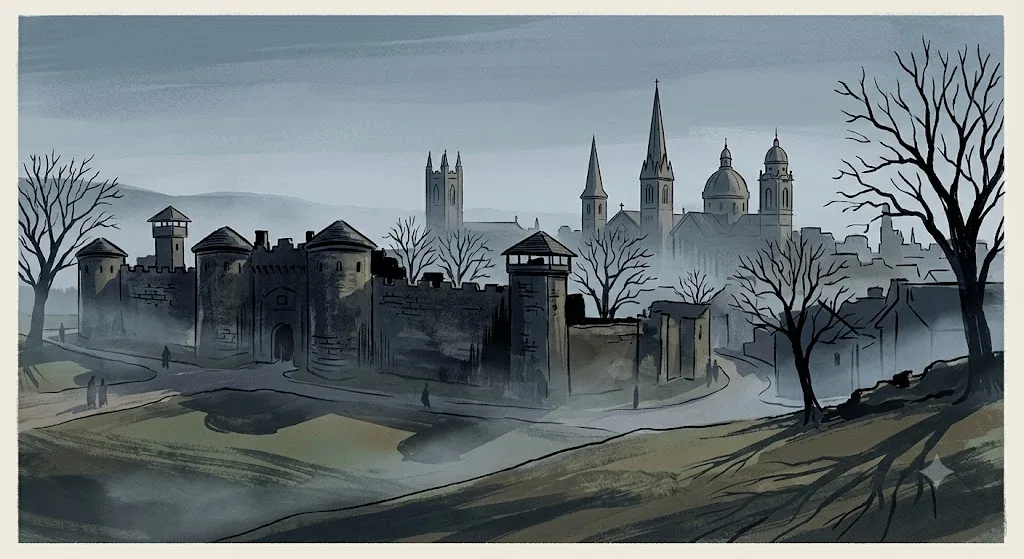
County Armagh is one of Northern Ireland’s six historic counties, bordering Lough Neagh to the north and the Republic of Ireland counties of Louth and Monaghan to the south and south-west. Historic county geography still matters for this project because folklore, old estates and parish traditions rarely follow modern council boundaries neatly. Wikishire’s historic-county mapping places Armagh between Tyrone, Down, Monaghan, Louth and the southern shore of Lough Neagh, while noting the Ring of Gullion and the River Blackwater as important boundary features.[Wikishire]wikishire.co.ukunty Armaghunty Armagh10 Nov 2015 — County Armagh's boundary with Louth is marked by the rugged Ring of Gullion rising in the south of th…
Where Armagh’s ghost stories cluster
Armagh’s haunted map is not random. The best-known stories gather around buildings and landscapes already loaded with memory: the old gaol, the ecclesiastical city, the Observatory, country houses, graveyards, roads and prehistoric sites. This matters because many hauntings become locally famous not only because someone claims to have seen something, but because the place already invites people to imagine unfinished business.
Armagh Gaol is the clearest example. The former prison is repeatedly described in local and paranormal sources as one of the county’s central haunted sites, especially through stories of a “Woman in White” and photographs said to show an unexplained female figure. Local news site Armagh I reported in 2015 on claims that a figure had been captured on camera at the gaol, while the Paranormal Database records a 2010 fashion-shoot photograph attributed to photographer Alan Wells as the basis for the “Woman in White” entry.[Armagh I]armaghi.comArmagh IIs this a ghost captured on camera at Armagh Gaol?The late 1700s building is steeped in cruelty, people were crammed into cells in…Read more…
The historical setting is real even if the ghost is disputed. Armagh Gaol was a major prison site, associated particularly with women prisoners in Ulster, and it closed in 1986. Making the Future, a National Lottery Heritage Fund-supported project, notes that the gaol has stood vacant since closure and appears on the Built Heritage at Risk register, while a 2025 Department for Communities announcement included support for a conservation and management plan for the building.[Making the Future]makingthefuture.euarmagh gaol is brought to life by young filmmakers in armagharmagh gaol is brought to life by young filmmakers in armagh
The important point is not that grim history proves a haunting. It does not. It is that prisons tend to generate ghost stories because they concentrate fear, punishment, separation, protest and institutional secrecy in a single architectural shell. At Armagh Gaol, the haunting tradition is inseparable from the site’s afterlife as an abandoned public landmark.
Armagh Gaol and the Woman in White
The “Woman in White” is Armagh’s most media-friendly ghost story. The usual version places a pale female figure inside or near the former prison, seen or photographed rather than preserved as an old oral tale. That makes it a modern haunted-place story, shaped by cameras, ghost-hunting culture and local-news circulation.
Armagh I’s 2015 report framed the claim around an alleged image from the gaol and quoted a paranormal group’s description of the building as steeped in harsh conditions, executions and prison burials. Spooky Isles, writing from a paranormal-investigation perspective, also places Armagh Gaol within a longer haunted-prison tradition and links the atmosphere of the site to its history of confinement. These are not neutral academic sources, but they are useful for understanding how the ghost story is now told and why the building attracts investigators.[Armagh I]armaghi.comArmagh IIs this a ghost captured on camera at Armagh Gaol?The late 1700s building is steeped in cruelty, people were crammed into cells in…Read more…
Historically, the gaol’s 20th-century memory is also politically charged. Research on Armagh prison has examined women prisoners, protest and gendered memory during the Troubles, while heritage material notes the prison’s closure in 1986 and continuing vacancy. That recent history can make ghost tourism difficult: the building is not merely “spooky”, but a place connected to living memory, former prisoners, staff and families.[Queen's University Belfast]pure.qub.ac.ukQueen's University Belfast Memory, Place and GenderQueen's University Belfast Memory, Place and Gender
A careful reading therefore treats the Woman in White as a claim with local fame, not as a settled apparition. The evidence rests mainly on reported photographs and paranormal interpretation. The credibility is weaker than the historical record of the gaol itself, but the legend reveals how abandoned institutions become screens for unresolved public feeling.
Richhill Castle and the ghost of Dolly Munroe
Richhill Castle gives County Armagh a more traditional big-house ghost: Dolly Munroe, remembered as a celebrated beauty and linked to the Richardson family. In ghost-story retellings she is said to haunt Richhill Castle, sometimes joined by other presences. Armagh I’s roundup of county hauntings says Dolly is one of several ghosts associated with the site, and the Paranormal Database records “Dolly Munroe” at Richhill Castle as a haunting manifestation connected with 2000s investigation claims.[Armagh I]armaghi.comArmagh ISeven ghostly tales of county Armagh hauntingsArmagh ISeven ghostly tales of county Armagh hauntings
The historical Dolly is not purely fictional. Richhill local-history material records the marriage of William Richardson and Dorothea “Dolly” Monroe and preserves traditions about her sympathy for Catholics worshipping in the open air, leading to land being provided for a chapel. A local-history investigation account also identifies Dolly as the wife of William Richardson and places her within the social memory of the Richardson family and castle.[The Remarkable History of Richhill]richhillhistory.orgThe Remarkable History of Richhill The Eighteenth CenturyThe Remarkable History of Richhill The Eighteenth Century
That is exactly the kind of soil in which a “lady of the house” ghost grows. The apparition is less a documented event than a folkloric after-image of status, beauty, religion, memory and place. Her story fits a familiar haunted-house pattern: a notable woman becomes attached to the stairs, rooms or atmosphere of a country house, and later visitors or investigators reinterpret odd sensations as her return.
The credibility is mixed. There is sounder evidence for Dolly as a historical person in Richhill tradition than for Dolly as a ghost. The haunting survives because it gives the castle a human face: not just stone, ownership and local prestige, but a woman whose remembered presence can be imagined still moving through the house.
Armagh Observatory and the quiet clerical ghost
The Observatory story is one of the county’s most distinctive hauntings because it belongs not to a ruin or prison, but to a scientific institution. The figure usually named is the Rev Dr William Davenport, second director of Armagh Observatory. The tale describes a sober, quiet presence who walks the site and seems more absorbed in the heavens than in the living.
The historical framework is strong. Armagh Observatory’s own heritage pages state that the institution has had more than 230 years of history and list Davenport among its directors. Trinity College Dublin’s biographical note says William Davenport was Director of Armagh Observatory and incumbent of Clonfeacle from 1815 until his death in 1823. A published archive guide for the Observatory states that Davenport’s directorship ended with his suicide in 1823.[armagh.space]armagh.spaceObservatory and Planetarium Armagh ObservatoryObservatory and Planetarium Armagh Observatory
The ghost tradition is more recent in public circulation but appears to draw on local historical writing. Armagh I reported in 2025 that, according to writings associated with Armagh historian and first county-museum curator T. G. F. Paterson, the Observatory ghost is said to be Davenport rather than the first director, James Archibald Hamilton. The Paranormal Database also records Davenport as an Observatory manifestation, describing him as walking quietly around the site.[Armagh I]armaghi.comOpen source on armaghi.com.
This is a good example of how a haunting can soften a difficult biography. Davenport’s recorded death is tragic; the ghost story turns that tragedy into a restrained, almost scholarly apparition. It is not a tale of rattling chains, but of a man still looking upward. As folklore, it is memorable because it suits the place: an observatory naturally lends itself to silence, night, watchfulness and unfinished contemplation.
Gosford Castle, grey ladies and Gothic atmosphere
Gosford Castle, near Markethill, supplies the county’s Gothic stage-set. It is a 19th-century Norman Revival country house built for the Acheson family, later associated with Gosford Forest Park, military use and redevelopment. Official and architectural sources identify it as a major listed building; secondary summaries describe it as one of Ulster’s largest castles and note its later conversion into private dwellings.[Wikipedia]WikipediaGosford CastleGosford Castle
The haunting claim is less securely rooted than the building history. Spirited Isle describes Gosford Castle as haunted by several spirits, including a “Grey Lady” said to appear near the nursery and tower, with reports of cold spots, noises and a spectral figure. Spooky Isles also includes Gosford among Armagh haunted-place roundups. These are specialist paranormal and folklore-tourism sources rather than archival proof, but they show how the castle is marketed and imagined within modern haunted Ireland.[Spirited Isle]spiritedisle.ieSpirited Isle Gosford Castle | Explore Haunted IrelandSpirited Isle Gosford Castle | Explore Haunted Ireland
Gosford’s appeal is easy to understand. A large castellated house, a forested demesne, aristocratic decline, military occupation and partial dereliction are all ingredients that encourage ghost stories. Even when the specific Grey Lady tradition is thinly sourced, the atmosphere is doing much of the cultural work.
For readers, the useful distinction is this: Gosford Castle is historically significant in its own right, while its ghost stories are best treated as modern local legend and visitor lore. They may be enjoyable, but they should not be presented with the same confidence as the castle’s architectural and estate history.
Navan Fort and the older supernatural landscape
Not all Armagh supernatural tradition is about ghosts of named dead people. Navan Fort, west of Armagh city, belongs to a much older imaginative landscape. Visitor bodies describe it as one of Ireland’s major archaeological and mythological sites, associated with Emain Macha, the Ulster Cycle, Cú Chulainn and the Red Branch Knights. Visit Armagh calls it a place where “myth and reality meet”, while Discover Northern Ireland highlights the archaeology and the great temple dated to around 95 BC.[Visit Armagh]visitarmagh.comOpen source on visitarmagh.com.
This is not a haunted-house story in the ordinary sense. It is closer to sacred landscape, heroic legend and deep-time unease. Modern haunted roundups sometimes describe visitors feeling a presence at Navan Fort, but the stronger evidence concerns mythic association rather than apparition reports.[Spirited Isle]spiritedisle.ieSpirited Isle Haunted Armagh: Exploring Ghostly LegendsSpirited Isle Haunted Armagh: Exploring Ghostly Legends
The distinction matters. Calling Navan Fort simply “haunted” flattens it. Its power comes from being a place where archaeology, place-name tradition, heroic literature and local tourism meet. The supernatural register is older than Victorian ghosts: goddesses, warriors, ritual monuments and the idea that a landscape can remember.
For a County Armagh haunted-history page, Navan Fort is essential because it shows that “haunting” need not mean a white figure in a corridor. Sometimes the haunting is a story-world that has clung to a hill for centuries.
Fairy forts, banshees and South Armagh oral tradition
The richest evidence for Armagh’s older folk belief comes not from ghost tours but from folklore archives. Dúchas, the online portal for Ireland’s National Folklore Collection, explains that it publishes digitised material from the Main Manuscript Collection, the Schools’ Collection, the Photographic Collection and the Audio Collection, searchable by place, person and subject.[Dúchas]duchas.ieOpen source on duchas.ie.
One striking Schools’ Collection item from Annalitten records a “Fairy Fort” at Corliss near Crossmaglen. The account describes underground rooms, a belief that the place was a fairy palace, lights moving between forts, music like bagpipes, and warnings not to speak loudly in case the “good people” heard. It also tells of a girl, Mary Ann Mallon, being taken away on a white horse by fairies.[Dúchas]duchas.ieOpen source on duchas.ie.
Another Dúchas item records a 1965 audio piece titled “The Banshee”, collected by Leo Corduff and Michael J. Murphy from informant James Murphy of Clontygora, Co. Armagh. The value here is not that it proves a banshee existed, but that it anchors banshee belief in a named Armagh informant, place and recording date.[Dúchas]duchas.ieOpen source on duchas.ie.
These materials are important because they show how Armagh’s supernatural culture extends beyond famous buildings. Rural haunting traditions often concern thresholds: forts, bushes, fields, lakes, roads, graveyards and family death omens. They are less tourist-polished than castle ghosts, and often more revealing of how people once explained danger, illness, death, trespass and luck.
Why Armagh’s haunted stories feel different from simple ghost lists
County Armagh’s ghost stories are strongest when read as place-memory. The gaol speaks to punishment and institutional suffering; the Observatory to grief, learning and night work; Richhill and Gosford to landed houses and social memory; Navan Fort to mythic time; South Armagh fairy lore to rural respect for hidden forces in the landscape.
That also explains why evidence quality varies so sharply. The historical records for buildings and people are often solid. The apparitions attached to them usually depend on local reporting, investigator testimony, later retellings or folklore collection. Those sources are valuable, but they answer different questions.
A practical way to read Armagh hauntings is to separate three layers:
- Documented place history: the gaol closed in 1986; the Observatory had Davenport as director; Gosford Castle is a major 19th-century listed country house; Navan Fort is a recognised archaeological and mythological site.[makingthefuture.eu]makingthefuture.euarmagh gaol is brought to life by young filmmakers in armagharmagh gaol is brought to life by young filmmakers in armagh
- Recorded folklore: Dúchas preserves Armagh-linked fairy and banshee material with named collections, places and informants.[Dúchas]duchas.ieOpen source on duchas.ie.
- Modern haunting claims: the Woman in White, Dolly Munroe, the Gosford Grey Lady and paranormal investigations are reported traditions rather than verified events.[Paranormal Database]paranormaldatabase.comParanormal DatabaseArmaghCounty Armagh Ghosts, Folklore and Forteana. Woman in White. Location: Armagh - Armagh Gaol Type: Haunting Manif…
This does not make the stories worthless. It makes them readable. The question is not “is it definitely true?” but “what kind of story is this, who preserved it, and why did this place attract it?”
Visiting with curiosity and care
For haunted-history visitors, Armagh rewards a slower approach than a checklist of “most haunted” stops. Armagh city itself offers the Gaol, Observatory, churches, Vicar’s Hill associations and museum collections within a compact historic setting. Armagh County Museum is particularly relevant because its archaeology and folklore resources include material ranging from fairy thorn trees and ghost stories to ancient monuments.[Visit Armagh]visitarmagh.comOpen source on visitarmagh.com.
South Armagh offers a different mood: ringforts, border roads, mountain views, fairy lore and oral tradition around places such as Crossmaglen and the Ring of Gullion area. These stories should be approached as local heritage, not as permission to trespass on private land or disturb archaeological features. The folklore itself often warns against disrespecting fairy places, which is also good modern conservation advice.
The best Armagh ghost itinerary therefore moves between two registers. In the city and big houses, look for the afterlife of institutions and families. In the countryside, look for older beliefs about forts, fields, omens and unseen neighbours. Together they make County Armagh one of the more subtle haunted landscapes in the UK historic-county frame: not the loudest, but unusually rich in the way myth, memory and place overlap.
Amazon book picks
Further Reading
Books and field guides related to Why Does Armagh Feel So Haunted?. Use these as the next step if you want deeper reading beyond the article.
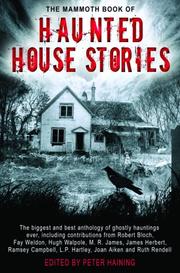
The Mammoth Book of Haunted House Stories
Provides classic haunted-building context matching Armagh's prisons, castles and estates.
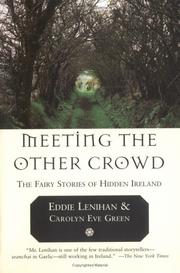
Meeting the Other Crowd
Covers Irish supernatural traditions that underpin Armagh's haunted landscape.
The lore of Ireland
Explains the myths and legends reflected in County Armagh traditions.
Irish ghost stories of Sheridan Le Fanu
First published 1973. Subjects: Ghost stories.
eBay marketplace picks
Marketplace Samples
Live-tested eBay searches with available results related to this page.

Endnotes
1.
Source: armaghi.com
Title: Armagh IIs this a ghost captured on camera at Armagh Gaol?
Link:https://armaghi.com/news/is-this-a-ghost-captured-on-camera-at-armagh-gaol/28321
Source snippet
The late 1700s building is steeped in cruelty, people were crammed into cells in...Read more...
2.
Source: armaghi.com
Title: Armagh ISeven ghostly tales of county Armagh hauntings
Link:https://armaghi.com/news/armagh-news/seven-ghostly-tales-of-county-armagh-hauntings/31211
3.
Source: armagh.space
Title: Observatory and Planetarium Armagh Observatory
Link:https://armagh.space/heritage/armagh-observatory/notable-figures
4.
Source: armaghi.com
Link:https://armaghi.com/news/armagh-news/meet-the-armagh-observatorys-quiet-ghost-who-gazes-at-the-heavens-refusing-to-talk/284131
5.
Source: Wikipedia
Title: Gosford Castle
Link:https://en.wikipedia.org/wiki/Gosford_Castle
6.
Source: ireland.com
Link:https://www.ireland.com/en-se/things-to-do/attractions/navan-centre-and-fort/
7.
Source: Wikipedia
Title: Maghera Old Church
Link:https://en.wikipedia.org/wiki/Maghera_Old_Church
8.
Source: Wikipedia
Title: HM Prison Armagh
Link:https://en.wikipedia.org/wiki/HM_Prison_Armagh
9.
Source: Wikipedia
Title: Armagh Observatory
Link:https://en.wikipedia.org/wiki/Armagh_Observatory
10.
Source: Wikipedia
Title: County Armagh
Link:https://en.wikipedia.org/wiki/County_Armagh
11.
Source: Wikipedia
Title: Charlemont Fort
Link:https://en.wikipedia.org/wiki/Charlemont_Fort
12.
Source: armagh.space
Title: thomas romney robinson and the new instruments
Link:https://armagh.space/heritage/armagh-observatory/history/thomas-romney-robinson-and-the-new-instruments
13.
Source: wikishire.co.uk
Title: unty Armagh
Link:https://wikishire.co.uk/wiki/County_Armagh
Source snippet
unty Armagh10 Nov 2015 — County Armagh's boundary with Louth is marked by the rugged Ring of Gullion rising in the south of th...
14.
Source: wikishire.co.uk
Title: Wikishire Great Britain and Ireland
Link:https://wikishire.co.uk/map/
Source snippet
ntains border data provided by the Historic County Borders Project © Historic Counties...Read more...
15.
Source: paranormaldatabase.com
Link:https://www.paranormaldatabase.com/ireland/armagh.php
Source snippet
Paranormal DatabaseArmaghCounty Armagh Ghosts, Folklore and Forteana. Woman in White. Location: Armagh - Armagh Gaol Type: Haunting Manif...
16.
Source: makingthefuture.eu
Title: armagh gaol is brought to life by young filmmakers in armagh
Link:https://www.makingthefuture.eu/news/armagh-gaol-is-brought-to-life-by-young-filmmakers-in-armagh
17.
Source: pure.qub.ac.uk
Title: Queen’s University Belfast Memory, Place and Gender
Link:https://pure.qub.ac.uk/files/133649813/Armagh_Stories_amended.pdf
18.
Source: richhillhistory.org
Title: The Remarkable History of Richhill The Eighteenth Century
Link:https://richhillhistory.org/Timelines/Timelines/eighteen.html
19.
Source: tcd.ie
Title: Trinity College Dublin William Davenport
Link:https://www.tcd.ie/physics/300/erasmus-smiths-professors/william-davenport/
20.
Source: spiritedisle.ie
Title: Spirited Isle Gosford Castle | Explore Haunted Ireland
Link:https://spiritedisle.ie/explore/listing/gosford-castle/
21.
Source: visitarmagh.com
Link:https://visitarmagh.com/places-to-explore/navan-centre-fort/
22.
Source: discovernorthernireland.com
Link:https://discovernorthernireland.com/listing/navan-centre-%26-fort/68784101/
23.
Source: spiritedisle.ie
Title: Spirited Isle Haunted Armagh: Exploring Ghostly Legends
Link:https://spiritedisle.ie/haunted-armagh/
24.
Source: duchas.ie
Link:https://www.duchas.ie/en/info/cbe
25.
Source: duchas.ie
Link:https://www.duchas.ie/en/cbes/4723845/4718215/4942912
26.
Source: duchas.ie
Link:https://www.duchas.ie/en/cbef/6100249/6252194
27.
Source: visitarmagh.com
Link:https://visitarmagh.com/places-to-explore/armagh-county-museum/research-geneology/archaeology/
28.
Source: spiritedisle.ie
Link:https://spiritedisle.ie/explore/listing/armagh-gaol/
29.
Source: spiritedisle.ie
Link:https://spiritedisle.ie/explore/listing/armagh-observatory/
30.
Source: spiritedisle.ie
Title: richhill castle
Link:https://spiritedisle.ie/explore/listing/richhill-castle/
31.
Source: duchas.ie
Link:https://www.duchas.ie/en/meitheal/log/cbes
32.
Source: duchas.ie
Link:https://www.duchas.ie/en/meitheal/log/cbe
33.
Source: duchas.ie
Link:https://www.duchas.ie/en/cbes/5070783/5062904/5094720
34.
Source: duchas.ie
Link:https://www.duchas.ie/en/cbes/4723876/4721375/4779938?Route=stories
35.
Source: duchas.ie
Link:https://www.duchas.ie/en/cbes/4742046/4730661/4938397
36.
Source: duchas.ie
Link:https://www.duchas.ie/en/cbes/5008832/4959507/5073943
37.
Source: duchas.ie
Link:https://www.duchas.ie/en/cbes/5008832/4959473
38.
Source: duchas.ie
Link:https://www.duchas.ie/en/cbes/5070833/5068712
39.
Source: duchas.ie
Link:https://www.duchas.ie/en/cbes/4723825/4716654/4938732?Route=stories
40.
Source: duchas.ie
Link:https://www.duchas.ie/en/cbes/4498263/4383614/4498271
41.
Source: duchas.ie
Link:https://www.duchas.ie/en/cbes/4498263/4383613
42.
Source: duchas.ie
Link:https://www.duchas.ie/en/cbes/4649693/4647827
43.
Source: duchas.ie
Link:https://www.duchas.ie/en/cbef/6100236/6252010
44.
Source: duchas.ie
Link:https://www.duchas.ie/en/cbes/5008832/4959505/5073938
45.
Source: duchas.ie
Link:https://www.duchas.ie/en/cbes/4493750/4416438/4530911
46.
Source: duchas.ie
Link:https://www.duchas.ie/en/cbef/6100233/6251970
47.
Source: duchas.ie
Link:https://www.duchas.ie/en/cbeg/3981
48.
Source: duchas.ie
Link:https://www.duchas.ie/en/cbes/5008832/4959475/5073838
49.
Source: duchas.ie
Link:https://www.duchas.ie/en/cbes/5008832/4959498/5073895
50.
Source: duchas.ie
Link:https://www.duchas.ie/en/cbes/4742067/4732296/4786014
51.
Source: discovernorthernireland.com
Link:https://discovernorthernireland.com/listing/navan-fort/68849101/
52.
Source: discovernorthernireland.com
Link:https://discovernorthernireland.com/listing/armagh-county-museum/67510101/
53.
Source: visitarmagh.com
Link:https://visitarmagh.com/72-hour-itinerary/
54.
Source: nimc.co.uk
Link:https://nimc.co.uk/members/armagh-county-museum/
55.
Source: wikishire.co.uk
Title: unty Down
Link:https://wikishire.co.uk/wiki/County_Down
56.
Source: en.wikivoyage.org
Title: County Armagh
Link:https://en.wikivoyage.org/wiki/County_Armagh
57.
Source: shasurvey.wordpress.com
Link:https://shasurvey.wordpress.com/northern-ireland/armagh/
58.
Source: tripadvisor.com
Title: Armagh Gaol
Link:https://www.tripadvisor.com/Attraction_Review-g186474-d8398737-Reviews-Armagh_Gaol-Armagh_County_Armagh_Northern_Ireland.html
59.
Source: paranormaldatabase.com
Link:https://www.paranormaldatabase.com/ireland/antrim.php
60.
Source: virtualvisittours.com
Title: armagh gaol
Link:https://www.virtualvisittours.com/armagh-gaol/
Additional References
61.
Source: hauntedrooms.co.uk
Link:https://www.hauntedrooms.co.uk/haunted-places/northern-ireland
62.
Source: facebook.com
Link:https://www.facebook.com/spookyisles/posts/armagh-gaols-ghosts-and-hauntings-a-paranormal-investigation-sharon-clarke-tells/1374858214647736/
63.
Source: reddit.com
Link:https://www.reddit.com/r/northernireland/comments/t2isdc/any_haunted_place_in_northen_ireland_in_around_co/
64.
Source: sportingheritage.org.uk
Link:https://www.sportingheritage.org.uk/content/collection/armagh-county-museum
65.
Source: devlin-family.com
Link:https://www.devlin-family.com/armaghtales.htm
66.
Source: artfund.org
Link:https://www.artfund.org/explore/museums-and-galleries/armagh-county-museum
67.
Source: discoveringireland.com
Link:https://www.discoveringireland.com/armagh/
68.
Source: milfordhouse.org.uk
Link:https://www.milfordhouse.org.uk/news/ghost-stories
69.
Source: clarelibraries.ie
Link:https://clarelibraries.ie/localstudies/folklore/a-folklore-survey-of-county-clare-by-thomas-johnson-westropp/ghosts-and-haunted-houses/
70.
Source: komoot.com
Link:https://www.komoot.com/highlight/2294149
Topic Tree
Follow this branch
Related pages 91
- Haunted Clackmannanshire
- Haunted Antrim
- Haunted Durham
- Haunted Londonderry
- Haunted Buteshire
- +86 more in sidebar