Within Haunted Selkirkshire
Why Is Carterhaugh Selkirkshire's Fairy Heart?
Carterhaugh is less a ghost site than an enchanted Border setting shaped by Tam Lin, Halloween and fairy transformation.
On this page
- Where Ettrick and Yarrow meet
- Tam Lin, Janet and Halloween rescue
- Why ballads make places feel haunted
Page outline Jump by section
Introduction
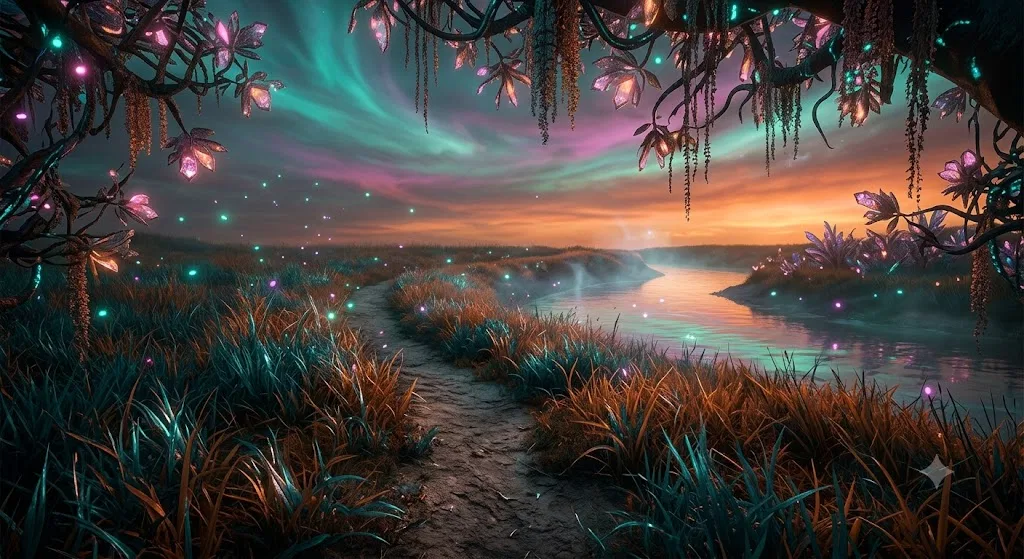
Carterhaugh is Selkirkshire’s fairy heart because it gives one of Scotland’s best-known supernatural ballads a real Border landscape: a low, river-washed place near the meeting of the Ettrick Water and Yarrow Water, just outside Selkirk, where the story of Tam Lin places Janet’s dangerous walk, her encounter with an enchanted knight, and her Halloween rescue from the Fairy Queen. It is not a ghost site in the usual sense. There is no strong tradition here of a recurring apparition in a window or a documented modern haunting. Its power is older and stranger: Carterhaugh feels “haunted” because a ballad has taught readers and singers to see the ground as a threshold between ordinary Selkirkshire and the realm of fairies.[tam-lin.org]tam-lin.orgTam Lin and Carterhaugh Location of Carterhaugh. Carterhaugh WoodsTam Lin and CarterhaughLocation of Carterhaugh. Carterhaugh Woods - Where Janet meets Tam Lin; Tamlane's Well - Where Janet throws Tam Li…
That distinction matters. Carterhaugh belongs in Selkirkshire’s haunted history not as evidence of a proven supernatural event, but as a preserved fairy landscape: a named wood, a well, a river meeting, a night of transformation, and a story old enough to have been noticed in sixteenth-century Scotland before being reshaped by collectors, singers, Robert Burns, Sir Walter Scott and later folklorists.[walterscott.eu]walterscott.euedderburn's Complaynt of Scotland of 1549, and Wedderburn also lists a…Read more…
Where Ettrick and Yarrow Meet
Carterhaugh’s atmosphere begins with geography. The place is usually identified with land near the confluence of the Yarrow Water and the Ettrick Water, close to Selkirk in the Scottish Borders and within the historic county frame of Selkirkshire. The modern visitor is not entering a theatrical ruin or a preserved “haunted house”; they are entering a working rural landscape of roads, farms, riverside ground, fishing rights and scattered heritage markers. That makes the story more, not less, powerful. The ballad’s enchanted forest survives less as a managed attraction than as a remembered layer laid over a real Border place.[Philiphaugh Estate]philiphaughestate.comPhiliphaugh EstateLocation and Surrounding AreaPhiliphaugh Estate is situated approximately 2 miles (3 km) west of the town of Selkirk in…
The river setting is important because Selkirkshire’s older supernatural traditions often gather at thresholds. Carterhaugh sits where waters meet; nearby Philiphaugh carries battle memory; Newark Castle and the Yarrow valley carry their own strands of Border legend and literary association. Carterhaugh’s fairy story is therefore part of a wider local pattern in which woods, wells, bridges and river crossings feel like edges between kinds of experience: safe and unsafe, human and otherworldly, remembered and half-lost.[Philiphaugh Estate]philiphaughestate.comPhiliphaugh EstateLocation and Surrounding AreaPhiliphaugh Estate is situated approximately 2 miles (3 km) west of the town of Selkirk in…
The place is also physically modest. Tamlane’s Well, now one of the easiest points for readers of the ballad to attach to the ground, is described by Scottish Borders tourism material as a roadside site connected with the Tam Lin tradition and with references in Sir Walter Scott’s Minstrelsy of the Scottish Border. Trove, which brings together material from Historic Environment Scotland and related records, places Tamlane’s Well by the roadside at the foot of the slope below Carterhaugh farm buildings.[Scotland Starts Here]scotlandstartshere.comOpen source on scotlandstartshere.com.
That modesty should temper any sensational reading. The named well and Carterhaugh landscape help visitors imagine the ballad, but they do not prove that the events of the ballad happened at that exact spot. Even sympathetic folklore sources note uncertainty around how far particular local markers, including the well as now presented, can be traced back as historic features rather than later commemorations of a famous story.[Megalithic Portal]megalithic.co.ukOpen source on megalithic.co.uk.
Tam Lin, Janet and the Halloween Rescue
The story most readers come looking for is the ballad of Tam Lin. In its best-known shape, young women are warned not to go by Carterhaugh because Tam Lin is there. Janet goes anyway, plucks roses or plants, and summons the mysterious guardian of the place. When he challenges her, she answers with ownership rather than fear: Carterhaugh is hers, given by her father, and she will come and go without asking his permission.[Internet Sacred Text Archive]sacred-texts.comOpen source on sacred-texts.com.
The tale then turns from eerie encounter to rescue story. Tam Lin tells Janet that he was once a mortal man, taken by the Queen of Fairies after falling from his horse, and that he now belongs to the fairy company. On Halloween, the fairies must pay a tithe, often described as a dreadful tribute, and Tam Lin fears he may be the one surrendered. Janet can save him only by pulling him from his horse and holding him through a sequence of frightening transformations until the spell breaks.[Google Arts & Culture]artsandculture.google.comOpen source on google.com.
This is why Carterhaugh’s supernatural reputation feels different from a ghost story. The central terror is not a dead person returning, but a living person caught between worlds. Tam Lin is neither comfortably human nor wholly fairy; Janet must prove her courage by refusing to let go when the enchanted body in her arms becomes monstrous, dangerous or impossible. The “haunting” is a story of captivity, desire, danger and release, not a report of a spectre seen at a window.[Wikipedia]WikipediaTam LinTam Lin
Halloween gives the ballad its sharpest seasonal charge. In the story, that night is not merely decorative. It is the moment when the fairy procession rides, when the boundary between worlds becomes perilous, and when Janet’s action must be exact. For a haunted-history reader, this makes Carterhaugh a classic threshold landscape: a place where a particular night, a particular route and a particular act of nerve combine to make the ordinary countryside feel charged.[Scotland Starts Here]scotlandstartshere.comOpen source on scotlandstartshere.com.
How Old Is the Tam Lin Tradition?
The Tam Lin tradition is old, but its exact early shape is difficult to pin down. A form of the tale is usually traced at least to The Complaynt of Scotland, printed in 1549, where “The tayl of the yong Tamlene” is listed among songs and tales. That does not give us the full ballad text as later readers know it, but it shows that a recognisable Tam Lin story was already part of Scotland’s known narrative culture in the mid-sixteenth century.[walterscott.eu]walterscott.euedderburn's Complaynt of Scotland of 1549, and Wedderburn also lists a…Read more…
The later literary record matters because it shaped how Carterhaugh became famous. Francis James Child classified “Tam Lin” as Child Ballad 39 in his great nineteenth-century ballad collection, while the Vaughan Williams Memorial Library records it in the Roud Folk Song Index as Roud 35. Those catalogue numbers may sound dry, but they are useful evidence that the story belongs to the serious study of traditional song rather than to modern invented folklore alone.[archives.vwml.org]archives.vwml.orgTA M LINTA M LIN
Robert Burns also played a major role in the version many readers recognise. Research on the Burns text notes its printing in James Johnson’s Scots Musical Museum in 1796, while surviving song pages from the Museum show the familiar opening warning against going by Carterhaugh because young Tam Lin is there. Burns did not invent the story from nothing; he worked within older traditional material, helping to fix one influential literary form of it.[Edinburgh Diamond]open.journals.ed.ac.ukOpen source on ed.ac.uk.
Sir Walter Scott’s influence is important too, especially for the Border setting. Scott’s Minstrelsy of the Scottish Border helped preserve and popularise Border ballads and supernatural traditions, including material associated with Tam Lin and Tamlane’s Well. Yet Scott’s role also raises a credibility question: he was a preserver of tradition, but also a literary shaper of it. For Carterhaugh, that means the place’s fame is best understood as a blend of local landscape, oral tradition, antiquarian collecting and Romantic-era literary framing.[Scotland Starts Here]scotlandstartshere.comOpen source on scotlandstartshere.com.
Why Ballads Make Places Feel Haunted
A ballad can haunt a place without claiming to be a witness statement. “Tam Lin” does this by giving Carterhaugh a repeated set of images: the forbidden wood, the well, the plucked rose, the hidden horse, the fairy troop, the midnight rescue, and the body that changes shape in Janet’s arms. Each repetition in print, song or retelling teaches the listener to map those images onto the real ground near Selkirk.[Internet Sacred Text Archive]sacred-texts.comOpen source on sacred-texts.com.
This is different from a castle ghost tradition, where the reader often asks who saw the apparition and when. At Carterhaugh, the better question is how a sung narrative turned a landscape into a supernatural landmark. The ballad does not depend on a single named witness. Its authority comes from endurance: it survived in oral and printed tradition, entered major collections, attracted scholarly classification, and kept being sung and reimagined by later performers.[archives.vwml.org]archives.vwml.orgTA M LINTA M LIN
The story’s emotional structure also helps explain its staying power. Janet is not a passive victim wandering into danger. She crosses into the forbidden place, answers back, returns when the stakes are highest, and physically holds on until Tam Lin is restored. For modern readers, that makes Carterhaugh more than a spooky setting. It becomes a place associated with female agency, sexual danger, fairy glamour and resistance to supernatural possession.[Google Arts & Culture]artsandculture.google.comOpen source on google.com.
The landscape therefore feels haunted in a literary-folkloric sense. The “presence” at Carterhaugh is not best described as a ghost waiting to be photographed, but as a story that keeps reappearing whenever the place is named. The rivers, road and well are ordinary features; the ballad makes them uncanny by asking the reader to imagine another version of the same ground, one where the fairy company may ride through at Halloween.[tam-lin.org]tam-lin.orgTam Lin and Carterhaugh Location of Carterhaugh. Carterhaugh WoodsTam Lin and CarterhaughLocation of Carterhaugh. Carterhaugh Woods - Where Janet meets Tam Lin; Tamlane's Well - Where Janet throws Tam Li…
What Can Still Be Seen?
A visitor looking for Carterhaugh should expect a quiet Border landscape rather than a heavily interpreted folklore attraction. Tourism material for Tamlane’s Well gives the address area as Selkirk TD7 5HE and treats the well as a heritage point of interest linked with the Tam Lin story. Independent site descriptions and heritage records place it close to the road near Carterhaugh farm, with the water now delivered through a pipe into a small roadside arrangement rather than into some dramatic ancient pool.[Scotland Starts Here]scotlandstartshere.comOpen source on scotlandstartshere.com.
Carterhaugh Bridge is another tangible marker in the area. Historic Environment Scotland lists Caterhaugh Bridge under designation reference LB13866, which confirms that the wider Carterhaugh name belongs to a real historic landscape with recorded built features, not just to a floating literary setting. The listing, however, is architectural and heritage evidence, not proof of a fairy encounter.[Historic Environment Scotland]portal.historicenvironment.scotOpen source on historicenvironment.scot.
The surrounding Ettrick and Yarrow valleys also help the visitor understand why this story belongs to Selkirkshire. Local heritage promotion presents the valleys as a place of walking, fishing, rural history and balladry, while the nearby Philiphaugh area is described as lying north of the confluence where the Yarrow and Ettrick meet. Carterhaugh’s fairy reputation sits inside that same valley culture of rivers, old routes, estate land and remembered stories.[ettrickandyarrow.co.uk]ettrickandyarrow.co.ukOpen source on ettrickandyarrow.co.uk.
The practical caution is simple: Carterhaugh is not a theme-park version of folklore. Access, boundaries and land use matter, and some areas are working farms or subject to local restrictions. That reality actually strengthens a careful reading of the place. The old warning not to go by Carterhaugh belongs to the ballad, but the modern reason to tread carefully is respect for land, roads, rivers and private property.[tam-lin.org]tam-lin.orgTam Lin and Carterhaugh Location of Carterhaugh. Carterhaugh WoodsTam Lin and CarterhaughLocation of Carterhaugh. Carterhaugh Woods - Where Janet meets Tam Lin; Tamlane's Well - Where Janet throws Tam Li…
How Credible Is the Fairy Landscape?
Carterhaugh is highly credible as a folklore landscape and much less credible as a literal record of supernatural events. The sources strongly support three things: Carterhaugh is a real place near the Ettrick and Yarrow; “Tam Lin” is an old and important Scottish Borders ballad; and later collectors, writers and singers fixed the association strongly enough for Tamlane’s Well and Carterhaugh to become recognised folklore landmarks.[tam-lin.org]tam-lin.orgTam Lin and Carterhaugh Location of Carterhaugh. Carterhaugh WoodsTam Lin and CarterhaughLocation of Carterhaugh. Carterhaugh Woods - Where Janet meets Tam Lin; Tamlane's Well - Where Janet throws Tam Li…
The sources do not prove that Janet, Tam Lin or the Fairy Queen existed as historical individuals. Nor do they prove that the well now shown to visitors is the exact well imagined by early singers. The ballad has variants, changing names and shifting details, which is normal for oral tradition. In some versions Tam Lin is linked with different noble families; in others the wording and sequence vary. That variation is a sign of a living song tradition, not a stable eyewitness record.[Wikipedia]WikipediaTam LinTam Lin
For haunted-history purposes, this makes Carterhaugh valuable in a different way from a documented apparition case. Its credibility lies in cultural memory: the way a community and its collectors attached a supernatural narrative to a specific Border setting over centuries. The question is not “Did fairies objectively ride here?” but “Why did this place become the natural home for one of Scotland’s most memorable stories about fairy abduction, transformation and rescue?”[Edinburgh Diamond]open.journals.ed.ac.ukOpen source on ed.ac.uk.
A sceptical explanation does not empty the place of atmosphere. Rivers meet; woods retreat and return; roads shift; wells are renamed or repaired; songs are printed, altered and sung again. Carterhaugh’s uncanny force comes from that layering. It is a real Selkirkshire place carrying a story that has repeatedly made ordinary ground feel porous, as though the Border country itself remembers a door into fairyland.[Philiphaugh Estate]philiphaughestate.comPhiliphaugh EstateLocation and Surrounding AreaPhiliphaugh Estate is situated approximately 2 miles (3 km) west of the town of Selkirk in…
Why Carterhaugh Belongs on Selkirkshire’s Haunted Map
Carterhaugh earns its place on Selkirkshire’s haunted map precisely because it broadens what “haunted” can mean. Selkirkshire has darker traditions tied to battle, ruins and violent memory, especially around Philiphaugh and Newark Castle, but Carterhaugh represents the county’s enchanted register: not blood on stone, but glamour in the woods; not a murdered ghost, but a captive knight; not a scream in a corridor, but a song that turns a riverside landscape into a place of warning and rescue.[ettrickandyarrow.co.uk]ettrickandyarrow.co.ukHistory and Heritage MapHistory and Heritage Map
It also connects Selkirkshire to a larger Border pattern. The Ettrick and Yarrow valleys have long been associated with balladry, literary preservation and rural supernatural tradition. Carterhaugh is one of the clearest examples of that pattern because the place-name, story and landscape still reinforce one another. Even readers who never visit can picture the route: Janet going down to Carterhaugh, the well, the horse, the fairy company and the terrible need to hold on.[ettrickandyarrow.co.uk]ettrickandyarrow.co.ukOpen source on ettrickandyarrow.co.uk.
That is why Carterhaugh remains locally famous. It is not famous because modern investigators have produced decisive paranormal evidence there. It is famous because one of Scotland’s great supernatural ballads gave Selkirkshire a fairy threshold that could be sung, printed, walked towards, doubted, reimagined and remembered. In a county where haunted history often follows rivers, woods and old Border memory, Carterhaugh is the place where the map turns green and uncanny.
eBay marketplace picks
Marketplace Samples
Live-tested eBay searches with available results related to this page.
Endnotes
1.
Source: tam-lin.org
Title: Tam Lin and Carterhaugh Location of Carterhaugh. Carterhaugh Woods
Link:https://www.tam-lin.org/scotland/carterhaugh.html
Source snippet
Tam Lin and CarterhaughLocation of Carterhaugh. Carterhaugh Woods - Where Janet meets Tam Lin; Tamlane's Well - Where Janet throws Tam Li...
2.
Source: walterscott.eu
Link:https://walterscott.eu/education/ballads/supernatural-ballads/1344-2/
Source snippet
edderburn's Complaynt of Scotland of 1549, and Wedderburn also lists a...Read more...
3.
Source: archives.vwml.org
Title: TA M LIN
Link:https://archives.vwml.org/songs/35b9cbfe-6d0c-47a2-80f0-485a811bd5aa
4.
Source: ettrickandyarrow.co.uk
Title: History and Heritage Map
Link:https://www.ettrickandyarrow.co.uk/maps/culture-and-history-map.html
5.
Source: trove.scot
Link:https://www.trove.scot/place/54304
6.
Source: artsandculture.google.com
Link:https://artsandculture.google.com/story/myths-and-tales-from-the-scottish-borders-national-library-of-scotland/6wWxxemLDPDSkQ?hl=en
7.
Source: Wikipedia
Title: Tam Lin
Link:https://en.wikipedia.org/wiki/Tam_Lin
8.
Source: archives.vwml.org
Title: Tam Lin
Link:https://archives.vwml.org/songs/SongSubjectIndex/MAS996
9.
Source: ettrickandyarrow.co.uk
Link:https://www.ettrickandyarrow.co.uk/
10.
Source: tam-lin.org
Link:https://tam-lin.org/versions/39A.html
11.
Source: tam-lin.org
Link:https://tam-lin.org/library/complaynt.html
12.
Source: archive.org
Link:https://archive.org/download/complayntofscotl00leyd/complayntofscotl00leyd.pdf
13.
Source: archive.org
Link:https://archive.org/details/complayntofscotl01henruoft
14.
Source: trove.scot
Link:https://www.trove.scot/place/232568
15.
Source: trove.scot
Title: 19, 20, 21, 22 Drumsheugh Gardens
Link:https://www.trove.scot/designation/LB28675
16.
Source: Wikipedia
Link:https://en.wikipedia.org/wiki/Carterhaugh
17.
Source: Wikipedia
Title: List of listed buildings in Selkirk, Scottish Borders
Link:https://en.wikipedia.org/wiki/List_of_listed_buildings_in_Selkirk%2C_Scottish_Borders
18.
Source: Wikipedia
Title: List of Historic Environment Scotland properties
Link:https://en.wikipedia.org/wiki/List_of_Historic_Environment_Scotland_properties
19.
Source: Wikipedia
Title: The Complaynt of Scotland
Link:https://en.wikipedia.org/wiki/The_Complaynt_of_Scotland
20.
Source: youtube.com
Title: The Ballad of Tam Lin | Scottish Border Folklore
Link:https://www.youtube.com/watch?v=NtQM0tiib-w
Source snippet
Tam Lin: The Elven Knight of Carterhaugh (Scottish Folklore)...
21.
Source: youtube.com
Title: Anais Mitchell & Jefferson Hamer
Link:https://www.youtube.com/watch?v=u97jHBd8TDA
Source snippet
The Ballad of Tam Lin - Anne Maria Clarke and David Johnson...
22.
Source: youtube.com
Title: The Ballad of Tam Lin
Link:https://www.youtube.com/watch?v=Zfn1iecebfQ
23.
Source: philiphaughestate.com
Link:https://www.philiphaughestate.com/location-and-surrounding-area
Source snippet
Philiphaugh EstateLocation and Surrounding AreaPhiliphaugh Estate is situated approximately 2 miles (3 km) west of the town of Selkirk in...
24.
Source: open.journals.ed.ac.uk
Link:https://open.journals.ed.ac.uk/ScottishStudies/article/download/429/455/484
25.
Source: scotlandstartshere.com
Link:https://scotlandstartshere.com/point-of-interest/tamlanes-well/
26.
Source: megalithic.co.uk
Link:https://www.megalithic.co.uk/article.php?sid=53344
27.
Source: sacred-texts.com
Link:https://sacred-texts.com/neu/eng/child/ch039.htm
28.
Source: portal.historicenvironment.scot
Link:https://portal.historicenvironment.scot/apex/f?p=1505%3A300%3A%3A%3A%3A%3AVIEWTYPE%2CVIEWREF%3Adesignation%2CLB13866
29.
Source: historicenvironment.scot
Link:https://www.historicenvironment.scot/protect-and-care/protected-historic-places/listed-buildings/
30.
Source: portal.historicenvironment.scot
Link:https://portal.historicenvironment.scot/apex/f?p=1505%3A300%3A%3A%3A%3A%3AVIEWTYPE%2CVIEWREF%3Adesignation%2CLB16062
31.
Source: portal.historicenvironment.scot
Link:https://portal.historicenvironment.scot/apex/f?p=1505%3A300%3A%3A%3A%3A%3AVIEWTYPE%2CVIEWREF%3Adesignation%2CLB43808
32.
Source: portal.historicenvironment.scot
Title: scot Search
Link:https://portal.historicenvironment.scot/search
33.
Source: historicenvironment.scot
Link:https://www.historicenvironment.scot/protect-and-care/protected-historic-places/
34.
Source: historicenvironment.scot
Link:https://www.historicenvironment.scot/protect-and-care/protected-historic-places/search-for-a-protected-historic-place/
35.
Source: johnfitz.com
Link:https://www.johnfitz.com/project/tamlin/
36.
Source: facebook.com
Link:https://www.facebook.com/HistoricEnvScotland/
37.
Source: house-of-lynn.com
Title: Tam Lin
Link:https://www.house-of-lynn.com/Tam_Lin_Intro.html
38.
Source: contemplator.com
Title: Tam Lin
Link:https://www.contemplator.com/child/tamlin.html
39.
Source: philiphaughestate.com
Link:https://www.philiphaughestate.com/
40.
Source: pinterest.com
Link:https://www.pinterest.com/pin/46936021092738028/
41.
Source: wikishire.co.uk
Title: Yarrow Water
Link:https://wikishire.co.uk/wiki/Yarrow_Water
42.
Source: play.anghami.com
Link:https://play.anghami.com/song/1246825869
43.
Source: en.wikisource.org
Title: Tam Lin
Link:https://en.wikisource.org/wiki/Tam_Lin
Additional References
44.
Source: youtube.com
Title: Folk Alley Sessions: Anaïs Mitchell & Jefferson Hamer
Link:https://www.youtube.com/watch?v=c3yTEUnyYDA
Source snippet
Anais Mitchell & Jefferson Hamer - Tam Lin (Child 39) // The Crypt Sessions...
45.
Source: youtube.com
Title: Tam Lin: The Elven Knight of Carterhaugh (Scottish Folklore)
Link:https://www.youtube.com/watch?v=DJeaqPCJzwo
Source snippet
Folk Alley Sessions: Anaïs Mitchell & Jefferson Hamer - "Tam Lin (Child 39)"...
46.
Source: instagram.com
Link:https://www.instagram.com/reel/DOF-HHaja3P/
47.
Source: ettrickandyarrow.org.uk
Link:https://ettrickandyarrow.org.uk/
48.
Source: facebook.com
Link:https://www.facebook.com/groups/2089437891184119/posts/24365904883110768/
49.
Source: gutenberg.org
Link:https://www.gutenberg.org/ebooks/31678.epub.noimages
50.
Source: scotborders.gov.uk
Link:https://www.scotborders.gov.uk/planning-building-1/listed-buildings
51.
Source: mainlynorfolk.info
Link:https://mainlynorfolk.info/sandy.denny/songs/tamlin.html
52.
Source: musicanet.org
Link:https://www.musicanet.org/robokopp/scottish/oiforbid.htm
53.
Source: facebook.com
Link:https://www.facebook.com/StoryScotland/posts/take-four-minutes-this-morning-and-enjoy-the-story-of-tam-lin-from-the-scottish-/659675096168877/
Topic Tree