Within Haunted Fermanagh
Why Do Fermanagh's Ghosts Gather by Water?
Many Fermanagh legends feel rooted in water, islands and shore roads rather than in a single haunted room.
On this page
- Lough Erne as a haunted setting
- Banshees, fairies and cries across water
- Lake estates, roads and ruins as story routes
Page outline Jump by section
Introduction
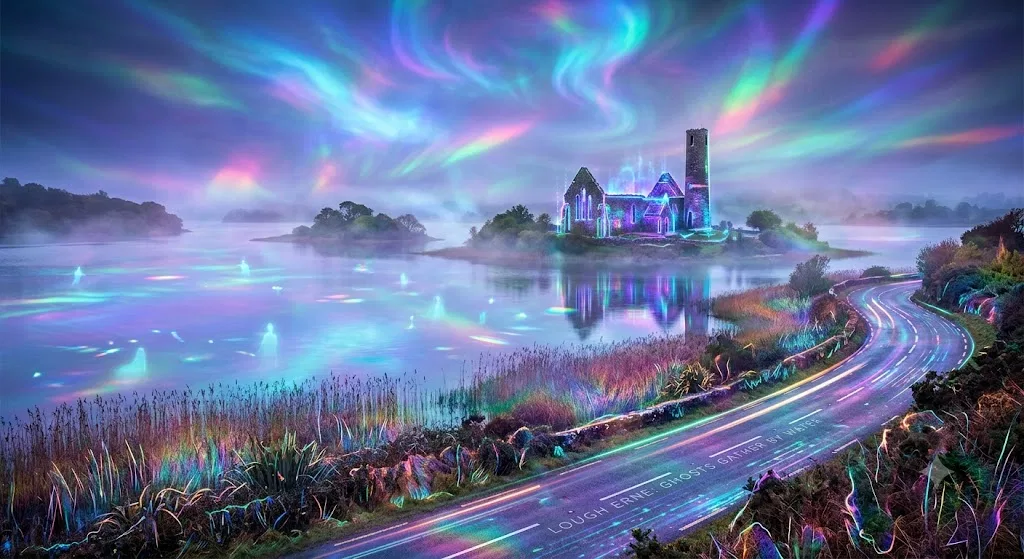
Fermanagh’s ghosts gather by water because the county’s folklore is shaped less by a single haunted room than by a whole wet landscape: Upper and Lower Lough Erne, the island town of Enniskillen, shore roads, ruined castles, church islands, ferry routes and sudden stretches of mist. Lough Erne is not merely scenery in these stories. It is the route by which cries carry, the boundary between ordinary life and the otherworld, and the mirror in which older memories of Gaelic lordship, Plantation violence, pilgrimage and local death-omens are reflected. The best sources do not prove that the lough is “haunted” in a literal sense. They show something more interesting: Fermanagh’s eerie traditions repeatedly use water, islands and lake-edge ruins as places where loss, warning and enchantment become easier to imagine.[wikishire.co.uk]wikishire.co.ukLough ErneLough Erne
For this historic-county page, the centre of gravity is Fermanagh itself. Modern tourism routes sometimes connect Lough Erne with Lough Derg in County Donegal, and the wider Erne system crosses the border, but the haunted landscape considered here is the Fermanagh lakeland: Enniskillen between the two loughs, the island monasteries, the Maguire strongholds, the wooded estates and the roads around Lower and Upper Lough Erne.[Wikishire]wikishire.co.ukOpen source on wikishire.co.uk.
Lough Erne as a haunted setting
Lough Erne’s folklore works because the geography already feels liminal. The lough is really two connected lakes formed by the River Erne: Upper Lough Erne above Enniskillen and Lower Lough Erne below it. Wikishire describes Upper Lough Erne as a maze of islands, while Lower Lough Erne is longer, deeper and more exposed, capable in windy weather of producing waves that make navigation feel almost coastal.[Wikishire]wikishire.co.ukLough ErneLough Erne The Northern Ireland environment record for Upper Lough Erne also stresses its complexity: flooded drumlins, islands, bays, reed beds, wet pasture, woodland and fen. That landscape naturally favours tales of hidden people, warning cries, drowned beings and encounters glimpsed at a distance.[DAERA]daera-ni.gov.ukOpen source on daera-ni.gov.uk.
This matters for Fermanagh’s haunted reputation because many local stories are not fixed to a bedchamber or staircase. They move. A tale can pass along a ferry crossing, cling to a castle point, echo from an island, or attach itself to a road that skirts the shore. Lower Lough Erne tourism material presents the route around the lough as a chain of early Christian settlements, Plantation castles, forests and nature reserves, which is also a useful way to understand the folklore: the stories sit where people already pause, cross, worship, inherit, fish, mourn or travel.[Cuilcagh Lakelands Geopark]cuilcaghlakelands.orgOpen source on cuilcaghlakelands.org.
The lough also gives Fermanagh’s supernatural traditions a distinctive soundscape. Water carries sound strangely. A bird call, a boat chain, a dog, a voice from another shore or wind moving through reeds can feel close and far away at once. That does not explain every story away, but it helps explain why banshee cries, fairy music and ghostly warnings belong so comfortably here. The setting invites uncertainty: was that sound from a person, an animal, the weather, or something older that the listener already half-believed in?
Why water changes the kind of ghost story Fermanagh tells
A classic haunted-house story asks, “What happened in this room?” Lough Erne folklore more often asks, “What crossed this boundary?” The boundary may be physical, such as the passage from shore to island, or social, such as the line between a living household and the dead. In Irish folklore more widely, water is often a threshold: wells overflow, women drown and become associated with rivers, lake-dwellers live below the surface, and saints choose islands as places between the world and withdrawal.
Lough Erne’s own origin traditions fit that pattern. Modern summaries of the mythic material preserve several explanations for the lough’s beginning: one links it to a woman named Erne who flees north and drowns; another to an overflowing enchanted well; another to waters bursting from the ground during battle. These are not historical accounts of geology, but they show that the lough has long been imagined as something that appears through rupture, drowning or enchantment rather than as a neutral body of water.[Wikipedia]WikipediaLough ErneLough Erne
The same water-bound imagination appears in nineteenth-century literary folklore. W. B. Yeats’s Fairy and Folk Tales of the Irish Peasantry includes “The Story of Conn-eda; or, The Golden Apples of Lough Erne”, a tale in which marvellous objects are held by a supernatural king associated with Lough Erne. The detail is not a ghost report, but it matters because it places Lough Erne within a wider Irish otherworld geography: a place where precious, dangerous and guarded things belong beneath or beyond ordinary access.[Internet Sacred Text Archive]sacred-texts.comInternet Sacred Text Archive Fairy and Folk Tales of the Irish Peasantry IndexInternet Sacred Text Archive Fairy and Folk Tales of the Irish Peasantry Index
Banshees, fairies and cries across water
Banshee tradition is one of the easiest ways to see how Fermanagh’s haunted landscape differs from a simple “ghost sighting” map. The banshee is usually treated in folklore as a female death-omen, heard crying or keening before a death rather than necessarily seen as a full apparition. Smithsonian Folklife’s modern discussion of the banshee stresses her role as a death omen and as a figure that reveals family and community memory as much as fear of the supernatural.[Smithsonian Folklife]folklife.si.eduirish bansheeirish banshee
That makes the lough an ideal setting for banshee lore. A cry heard across water can be difficult to locate. It may seem to come from an island, from the far bank, from the air above the lake, or from no clear direction at all. In a county associated with old Gaelic families such as the Maguires, a death-omen tradition also fits the way lineage, land and memory remain attached to place. Enniskillen Castle’s own heritage account notes that the Maguire chieftains ruled Gaelic Fermanagh for more than 300 years, from the late thirteenth century until the early seventeenth century.[Enniskillen Castle]enniskillencastle.co.ukOpen source on enniskillencastle.co.uk.
Fairy traditions work in a similar way. The Schools’ Collection on Dúchas, compiled in the 1930s, preserves local accounts of fairy forts near the Erne region, including a Fermanagh fort where lights were said to have been seen.[Dúchas]duchas.ieOpen source on duchas.ie. Such material is not the same as a named modern ghost report, but it is part of the haunted grammar of the county. Lights at forts, cries across water, fairy dwellings, warnings and unexplained music all teach listeners that parts of the landscape are not socially empty. They are inhabited in memory, even when no person is visible.
The important point is not that every eerie sound around Lough Erne must be a banshee or fairy. It is that Fermanagh’s older folklore gives people a vocabulary for interpreting uncertain experiences. A sound at night becomes a warning; a light at a fort becomes fairy activity; a lonely island becomes a place where the living world thins. That vocabulary is what turns landscape into haunted landscape.
Islands make Fermanagh’s folklore feel different
Lough Erne’s islands are central to the county’s eerie character because they are both reachable and set apart. Devenish, White Island, Boa Island and other sacred or storied places are not remote in a wilderness sense, yet they require a crossing or a deliberate route. That small act of separation changes how a visitor reads them. An island ruin already feels like a survivor from another order of time.
The Lough Erne Pilgrim Way makes this island pattern visible for modern visitors. Fermanagh and Omagh District Council describes it as a route linking early Christian monastic sites throughout the Fermanagh Lakelands, with histories of pilgrims, saints, scholars and Viking attacks, as well as local legends and folklore associated with the sites.[Fermanagh & Omagh District Council]fermanaghomagh.comOpen source on fermanaghomagh.com. The National Churches Trust similarly presents the route through Fermanagh’s sacred isles, highlighting White Island and the old church with carved Romanesque figures near the eastern shore of Lower Lough Erne.[National Churches Trust]nationalchurchestrust.orgOpen source on nationalchurchestrust.org.
These are not “haunted attractions” in the narrow sense. Their atmosphere comes from overlap: religious memory, carved stone, ruined buildings, lake travel and stories retold at the edge of the water. In a haunted-history project, that matters because ghost belief rarely grows from one ingredient alone. It often gathers where old worship, burial, abandonment and difficult access combine.
Boa Island adds a darker visual note to the same pattern. The island is widely associated with enigmatic carved stone figures in Caldragh graveyard, and modern visitor material places it within the same Lough Erne sacred-landscape network.[Fermanagh & Omagh District Council]fermanaghomagh.comOpen source on fermanaghomagh.com. Even without accepting sensational claims about hauntings, it is easy to see why such places attract supernatural interpretation: ancient-looking figures, graveyard setting, island isolation and uncertain meanings all encourage the sense that the past is still watching.
Lake estates, roads and ruins as story routes
Fermanagh’s haunted landscape is also a route of houses and ruins, not just an ancient mythic lake. Around Lower Lough Erne, the visitor encounters Plantation castles, wooded demesnes, old ecclesiastical sites and narrow shore roads. Cuilcagh Lakelands Geopark describes the Lower Lough Erne route as taking in early Christian settlements, Plantation castles, nature reserves and forests; that mixture is exactly why local ghost traditions can shift so easily between folklore, history and tourism.[Cuilcagh Lakelands Geopark]cuilcaghlakelands.orgOpen source on cuilcaghlakelands.org.
Tully Castle shows the process clearly. It stands on Tully Point beside Lower Lough Erne and was built for Sir John Hume. The Department for Communities states that it was attacked and burned on Christmas Eve 1641 by Rory Maguire, that the inhabitants were massacred, and that the house was not lived in again.[Department for Communities]communities-ni.gov.ukDepartment for Communities Tully CastleDepartment for Communities Tully Castle Enniskillen Castle’s account gives a fuller traditional figure for the dead, saying that 16 men and 69 women and children were killed after the surrender, with the Humes spared.[Enniskillen Castle]enniskillencastle.co.ukOpen source on enniskillencastle.co.uk.
That historical violence explains why Tully is one of Fermanagh’s most natural haunting sites. A ruined fortified house on a lake point, abandoned after massacre, needs little embellishment to feel ghostly. Later Christmas ghost lore around the castle is best treated as tradition rather than evidence, but it has an obvious emotional anchor: the date, the betrayal motif, the destruction of the house and the fact that the ruin remained in the landscape as a reminder.
Enniskillen itself also shows how water, lordship and conflict meet. The town sits between Upper and Lower Lough Erne, and its historic centre is on an island between streams of the River Erne.[Wikishire]wikishire.co.ukOpen source on wikishire.co.uk. Enniskillen Castle, now a museum site, presents the county’s Maguire history and stands as a reminder that the lough was once strategic as well as picturesque.[Enniskillen Castle]enniskillencastle.co.ukOpen source on enniskillencastle.co.uk. A place built to control crossings and waterways easily becomes, in later imagination, a place where unsettled histories still move.
The lough as a memory machine, not just a backdrop
The strongest way to read Lough Erne folklore is not to ask whether every tale is literally true, but to ask what the landscape helps people remember. Around the lough, stories preserve several kinds of memory at once.
Family memory appears in banshee traditions, where the supernatural warning is tied to death, kinship and old names rather than to anonymous terror. The cry matters because it is heard as belonging to a family line or community, not just to a monster in the dark.[Smithsonian Folklife]folklife.si.eduirish bansheeirish banshee
Territorial memory appears in Maguire and Plantation sites. Fermanagh’s old Gaelic lordship, the seventeenth-century upheavals and the ruins of fortified houses give lake-edge stories a political and historical undertone. Enniskillen Castle’s Maguire interpretation and Tully Castle’s State Care heritage account both show how strongly Fermanagh’s built remains are tied to changes in power.[Enniskillen Castle]enniskillencastle.co.ukOpen source on enniskillencastle.co.uk.
Religious memory appears on the islands. The Pilgrim Way does not present the lough simply as a scenic route, but as a chain of former monastic sites and sacred places. In folklore terms, such places are powerful because they mix holiness, isolation and ruin.[Fermanagh & Omagh District Council]fermanaghomagh.comOpen source on fermanaghomagh.com.
Natural memory appears in the landscape itself. The Geopark’s account of Big Dog Forest gives a useful parallel: folklore says the hills are Finn MacCool’s hounds turned to stone by a witch, while geology explains the forms as harder sandstone left standing after softer rock eroded around them.[Cuilcagh Lakelands Geopark]cuilcaghlakelands.orgOpen source on cuilcaghlakelands.org. That is a neat model for many Fermanagh legends. The story does not replace the physical explanation; it gives the physical feature a memorable human and supernatural shape.

How credible are the Lough Erne ghost traditions?
The evidence for Lough Erne’s haunted landscape is strongest when treated as folklore, local memory and place tradition, rather than as proof of paranormal events. The difference matters. Some Fermanagh stories, such as Tully Castle’s massacre, rest on documented historical events and official heritage interpretation; the haunting traditions attached to them are later cultural responses to that history.[Department for Communities]communities-ni.gov.ukDepartment for Communities Tully CastleDepartment for Communities Tully Castle Other material, such as fairy lights, giant stones, enchanted beings and banshee cries, survives as collected folklore, literary retelling or modern local-tourism storytelling.[Dúchas]duchas.ieOpen source on duchas.ie.
Dúchas is especially valuable because it preserves folklore as it was collected from communities, including schoolchildren’s material from the 1930s and later audio recordings. It does not turn every account into fact; instead, it shows what people said, where they located the story, and how supernatural explanation sat beside ordinary rural life. For example, the Schools’ Collection records a giant throwing a stone into Lough Erne and another local tradition of Fionn MacCool’s stone near the southern shore, both of which show how the lake’s physical features were folded into legendary explanation.[Dúchas]duchas.ieOpen source on duchas.ie.
Modern tourism sources add another layer. Fermanagh Lakelands advertises “The Gorey Story of Lough Erne” as a boat experience on the dark side of local history, resident ghosts and paranormal activity.[Fermanagh Lakelands]fermanaghlakelands.comFermanagh Lakelands The Gorey Story of Lough ErneFermanagh Lakelands The Gorey Story of Lough Erne That is useful evidence for how the county’s haunted identity is being packaged now, but it should not be confused with an independent witness archive. The same is true of seasonal spooky blog material: it shows what stories are popular and marketable, not necessarily which claims are best attested.[Fermanagh Lakelands]fermanaghlakelands.comFermanagh Lakelands Spooky Stories and Folklore: Unearthing Fermanagh'sFermanagh Lakelands Spooky Stories and Folklore: Unearthing Fermanagh's
A fair reading is therefore layered. Lough Erne is unquestionably a historically and folklorically dense landscape. It has documented ruins, island monastic sites, collected folk motifs and modern ghost-tour retellings. What it does not have, at least in the strongest public sources, is a single well-documented, repeatedly investigated lake apparition comparable to a classic psychical-research case. Its haunted power lies in accumulation.
Why Fermanagh’s water ghosts endure
Fermanagh’s lough legends endure because they match the way the county looks and moves. A traveller does not experience Lough Erne as one point on a map. They pass through channels, islands, bridges, bays, shore roads, castle points and wooded views. Each place seems to lead to another story, and each story seems to explain why the landscape feels older than the present moment.
That is why the county’s most atmospheric folklore is often indirect. A banshee is heard rather than interviewed. Fairies are inferred from lights, music or a forbidden place. A ruined castle is haunted less by a named spectre than by the knowledge of what happened there. An island church feels uncanny because it is sacred, isolated and half-ruined, not because it needs a sensational apparition attached to every stone.
Lough Erne gives Fermanagh a haunted mechanism: water separates, carries, conceals and returns. It turns local history into echo. It makes roads feel like routes between worlds and islands feel like survivals from an older order. In that sense, Fermanagh’s ghosts gather by water because the lough is where the county’s deepest memories have somewhere to travel.
Amazon book picks
Further Reading
Books and field guides related to Why Do Fermanagh's Ghosts Gather by Water?. Use these as the next step if you want deeper reading beyond the article.
The Penguin Guide to the Superstitions of Britain and Ireland
Explains supernatural beliefs associated with landscape and water.

eBay marketplace picks
Marketplace Samples
Live-tested eBay searches with available results related to this page.

Endnotes
1.
Source: daera-ni.gov.uk
Link:https://www.daera-ni.gov.uk/protected-areas/upper-lough-erne-spa
2.
Source: Wikipedia
Title: Lough Erne
Link:https://en.wikipedia.org/wiki/Lough_Erne
3.
Source: ireland.com
Link:https://www.ireland.com/en-us/destinations/county/fermanagh/lough-erne/
4.
Source: ireland.com
Link:https://www.ireland.com/en-ca/destinations/county/fermanagh/lough-erne/
5.
Source: ireland.com
Link:https://www.ireland.com/nl-nl/destinations/county/fermanagh/lough-erne/
6.
Source: ireland.com
Link:https://www.ireland.com/en-gb/destinations/county/fermanagh/lough-erne/
7.
Source: dn790001.ca.archive.org
Link:https://dn790001.ca.archive.org/0/items/fairyfolktalesof00yeat/fairyfolktalesof00yeat.pdf
8.
Source: archive.org
Link:https://archive.org/download/historyofirela00have/historyofirela00have.pdf
9.
Source: Wikipedia
Title: Enniskillen Castle
Link:https://en.wikipedia.org/wiki/Enniskillen_Castle
10.
Source: youtube.com
Title: Folklore of the Lough Erne Pilgrim Way
Link:https://www.youtube.com/watch?v=–Ki-1WNwLw
Source snippet
Lough Erne - A Lake Born of Love, Passion and a Moment of Magic...
11.
Source: youtube.com
Title: Lough Erne
Link:https://www.youtube.com/watch?v=2Pu8J-4zbJw
Source snippet
Folklore of the Lough Erne Pilgrim Way - Friar's Leap near Devenish Island...
12.
Source: wikishire.co.uk
Title: Lough Erne
Link:https://wikishire.co.uk/wiki/Lough_Erne
13.
Source: fermanaghomagh.com
Link:https://www.fermanaghomagh.com/services/arts-and-culture/lough-erne-pilgrim-way/
14.
Source: wikishire.co.uk
Link:https://wikishire.co.uk/wiki/Fermanagh
15.
Source: wikishire.co.uk
Link:https://wikishire.co.uk/wiki/Enniskillen
16.
Source: cuilcaghlakelands.org
Link:https://cuilcaghlakelands.org/itinerary/lower-lough-erne/
17.
Source: sacred-texts.com
Title: Internet Sacred Text Archive Fairy and Folk Tales of the Irish Peasantry Index
Link:https://sacred-texts.com/neu/yeats/fip/index.htm
18.
Source: sacred-texts.com
Link:https://sacred-texts.com/neu/yeats/fip/fip78.htm
19.
Source: folklife.si.edu
Title: irish banshee
Link:https://folklife.si.edu/magazine/irish-banshee
20.
Source: enniskillencastle.co.uk
Link:https://www.enniskillencastle.co.uk/fermanagh-stories/the-maguire-story/
21.
Source: duchas.ie
Link:https://www.duchas.ie/en/cbes/5044808/5040554/5084063
22.
Source: nationalchurchestrust.org
Link:https://www.nationalchurchestrust.org/explore/story/fermanaghs-sacred-isles
23.
Source: communities-ni.gov.uk
Title: Department for Communities Tully Castle
Link:https://www.communities-ni.gov.uk/heritage-sites/tully-castle
24.
Source: enniskillencastle.co.uk
Link:https://www.enniskillencastle.co.uk/fermanagh-stories/plantation-in-fermanagh/plantation-castles-in-fermanagh/tully-castle/
25.
Source: enniskillencastle.co.uk
Link:https://www.enniskillencastle.co.uk/
26.
Source: cuilcaghlakelands.org
Link:https://cuilcaghlakelands.org/geosite/big-dog-forest/
27.
Source: duchas.ie
Link:https://www.duchas.ie/en/cbes/5044787/5038052/5083645
28.
Source: duchas.ie
Link:https://www.duchas.ie/en/cbes/4428265/4389724/4477974
29.
Source: fermanaghlakelands.com
Title: Fermanagh Lakelands The Gorey Story of Lough Erne
Link:https://www.fermanaghlakelands.com/whats-on/the-gorey-story-of-lough-erne-p765241
30.
Source: fermanaghlakelands.com
Title: Fermanagh Lakelands Spooky Stories and Folklore: Unearthing Fermanagh’s
Link:https://www.fermanaghlakelands.com/blog/read/2024/10/spooky-stories-and-folklore-unearthing-fermanaghs-haunting-legends-b270
31.
Source: duchas.ie
Link:https://www.duchas.ie/en/cbef/6100258/6252303
32.
Source: duchas.ie
Link:https://www.duchas.ie/en/cbef/6100258/6252299
33.
Source: duchas.ie
Link:https://www.duchas.ie/en/cbes/4428253/4388645/4476801
34.
Source: duchas.ie
Link:https://www.duchas.ie/en/cbeg/50240
35.
Source: duchas.ie
Link:https://www.duchas.ie/en/cbes/4428256/4388971/4477628
36.
Source: duchas.ie
Link:https://www.duchas.ie/en/cbes/5162139/5157847/5198789
37.
Source: duchas.ie
Link:https://www.duchas.ie/en/cbes/5044803/5040002/5083043
38.
Source: duchas.ie
Link:https://www.duchas.ie/en/cbeg/50249
39.
Source: duchas.ie
Link:https://www.duchas.ie/en/cbes/4723857/4719632
40.
Source: duchas.ie
Link:https://www.duchas.ie/en/cbef/6100258/6252294
41.
Source: duchas.ie
Link:https://www.duchas.ie/en/cbeg/20030?HighlightText=informants&SearchLanguage=ga
42.
Source: fermanaghroots.com
Title: Lough Erne
Link:https://fermanaghroots.com/wiki/index.php?title=Lough_Erne
43.
Source: fermanaghlakelands.com
Title: Tully Castle
Link:https://www.fermanaghlakelands.com/things-to-see-and-do/tully-castle-p675521
44.
Source: fermanaghlakelands.com
Title: Big Dog Forest: Big Dog Walk
Link:https://www.fermanaghlakelands.com/things-to-see-and-do/big-dog-forest-big-dog-walk-p701761
45.
Source: fermanaghlakelands.com
Title: Guided Experience At Big Dog Forest
Link:https://www.fermanaghlakelands.com/whats-on/guided-experience-at-big-dog-forest-p823681
46.
Source: tuatha.ie
Title: Enniskillen Castle & Fermanagh County Museum
Link:https://www.tuatha.ie/enniskillen-castle/
47.
Source: en.wiktionary.org
Title: Lough Erne
Link:https://en.wiktionary.org/wiki/Lough%20Erne
48.
Source: emeraldisle.ie
Link:https://emeraldisle.ie/the-banshee
49.
Source: cuilcaghlakelands.org
Link:https://cuilcaghlakelands.org/about-us/what-is-a-geopark/history-folklore/
50.
Source: infrastructure-ni.gov.uk
Link:https://www.infrastructure-ni.gov.uk/articles/lough-erne-levels
51.
Source: spiritedisle.ie
Title: tully castle
Link:https://spiritedisle.ie/explore/listing/tully-castle/
Additional References
52.
Source: facebook.com
Link:https://www.facebook.com/LoughErnePilgrimWay/posts/the-mountain-that-cries-tears-of-stone-a-fermanagh-folklore-tale-high-above-swan/122279186870024204/
53.
Source: facebook.com
Link:https://www.facebook.com/irishembassynewzealand/posts/a-sight-to-behold-in-county-fermanaghthe-lough-erne-loch-%C3%A9irne-is-the-name-of-tw/1216602022117005/
54.
Source: facebook.com
Link:https://www.facebook.com/groups/457718515243482/posts/1557824155232907/
55.
Source: abcounties.com
Link:https://abcounties.com/counties/county-profiles/county_fermanagh/
56.
Source: waterwaysireland.org
Link:https://www.waterwaysireland.org/our-waterways/erne-system
57.
Source: facebook.com
Link:https://www.facebook.com/groups/LoveIrelandGroup/posts/1928984457638709/
58.
Source: gazetteer.org.uk
Link:https://gazetteer.org.uk/place/Enniskillen%2C_Fermanagh_321976
59.
Source: gutenberg.org
Link:https://www.gutenberg.org/files/33887/33887-h/33887-h.htm
60.
Source: facebook.com
Link:https://www.facebook.com/TheIrishPost/posts/fairy-folklore-in-the-west-of-ireland/10160015462248452/
61.
Source: thehistorypress.co.uk
Link:https://thehistorypress.co.uk/publication/fermanagh-folk-tales/
Topic Tree