Within Haunted Morayshire
Why Forres Feels So Deeply Supernatural
Forres draws its eerie force from witch-stone traditions, Macbeth associations and old supernatural storytelling around the town.
On this page
- Macbeth folklore and local place memory
- Witch stones and trial era echoes
- Sueno's Stone and the atmosphere of old Forres
Page outline Jump by section
Introduction
Forres feels deeply supernatural because three different kinds of story meet in the same small Morayshire town: Shakespeare’s Macbeth places royal power, battle news and a witches’ heath around Forres; the town’s Witches’ Stone preserves a grisly local tradition of accused witches rolled from Cluny Hill; and Sueno’s Stone gives the eastern edge of the town a monumental, half-readable medieval presence. None of this proves a haunting. What it does show is how Forres became one of Moray’s strongest places of supernatural memory: a real historic burgh, overlaid with drama, witch-trial trauma, roadside folklore and visitor storytelling.
The important distinction is between history and place-legend. Scotland’s witch-hunts were real, and the University of Edinburgh’s Survey of Scottish Witchcraft was created to document people accused between 1563 and 1736.[Edinburgh DataShare]datashare.ed.ac.ukOpen source on ed.ac.uk. But the most famous Forres witch-stone tale is much harder to prove from records, and historians have warned that the spiked-barrel story may be memorial folklore rather than documented execution practice.[The Bottle Imp]thebottleimp.org.ukThe Bottle Imp Remembering Scottish WitchesThe Bottle Imp Remembering Scottish Witches
Why Macbeth Keeps Pulling Forres Into the Supernatural
Forres has a stronger claim than most Scottish towns to Macbeth atmosphere because Shakespeare explicitly places key early scenes there. In Act I, the play moves from “a camp near Forres” to “a heath near Forres”, where the three Witches meet Macbeth and Banquo, and then to “Forres. The palace.”[opensourceshakespeare.org]opensourceshakespeare.orgOpen source on opensourceshakespeare.org. That stage geography matters: even readers who have never visited Moray inherit an image of Forres as a place of fog, prophecy, kingship and danger.
The Shakespeare connection is literary, not a map reference that can be pinned down with certainty. The Royal Shakespeare Company notes that Shakespeare borrowed heavily from Raphael Holinshed’s Chronicles, especially the accounts of Duncan and Macbeth, while also changing material for dramatic and political reasons.[Royal Shakespeare Company]rsc.org.ukDates and Sources | Macbeth | Royal Shakespeare Company | Royal Shakespeare Company… This means Forres’s Macbeth identity is built from layered sources: medieval royal tradition, Renaissance chronicle-writing, Shakespearean theatre, and later local tourism.
That layering explains why Forres legends often feel older than the evidence behind them. Macbeth’s Hillock near Brodie, west of Forres, is now promoted as the place where Macbeth is said to have met the three witches, with modern visitor accommodation built around that association.[macbethshillock]macbethshillock.co.ukOpen source on macbethshillock.co.uk. Local tourism sources also describe the site as overlooking the supposed meeting-place where the witches foretold Macbeth’s rise and fall.[Visit Forres]visitforres.scotOpen source on visitforres.scot. For a haunted-history reader, the key point is not whether Shakespeare’s scene happened there, but how firmly the story has attached itself to the landscape between Forres, Brodie and Nairn.
Witch Stones and Trial-Era Echoes
The Witches’ Stone at Forres is the town’s starkest witchcraft landmark. Local visitor and heritage accounts place it at the foot of Cluny Hill and repeat the tradition recorded on the plaque: accused witches were said to have been rolled down the hill in spiked barrels, and burned where the barrels stopped.[Visit Forres]visitforres.scotOpen source on visitforres.scot. The stone is often described as a roadside boulder now built around rather than removed, which helps explain its power as a small, everyday object that interrupts the modern street.
The legend also has a curse motif. VisitForres says the boulder was supposedly taken away for building work, cracked into pieces, and then returned after feverish illness affected the taker, who feared a curse.[Visit Forres]visitforres.scotOpen source on visitforres.scot. This is classic folklore structure: a troubling object is moved, misfortune follows, and the object is restored. The tale makes the stone feel active, not merely commemorative.
The difficult question is how much of this can be treated as history. The broader Scottish witch-hunt is well documented: Historic Environment Scotland explains that the Survey of Scottish Witchcraft estimates about two-thirds of accused witches were executed, usually by strangulation followed by burning of the body, while only a very small number are known to have been burned alive.[Historic Environment Scotland Blog]blog.historicenvironment.scotOpen source on historicenvironment.scot. That context makes the Forres legend emotionally plausible as a memory of persecution, but not automatically accurate in its specific details.
A particularly useful caution comes from historian Julian Goodare’s discussion of Scottish witch memorials in The Bottle Imp. He writes that the Forres Witches’ Stone notice claims witches were rolled down Cluny Hill in spiked barrels, but says there is no known historical documentation for that practice and no documentary record of witches from Forres; he also notes that the Macbeth setting has encouraged confusion between Shakespeare’s witches and witch-trial memory.[The Bottle Imp]thebottleimp.org.ukThe Bottle Imp Remembering Scottish WitchesThe Bottle Imp Remembering Scottish Witches For this page, that is the fairest reading: the Witches’ Stone is powerful local folklore and memorial culture, but its most lurid details should be presented as tradition, not established fact.
Sueno’s Stone and the Atmosphere of Old Forres
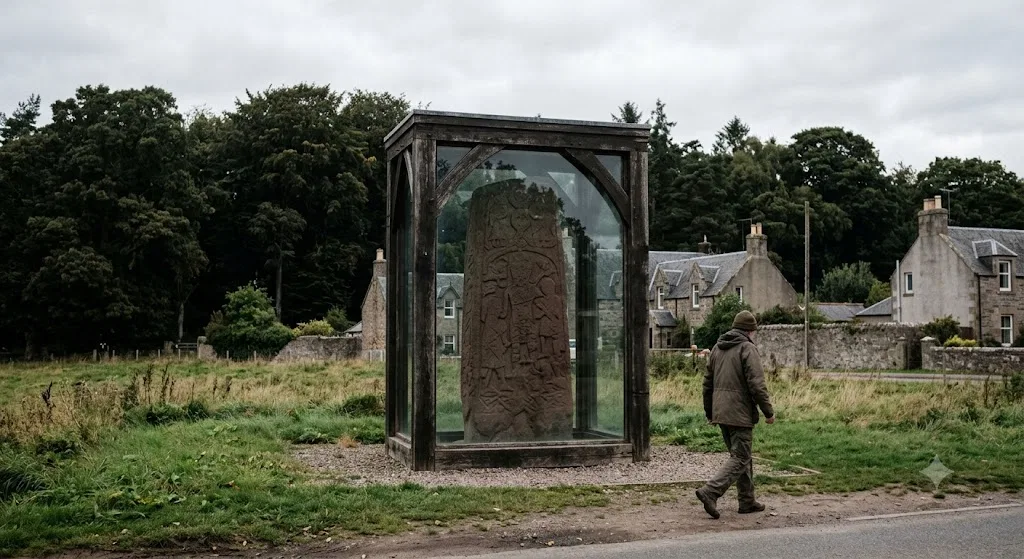
Sueno’s Stone gives Forres a different kind of supernatural charge. It is not a witch memorial, but its scale, age and battle imagery make it one of the town’s most atmospheric places. Historic Environment Scotland describes the monument on Findhorn Road as a huge early medieval cross-slab, with one face showing a Christian cross above a scene interpreted as a royal inauguration, and the other showing a grisly battle scene with headless corpses and severed heads.[Historic Environment Scotland]historicenvironment.scotOpen source on historicenvironment.scot.
The official Statement of Significance says Sueno’s Stone is thought to have been erected on or near its present site around 850–950, probably making it centuries older than Shakespeare’s play and older than the early modern witch trials. It also notes that maps from around 1590 and later appear to record one or two large carved pillars north of Forres, while the surviving stone was taken into state care in 1923 and enclosed in glass in 1991 to protect it.[HES Publications]app-hes-pubs-prod-neu-01.azurewebsites.netHES Publications Sueno's StoneHES Publications Sueno's Stone
The Macbeth association is therefore a later overlay on a much older monument. Local legend says Sueno’s Stone marks the place where Macbeth met the three witches, or that the witches’ souls are trapped inside the stone.[Discover Highlands and Islands]discoverhighlandsandislands.scotOpen source on discoverhighlandsandislands.scot. That story works because the monument already looks like something out of deep time: tall, carved, martial, Christian and mysterious. But the archaeological evidence points towards early medieval power, battle, kingship and commemoration, not a Shakespearean event.
This is where Forres becomes especially interesting. The stone’s real history is already dramatic enough: Historic Environment Scotland says scholars cannot know for certain what story the carvings tell, and possible interpretations include political upheaval in the mid-800s, Gaelic kingship, Pictish power, Christian messages, foundation legend or evidence for beheading practices.[Historic Environment Scotland]historicenvironment.scotOpen source on historicenvironment.scot. The supernatural legend is not the source of Sueno’s Stone’s importance; it is a later imaginative response to a monument that resists simple explanation.
How the Three Traditions Became Entangled
Forres’s eerie reputation comes from overlap. Macbeth gives the town witches and prophecy. The Witches’ Stone gives it persecution, punishment and curse-memory. Sueno’s Stone gives it a huge carved survivor from an earlier, half-lost political world. Each story could stand alone, but in local storytelling they reinforce one another.
A recent academic article, Forres: A Hotbed of Witches?, directly addresses this problem of reputation. Its abstract notes the long-standing image of Forres as a notable place for witches, and the search result summary highlights how Macbeth’s Hillock and the Witches’ Stone appear to commemorate unrelated traditions but have become “unavoidably linked” in the town’s narrative.[EUPublishing]euppublishing.comOpen source on euppublishing.com. That is the mechanism behind the atmosphere: separate stories begin to behave like one story because they share the same small geography.
For visitors, this creates a compact supernatural circuit:
- Macbeth’s Hillock gives the literary “where the witches met him” tradition.[facebook.com]facebook.comSource details in endnotes.
- The Witches’ Stone gives the roadside memorial and curse-like folklore.
- Sueno’s Stone gives the ancient monument whose carvings invite speculation.
- Cluny Hill and old Forres provide the physical setting that holds the stories together.
This does not make Forres a place of verified hauntings in the way some castle ghost traditions claim named apparitions or repeated witness reports. Its supernatural force is more folkloric. It is a town where theatrical witchcraft, historical witch-hunt memory and early medieval stone-carving have been folded into one local imagination.
What Is Credible, What Is Folklore, and What Still Matters
The strongest evidence is not for ghosts, but for the processes that made Forres feel haunted. Shakespeare really does set major scenes around Forres.[opensourceshakespeare.org]opensourceshakespeare.orgOpen source on opensourceshakespeare.org. Scotland’s witch prosecutions really were a severe historical phenomenon, documented by the Survey of Scottish Witchcraft and later institutional research.[Edinburgh DataShare]datashare.ed.ac.ukOpen source on ed.ac.uk. Sueno’s Stone really is an exceptional early medieval monument with battle and royal imagery, protected and interpreted by Historic Environment Scotland.[HES Publications]app-hes-pubs-prod-neu-01.azurewebsites.netHES Publications Sueno's StoneHES Publications Sueno's Stone
The weaker evidence concerns the famous spiked-barrel execution story at the Forres Witches’ Stone. Local sources preserve it, and the plaque makes it part of public memory.[Visit Forres]visitforres.scotOpen source on visitforres.scot. But specialist commentary warns that the specific practice is not supported by known documentation and may be a later memorial legend.[The Bottle Imp]thebottleimp.org.ukThe Bottle Imp Remembering Scottish WitchesThe Bottle Imp Remembering Scottish Witches That does not make the stone meaningless. It changes what the stone means: less a verified execution record, more a place where Forres has chosen, however imperfectly, to remember fear, accusation and injustice.
The Macbeth associations work in a similar way. Macbeth’s Hillock and Sueno’s Stone should not be treated as proven locations for Shakespeare’s witches. They are better understood as landscape traditions created by the meeting of literature and place. Shakespeare gave Forres a supernatural stage direction; local memory supplied visible landmarks; visitors and storytellers kept the connection alive.
Why Forres Belongs at the Heart of Morayshire’s Haunted Map
Within Morayshire’s haunted and eerie history, Forres is important because it shows how a place can become supernatural without relying on a single ghost story. Brodie Castle has named apparitions, Spynie Palace has ruin-lore, and Elgin has ecclesiastical and urban ghost traditions. Forres is different. Its haunting is a mechanism of association: witches in a play, witches in persecution memory, and a stone monument whose carvings still feel unresolved.
That makes Forres especially useful for readers who want haunted history rather than simple “most haunted” lists. The town’s stories ask better questions than “is it true?” They ask how legends attach to landmarks, how public memorials can preserve both memory and error, and how Shakespeare can reshape the atmosphere of a real Scottish town for centuries.
Forres feels supernatural because its landscape lets different pasts speak at once: the royal and theatrical world of Macbeth, the painful memory of accused witches, and the carved violence of early medieval Moray. The result is not a neat ghost case, but one of the county’s richest examples of eerie place-memory.


eBay marketplace picks
Marketplace Samples
Live-tested eBay searches with available results related to this page.
Endnotes
1.
Source: opensourceshakespeare.org
Link:https://www.opensourceshakespeare.org/views/plays/play_view.php?Act=1&Scope=act&WorkID=macbeth&msg=pl&pleasewait=1
2.
Source: rsc.org.uk
Title: Royal Shakespeare Company
Link:https://www.rsc.org.uk/macbeth/about-the-play/dates-and-sources
Source snippet
Dates and Sources | Macbeth | Royal Shakespeare Company | Royal Shakespeare Company...
3.
Source: visitforres.scot
Link:https://visitforres.scot/macbeths-hillock-rated-in-scotlands-top-five-campsites/
4.
Source: visitforres.scot
Link:https://visitforres.scot/listing/the-witches-stone/
5.
Source: opensourceshakespeare.org
Link:https://www.opensourceshakespeare.org/views/plays/play_view.php?WorkID=macbeth
6.
Source: opensourceshakespeare.org
Link:https://www.opensourceshakespeare.org/views/plays/play_view.php?Scope=entire&WorkID=macbeth&msg=pl&pleasewait=1
7.
Source: visitforres.scot
Link:https://visitforres.scot/listing/40197/
8.
Source: youtube.com
Title: The Witches’ Stone, Cluny Hill, Forres, Exploring Scotland’s History
Link:https://www.youtube.com/watch?v=rNQJUwKJAwg
9.
Source: datashare.ed.ac.uk
Link:https://datashare.ed.ac.uk/handle/10283/45
10.
Source: thebottleimp.org.uk
Title: The Bottle Imp Remembering Scottish Witches
Link:https://www.thebottleimp.org.uk/2013/11/remembering-scottish-witches/?print=print
11.
Source: macbethshillock.co.uk
Link:https://www.macbethshillock.co.uk/
12.
Source: blog.historicenvironment.scot
Link:https://blog.historicenvironment.scot/2022/06/the-witchcraft-act-and-its-impact-in-scotland/
13.
Source: historicenvironment.scot
Link:https://www.historicenvironment.scot/visit/all/suenos-stone/history-and-stories/
14.
Source: app-hes-pubs-prod-neu-01.azurewebsites.net
Title: HES Publications Sueno’s Stone
Link:https://app-hes-pubs-prod-neu-01.azurewebsites.net/api/file/788599c3-b313-48fe-90f8-ab3c00d351b2
15.
Source: discoverhighlandsandislands.scot
Link:https://discoverhighlandsandislands.scot/en/story/the-mystery-of-suenos-stone
16.
Source: euppublishing.com
Link:https://www.euppublishing.com/doi/10.3366/nor.2025.0325
17.
Source: ailishsinclair.com
Title: macbeths hillock and the three witches
Link:https://ailishsinclair.com/2025/09/macbeths-hillock-and-the-three-witches/
18.
Source: witches.hca.ed.ac.uk
Link:https://witches.hca.ed.ac.uk/faq/
19.
Source: Wikipedia
Title: Three Witches
Link:https://en.wikipedia.org/wiki/Three_Witches
20.
Source: Wikipedia
Title: Survey of Scottish Witchcraft
Link:https://en.wikipedia.org/wiki/Survey_of_Scottish_Witchcraft
21.
Source: folger.edu
Link:https://www.folger.edu/explore/shakespeares-works/Macbeth/read/1/3/
22.
Source: macbethshillock.co.uk
Link:https://www.macbethshillock.co.uk/contact-us
23.
Source: macbethshillock.co.uk
Link:https://www.macbethshillock.co.uk/places-to-visit
24.
Source: tripadvisor.com
Title: MACBET H’S HILLOCK
Link:https://www.tripadvisor.com/Hotel_Review-g551767-d15034234-Reviews-Macbeth_s_Hillock-Forres_Moray_Scotland.html
25.
Source: facebook.com
Link:https://www.facebook.com/macbethshillock/
26.
Source: facebook.com
Link:https://www.facebook.com/groups/138954903685/posts/10156148724488686/
27.
Source: campsites.co.uk
Link:https://www.campsites.co.uk/search/campsites-in-scotland/highlands/forres/macbeths-hillock
28.
Source: euppublishing.com
Link:https://www.euppublishing.com/doi/abs/10.3366/nor.2025.0325
29.
Source: uk-scotland.uk
Title: MACBET H’S HILLOCK, Forres
Link:https://uk-scotland.uk/hotel/macbethshillock
30.
Source: uk.trip.com
Title: macbeth s hillock
Link:https://uk.trip.com/hotels/brora-hotel-detail-23598355/macbeth-s-hillock/
31.
Source: myshakespeare.com
Link:https://myshakespeare.com/macbeth/act-1-scene-4
32.
Source: shakespeareatplay.ca
Link:https://www.shakespeareatplay.ca/macbeth-act-1-scene-2
33.
Source: ebsco.com
Link:https://www.ebsco.com/articles/drama-and-theater-arts/307333e3-3890-5775-a0e5-0899ae21703c/forres-a-hotbed-of-witches
34.
Source: folger-main-site-assets.s3.amazonaws.com
Link:https://folger-main-site-assets.s3.amazonaws.com/uploads/2022/11/macbeth_PDF_FolgerShakespeare.pdf
Additional References
35.
Source: youtube.com
Title: The Mysteries and Legends of Scotland’s Mac Beth’s Hillock
Link:https://www.youtube.com/watch?v=H5iPkhBcdd8
Source snippet
Sueno's Stone, Largest Cross Slab in Scotland...
36.
Source: facebook.com
Link:https://www.facebook.com/groups/forresloveslocal/posts/1445805136290338/
37.
Source: facebook.com
Link:https://www.facebook.com/ketv7/posts/31-days-of-halloween-the-scottish-graveyard-features-the-three-witches-who-told-/1223044359855201/
38.
Source: digitscotland.com
Link:https://www.digitscotland.com/fact-meets-fiction-shakespeare-and-scottish-archaeology/
39.
Source: morayspeyside.com
Link:https://morayspeyside.com/visit/forres/
40.
Source: facebook.com
Link:https://www.facebook.com/groups/scotlandsscenery/posts/5375580532461276/
41.
Source: scribd.com
Link:https://www.scribd.com/document/114581099/Macbeth-Act-1
42.
Source: medium.com
Link:https://medium.com/between-mountain-and-sea-new-writing-from-todays/morays-witches-stones-c9f33fd81ff5
43.
Source: studeersnel.nl
Link:https://www.studeersnel.nl/nl/document/katholieke-scholengemeenschap-de-breul/engels/no-fear-shakespeare-macbeth-full-text-with-modern-translation/141600067
44.
Source: elginmuseum.org.uk
Link:https://elginmuseum.org.uk/l/wp-content/uploads/2021/07/People-and-Place-6-Where-are-the-Women-of-History-Additional-Information.pdf
Topic Tree