Within Haunted Dunbartonshire
When Witchcraft Stories Haunted Dumbarton Rock
Dunbartonshire's eerie inheritance includes witchcraft accusations, saint legends and moral stories written into the landscape.
On this page
- The St Patrick rock hurling legend
- Janet Boyd and accused witches in the records
- From Halloween image to memorial history
Page outline Jump by section
Introduction
Dumbarton Rock is not haunted only by reported apparitions. Its darker inheritance is also made from saint legend, witchcraft accusation and the modern work of remembering people whose names were almost lost. Around this volcanic stronghold on the Clyde, the supernatural appears in three different forms: a folk tale in which witches try to destroy St Patrick, legal records in which real women were accused of witchcraft, and present-day memorial culture that asks readers to treat “witch” stories as evidence of fear, coercion and injustice rather than Halloween decoration. The result is one of Dunbartonshire’s most revealing haunted landscapes: not a simple ghost site, but a place where myth, power and social memory gather around the same rock.
Why Dumbarton Rock attracts supernatural memory
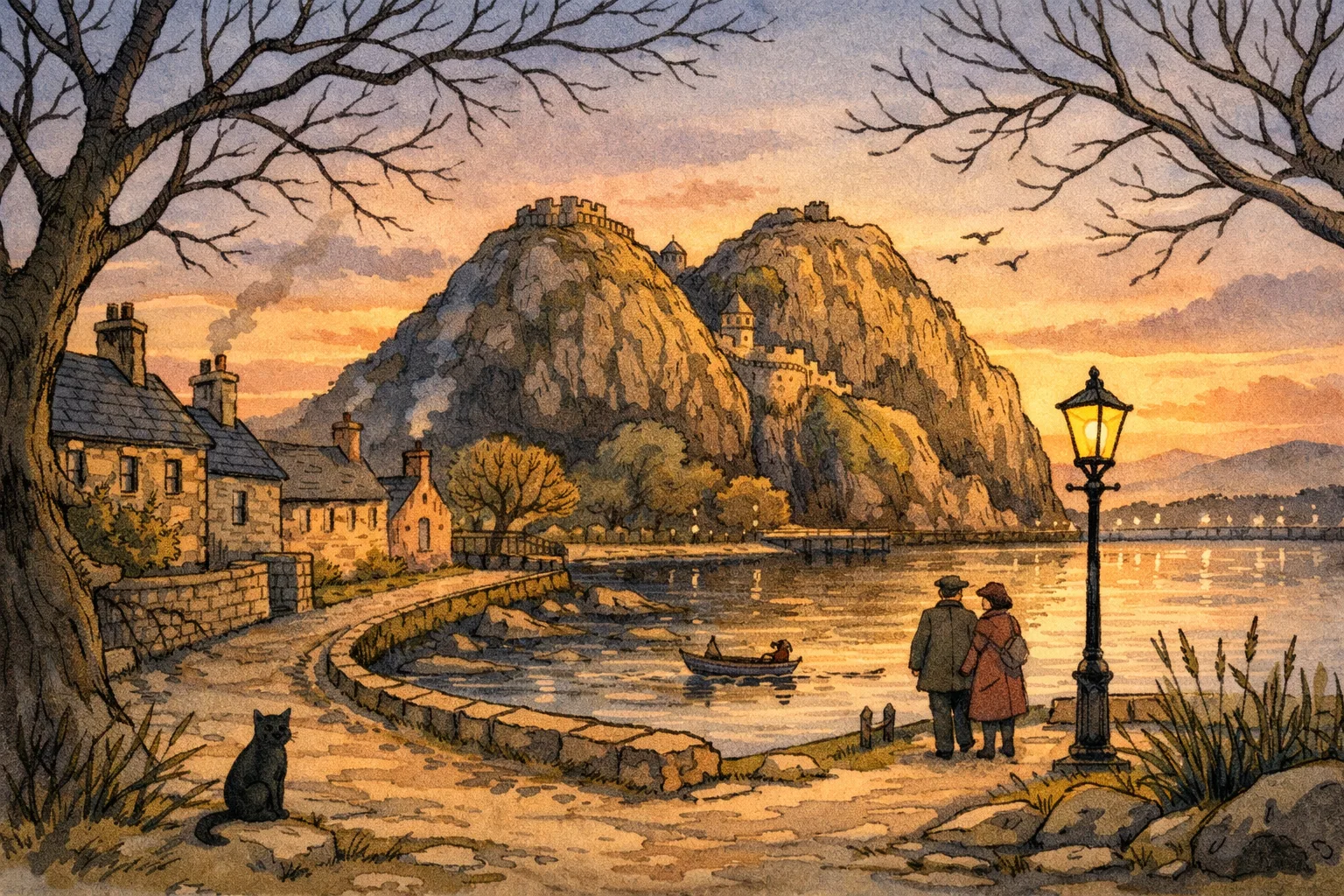
Dumbarton Castle stands on a basalt volcanic plug at the meeting of the River Leven and the River Clyde. Historic Environment Scotland describes it as a stronghold with around 1,500 years of recorded history, once central to the ancient kingdom known as Alt Clut and later used as a royal castle, border stronghold and military garrison.[Historic Environment Scotland]historicenvironment.scotHistoric Environment ScotlandDumbarton CastleIts recorded history goes back 1,500 years. From the Darks Ages through to the Second World… West Dunbartonshire Council gives the physical reason for its visual power plainly: the Rock rises about 75 metres, or 240 feet, above the river landscape.[West Dunbartonshire Council]west-dunbarton.gov.ukWest Dunbartonshire CouncilDumbarton CastleDumbarton Castle is built on top of a volcanic plug. The Rock rises to 75 metres (240 feet) fo…
That matters for haunted history because folklore is rarely attached at random. A place as visible as Dumbarton Rock becomes a landmark of explanation. People look at it and ask why it is there, who controlled it, who suffered there, and what kind of power it represents. Archaeological and historical work on Alt Clut shows that the rock was not merely a picturesque outcrop but a political centre known in early medieval sources; Leslie Alcock’s multidisciplinary study notes that Bede, writing in the early eighth century, gives the earliest unambiguous written reference to Castle Rock, Dumbarton, as a strongly defended centre of the Britons.[Society of Antiquaries of Scotland]journals.socantscot.orgTHE EARLY HISTORY OF ALT CLUT. The earliest unambiguous reference to Castle Rock, Dumbarton, is in Book I of Bede's.Read more…
This helps explain why Dumbarton’s supernatural material does not behave like a neat catalogue of ghosts. The rock already had the scale of legend before later ghost writers reached it. Its history includes warfare, siege, captivity and authority; its folklore adds saints, devils and witches; its witchcraft records turn fear into legal violence. For a reader tracing Dunbartonshire’s eerie inheritance, Dumbarton Rock is therefore a moral and imaginative centre as much as a castle.
The St Patrick rock-hurling legend
The most striking supernatural origin story connected with the Rock appears in material preserved from the Old Statistical Account and discussed by the University of Edinburgh’s Statistical Accounts blog. In this local tradition, Kilpatrick in Dumbartonshire is associated with St Patrick, and the Devil, angered by Patrick’s holiness and preaching, sends witches against him. Patrick flees by boat towards Ireland; unable to pursue him across the water, the witches tear a huge piece of rock from a nearby hill and hurl it after him. The missile misses, falls harmlessly, and with later human work becomes the Castle of Dumbarton.[Library & University Collections]libraryblogs.is.ed.ac.ukwicked witcheswicked witches
As geology, the story is not evidence. Dumbarton Rock is a volcanic formation, not a witch-thrown boulder. But as folklore it is valuable because it turns the landmark into a frozen moment of supernatural conflict. The Rock becomes the material trace of a failed assault: saintliness escapes, witchcraft misses, and the landscape keeps the memory of the attack. This is the kind of story that makes a place feel haunted even without a named apparition walking its stairs.
The tale also shows how older religious storytelling differs from modern paranormal tourism. The “witches” in this legend are not individual women with biographies. They are a hostile supernatural force, allied with the Devil and set against a Christian saint. That makes the story morally simple in a way the later trial records are not. The saint legend uses witches as symbolic enemies; the legal records show real people being named, accused, examined and sometimes executed.
St Patrick’s connection with the Dumbarton area has long been debated rather than settled. Patrick’s own Confessio says that his father Calpornius was a deacon, that his grandfather Potitus was a priest, and that the family was connected with Bannavem Taburniae, where Patrick was taken captive as a teenager.[confessio.ie]confessio.ieOpen source on confessio.ie. Modern commentary on the Confessio stresses that the exact location of Bannavem Taburniae remains uncertain, although it was probably somewhere near Britain’s western coast because of the ease with which Patrick was seized by Irish raiders.[confessio.ie]confessio.ieOpen source on confessio.ie.
That uncertainty is important. The Dumbartonshire tradition should be read as a local claim and a landscape legend, not as proof that Patrick was definitely born at Old Kilpatrick. Its power lies in how the story binds a saint, the Clyde, witches and Dumbarton Rock into one memorable explanation. It gives the Rock a supernatural biography: not merely “built on”, but hurled into history.

Janet Boyd and the accused witches in the records
The darker material around Dumbarton is not the saint legend but the witchcraft evidence. Here the word “haunted” must be handled carefully. The records do not prove supernatural events; they preserve a society’s fear of supernatural harm and the legal machinery that turned suspicion into punishment.
The Survey of Scottish Witchcraft, a major University of Edinburgh database covering Scottish witchcraft cases from 1563 to 1736, lists Janet Boyd of Dumbarton in a 1629 case. The trial record states that she confessed to the provost and bailies of Dumbarton, that the Privy Council became involved over the legality of the commission, and that her trial and execution were deemed legal after the fact on 13 January 1629.[Witches]witches.hca.ed.ac.ukOpen source on ed.ac.uk. The same database search for Dunbarton includes other named people in and around Dumbarton, including Janet Neil, Margaret Hunter, Janet Donald, Janet Mitchell, Janet Munn, Margaret Paterson of Old Kilpatrick, Isobel Laing, Janet Paterson of Bonhill and Agnes Wikean of Dumbarton.[Witches]witches.hca.ed.ac.ukOpen source on ed.ac.uk.
Those entries change the tone of the page. The witches of the St Patrick legend are folkloric figures. Janet Boyd and the others were real accused people living within a burgh, parish and court world. Their cases are not “spooky” in the harmless sense. They belong to early modern Scotland’s system of accusation, confession, commission, punishment and public fear.
The Janet Boyd case is especially useful because it shows how local and national authority overlapped. The record notes that a commission previously granted by the Earl of Monteith had to be ratified because he lacked authority, and that the Privy Council issued a new commission in case the earlier proceedings were defective.[Witches]witches.hca.ed.ac.ukOpen source on ed.ac.uk. A scholarly article by Michael Wasser on the Privy Council and witchcraft also identifies Jonet Boyd’s case at Dumbarton in October 1628 as one in which depositions and a confession were presented, raising procedural questions rather than producing a simple local trial narrative.[JSTOR]jstor.orgThe Privy Council and the WitchesThe Privy Council and the Witches
For haunted-place readers, this is where credibility must be divided into two questions. Was Janet Boyd a witch in any supernatural sense? There is no reason to treat that as fact. Was Janet Boyd caught in a documented witchcraft process in Dumbarton? Yes: the surviving records make that historically grounded. The haunting, if the word is used at all, is the afterlife of accusation.
What the records can and cannot tell us
Witchcraft records often look more complete than they are. They may preserve names, dates, legal steps and fragments of accusation, yet still leave the accused person’s own life almost invisible. The Survey of Scottish Witchcraft explains that a “case” records the sequence that emerged from a denunciation, including investigation, arrest and trial where known, rather than providing a rounded biography.[doc.ukdataservice.ac.uk]doc.ukdataservice.ac.ukSurvey of Scottish WitchcraftSurvey of Scottish Witchcraft
That limitation matters in Dumbarton. A name in a database is not the same as a voice. Janet Boyd appears most clearly when officials are acting upon her. The record tells us about confession, commissions and execution, but much less about her ordinary life before accusation. Even when local memory tries to restore that life, it is working from fragmentary civic and legal traces.
Recent remembrance work has pushed this issue into public view. Remembering the Accused Witches of Scotland describes its work as raising awareness of the ordinary women and men accused during this period.[Scottish Witches]raws.scotOpen source on raws.scot. A 2025 RAWS article on Dumbarton argues that local names are still being recovered and says that, before further research, Jonet Boyd had been assumed to be Dumbarton’s first accused witch, while the writer had identified four earlier accused people in 1624; it also warns that the surviving archive begins only in 1614, so earlier cases may be unrecoverable.[Scottish Witches]raws.scotScottish Witches The forgotten names of DumbartonScottish Witches The forgotten names of Dumbarton
That is a useful corrective to dramatic retellings. The archive is neither silent nor complete. It preserves enough to show that witchcraft accusation was part of Dumbarton’s history, but not enough to let modern writers turn every accused person into a fully knowable character. A responsible haunted-history page should therefore resist two temptations: treating the accusations as paranormal evidence, and smoothing the victims into a sentimental legend.
From Halloween image to memorial history
Dumbarton’s witchcraft inheritance now sits between two very different public uses of the word “witch”. One is seasonal, atmospheric and familiar: witches as Halloween imagery, broomsticks, devils, storms and spooky castles. The other is memorial: witches as people accused under a legal and religious system that could ruin or end lives.
The Dumbarton material contains both, but they should not be confused. The St Patrick story is a legend of witches acting as supernatural attackers. It belongs to a long tradition of moral landscape tales, where a rock, hill or ruin is explained by a saint’s victory over evil. It can be enjoyed as folklore, provided it is not mistaken for history.
The witch-trial records require a different response. Campaigns such as Witches of Scotland have framed the Scottish witch trials as a historical injustice, seeking a pardon, an apology and a memorial for people convicted and executed under the Witchcraft Act 1563.[Witches of Scotland]witchesofscotland.comOpen source on witchesofscotland.com. The Scottish Parliament petition PE1855 similarly called on the Scottish Government to pardon, apologise and create a national monument for people accused and convicted as witches under that Act.[Petitions - The Scottish Parliament]petitions.parliament.scotOpen source on parliament.scot.
This national memorial movement matters locally because it changes what a visitor might look for at Dumbarton. The “witch” is no longer only a figure in a scary story. She may also be Janet Boyd, Janet Neil, Margaret Hunter or another named person whose record survives because the authorities suspected, processed or punished her. Modern work on memorialising witch-trial injustice has stressed the scale and gendered nature of the Scottish persecutions, with thousands tried and executed during the early modern period.[media.leverhulme.ac.uk]media.leverhulme.ac.ukOpen source on leverhulme.ac.uk.
This shift does not remove the eerie atmosphere. It deepens it. The most unsettling thing around Dumbarton Rock is not that witches supposedly threw a stone at a saint. It is that, centuries later, ordinary people could be treated as servants of supernatural evil by their own neighbours, courts and councils.

Why this belongs to Dunbartonshire’s haunted map
Dunbartonshire’s haunted history is not only made from apparitions in ruined rooms. It also includes stories that explain fear: fear of invasion, fear of punishment, fear of spiritual danger and fear of women or neighbours imagined as hidden enemies. Dumbarton Rock concentrates those fears because it is both a real fortress and a symbolic height.
The saint legend gives the place a mythic origin. It says, in effect, that the Rock itself is the remains of a supernatural attack. The witchcraft records give the surrounding town a human darkness. They show how belief in supernatural harm could move from story into court action. Modern memorial work then adds a third layer, asking whether the proper response to such material is entertainment, mourning, education or all three held in tension.
This is why the Rock should not be treated as just another haunted castle stop. Its folklore is stronger when read as a cluster:
- A sacred escape story: St Patrick flees from witches and the Devil, and the missed missile becomes Dumbarton Castle in local tradition.[Library & University Collections]libraryblogs.is.ed.ac.ukwicked witcheswicked witches
- A documented witchcraft landscape: Janet Boyd and other named people appear in Dunbarton witchcraft records, with Boyd’s case tied to Dumbarton authorities, Privy Council procedure and execution.[Witches]witches.hca.ed.ac.ukOpen source on ed.ac.uk.
- A modern act of recovery: recent Scottish campaigns and local researchers are reframing witch stories as histories of accused people, not just spooky folklore.[Scottish Witches]raws.scotOpen source on raws.scot.
That cluster is more valuable than a single ghost story because it shows how haunted memory is made. A landmark becomes legendary; a fear becomes legal; a legal record becomes a memorial name.
How credible is the haunting tradition?
The most credible part of this subject is not the supernatural claim but the documentary trail. Dumbarton Rock’s geology and historical importance are well supported by official and archaeological sources.[Historic Environment Scotland]historicenvironment.scotHistoric Environment ScotlandDumbarton CastleIts recorded history goes back 1,500 years. From the Darks Ages through to the Second World… The St Patrick rock-hurling tale is credible as a preserved folklore tradition, especially because it can be traced through the Statistical Accounts tradition, but it is not credible as an explanation of the Rock’s formation.[Library & University Collections]libraryblogs.is.ed.ac.ukwicked witcheswicked witches
The witchcraft cases are credible as records of accusation and prosecution. Janet Boyd’s case, in particular, is anchored in the Survey of Scottish Witchcraft and in wider scholarship on the Privy Council’s role in Scottish witch trials.[Witches]witches.hca.ed.ac.ukOpen source on ed.ac.uk. What they do not prove is the reality of witchcraft as charged. The language of confession also needs caution, because early modern witchcraft confession could emerge under pressure, fear, imprisonment, examination or torture; it should not be read like a voluntary modern witness statement.
For a haunted-history reader, the fairest conclusion is that Dumbarton Rock is surrounded by strong dark memory rather than strong apparition evidence. Its supernatural reputation comes less from repeated modern ghost sightings than from the way saint legend and witchcraft accusation have attached themselves to the same dramatic place. The Rock looks like a natural stage for ghost stories, but its most disturbing material is older, quieter and more human.
What to look for in the story today
A visitor or reader approaching Dumbarton Rock through this theme should look beyond the obvious castle drama. The useful question is not simply “Is Dumbarton Castle haunted?” but “What kinds of fear have people placed here?” The answer moves from medieval-looking legend to early modern legal terror and then to present-day remembrance.
The St Patrick tale gives the Rock a theatrical supernatural image: witches, pursuit, a boat on the Clyde, and a stone thrown with deadly intent. The Janet Boyd record brings the story down from legend into the burgh, where named people faced accusation under civic and national authority. The memorial movement changes the final meaning again, asking whether the old word “witch” should make us think first of magic, or first of the accused.
That makes this one of Dunbartonshire’s most layered eerie places. Dumbarton Rock does not need a famous white lady or a well-packaged ghost tour to belong on the haunted map. Its haunting lies in the collision between landscape legend and recorded injustice: a saint escaping witches in folklore, and real people unable to escape the machinery of witchcraft belief in history.
Amazon book picks
Further Reading
Books and field guides related to When Witchcraft Stories Haunted Dumbarton Rock. Use these as the next step if you want deeper reading beyond the article.

The Penguin book of witches
Offers accessible historical context for witchcraft accusations.

Scottish Witches and Witch-Hunters
Directly addresses the historical context behind Scottish witchcraft stories.

eBay marketplace picks
Marketplace Samples
Live-tested eBay searches with available results related to this page.
Endnotes
1.
Source: confessio.ie
Link:https://www.confessio.ie/etexts/confessio_english
2.
Source: confessio.ie
Link:https://www.confessio.ie/more/article_kelly
3.
Source: jstor.org
Title: The Privy Council and the Witches
Link:https://www.jstor.org/stable/25529681
4.
Source: doc.ukdataservice.ac.uk
Title: Survey of Scottish Witchcraft
Link:https://doc.ukdataservice.ac.uk/doc/4667/mrdoc/pdf/guide.pdf
5.
Source: raws.scot
Link:https://www.raws.scot/
6.
Source: raws.scot
Title: Scottish Witches The forgotten names of Dumbarton
Link:https://www.raws.scot/post/the-forgotten-names-of-dumbarton
7.
Source: petitions.parliament.scot
Link:https://petitions.parliament.scot/petitions/PE1855
8.
Source: media.leverhulme.ac.uk
Link:https://media.leverhulme.ac.uk/feature/mmalloch
9.
Source: archive.org
Link:https://archive.org/download/historyofdumbar00irvi/historyofdumbar00irvi.pdf
10.
Source: nature.scot
Link:https://www.nature.scot/sites/default/files/site-special-scientific-interest/551/site-management-statement.pdf
11.
Source: parliament.scot
Title: Petition PE2122
Link:https://www.parliament.scot/~/media/committ/9661/Petition-PE2122
12.
Source: youtube.com
Title: Castle Known As Guardhouse Of Bloodiest Valley In Scotland
Link:https://www.youtube.com/watch?v=RPMEliL40zA
Source snippet
Dumbarton Castle | Scotland's History...
13.
Source: youtube.com
Title: Dumbarton Castle | Scotland’s History
Link:https://www.youtube.com/watch?v=HEw53Heh6qc
Source snippet
Dumbarton Castle: A Colquhoun Site...
14.
Source: historicenvironment.scot
Link:https://www.historicenvironment.scot/visit/all/dumbarton-castle/
Source snippet
Historic Environment ScotlandDumbarton CastleIts recorded history goes back 1,500 years. From the Darks Ages through to the Second World...
15.
Source: west-dunbarton.gov.uk
Link:https://www.west-dunbarton.gov.uk/leisure-parks-events/museums-and-galleries/collections/buildings/castles-and-country-houses/castles-and-country-houses-dumbarton/dumbarton-castle
Source snippet
West Dunbartonshire CouncilDumbarton CastleDumbarton Castle is built on top of a volcanic plug. The Rock rises to 75 metres (240 feet) fo...
16.
Source: journals.socantscot.org
Link:https://journals.socantscot.org/index.php/psas/article/download/8935/8903
Source snippet
THE EARLY HISTORY OF ALT CLUT. The earliest unambiguous reference to Castle Rock, Dumbarton, is in Book I of Bede's.Read more...
17.
Source: libraryblogs.is.ed.ac.uk
Title: wicked witches
Link:https://libraryblogs.is.ed.ac.uk/statacc/2016/10/31/wicked-witches/
18.
Source: witches.hca.ed.ac.uk
Link:https://witches.hca.ed.ac.uk/trial/T/LA/508
19.
Source: witches.hca.ed.ac.uk
Link:https://witches.hca.ed.ac.uk/quick/?casefrom=&caseto=&firstname=&lastname=&maritalstatus=&page=206&residence=&sex=Female&socioeconomicstatus=&sort=-res_county
20.
Source: witchesofscotland.com
Link:https://www.witchesofscotland.com/
21.
Source: portal.historicenvironment.scot
Link:https://portal.historicenvironment.scot/apex/f?p=1505%3A300%3A%3A%3A%3A%3AVIEWTYPE%2CVIEWREF%3Adesignation%2CSM90107
22.
Source: historicenvironment.scot
Link:https://www.historicenvironment.scot/visit/all/dumbarton-castle/history-and-stories/
23.
Source: libraryblogs.is.ed.ac.uk
Link:https://libraryblogs.is.ed.ac.uk/statacc/tag/research/
24.
Source: witches.hca.ed.ac.uk
Link:https://witches.hca.ed.ac.uk/quick/?fullname=&page=81&sort=res_county
25.
Source: libraryblogs.is.ed.ac.uk
Link:https://libraryblogs.is.ed.ac.uk/page/137/
26.
Source: clydesider.org
Title: witches of dumbarton
Link:https://www.clydesider.org/witches-of-dumbarton/
27.
Source: romaneranames.uk
Link:https://www.romaneranames.uk/b/bannavem.htm
28.
Source: Wikipedia
Title: Dumbarton Castle
Link:https://en.wikipedia.org/wiki/Dumbarton_Castle
29.
Source: Wikipedia
Title: Witches of Scotland
Link:https://en.wikipedia.org/wiki/Witches_of_Scotland
30.
Source: historicenvironmentscotland.teamkinetic.co.uk
Link:https://historicenvironmentscotland.teamkinetic.co.uk/volunteers/provider-profile/DumbartonCastle/268415
31.
Source: atlasobscura.com
Title: dumbarton rock
Link:https://www.atlasobscura.com/places/dumbarton-rock
32.
Source: atlasobscura.com
Title: witches scotland pardon apology
Link:https://www.atlasobscura.com/articles/witches-scotland-pardon-apology
33.
Source: gov.scot
Link:https://www.gov.scot/binaries/content/documents/govscot/publications/foi-eir-release/2024/01-d/pardoning-of-witches-foi-review/documents/foi-202200295186-information-released/foi-202200295186-information-released/govscot%3Adocument/FOI%2B202200295186%2BInformation%2Breleased.pdf
34.
Source: i.rcahms.gov.uk
Link:https://i.rcahms.gov.uk/canmore-pdf/WP00004568.pdf
35.
Source: journals.socantscot.org
Link:https://journals.socantscot.org/index.php/arch-scot/article/download/320/318/317
Additional References
36.
Source: youtube.com
Title: Dumbarton Castle: A Colquhoun Site
Link:https://www.youtube.com/watch?v=TMMGzfdfqAc
Source snippet
Dumbarton Castle has the longest recorded history of any stronghold DRONE - Glasgow Scotland - ECTV...
37.
Source: academia.edu
Link:https://www.academia.edu/144856029/Fairies_witches_and_the_devil
38.
Source: tradeshouselibrary.org
Link:https://www.tradeshouselibrary.org/uploads/4/7/7/2/47723681/ancient_records_of_dumbarton.pdf
39.
Source: facebook.com
Link:https://www.facebook.com/100088539433942/posts/around-370-years-ago-dirleton-castle-became-a-prison-for-people-accused-of-witch/933168552977784/
40.
Source: patrickstory.ie
Link:https://patrickstory.ie/confessio-of-st-patrick/
41.
Source: catholic.org
Link:https://www.catholic.org/saints/saintpatrick/confessio.php
42.
Source: ccel.org
Link:https://www.ccel.org/ccel/patrick/confession.ii.html
43.
Source: facebook.com
Link:https://www.facebook.com/emchalphotography/posts/did-you-know-the-last-execution-in-the-scottish-town-of-dornoch-was-punishment-f/1345379101060286/
44.
Source: scotlandfarandnear.co.uk
Link:https://scotlandfarandnear.co.uk/en/DumbartonCastle
45.
Source: facebook.com
Link:https://www.facebook.com/TheKiltedPhoto/posts/dumbarton-castle-and-dumbarton-rock-this-site-has-a-long-and-rich-history-it-has/980326613783533/
Topic Tree