Within Haunted Derbyshire
Why Eyam's Plague Story Still Haunts Visitors
Eyam's hauntings matter because its ghost stories grow out of named plague losses, memorial places and village tourism.
On this page
- The plague story and named village losses
- Eyam Hall and local ghost traditions
- Haunting as grief, memory and tourism
Page outline Jump by section
Introduction
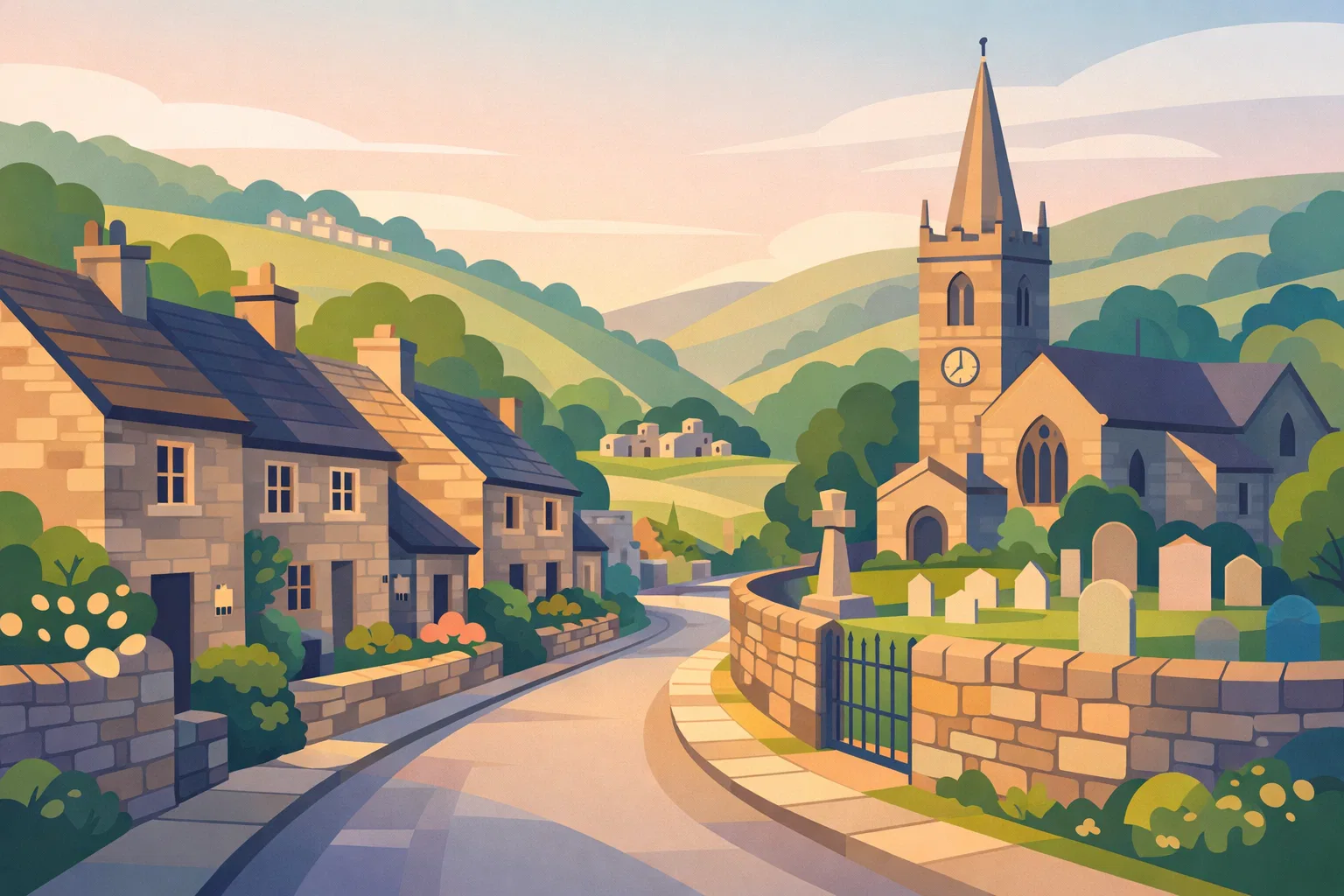
Eyam is one of Derbyshire’s most emotionally charged haunted places because its ghost stories do not float free from history: they cling to named cottages, graves, wells, boundary stones and family losses from the plague years of 1665–1666. Visitors come for the “Plague Village” story, but many leave with a stronger sense that Eyam is haunted by memory rather than by a single famous apparition. Its eerie appeal lies in the closeness of the evidence: plague plaques on houses, the Riley Graves in open fields, St Lawrence’s Church, Cucklett Delph, Mompesson’s Well, the Boundary Stone, Eyam Museum and Eyam Hall all turn grief into a walkable landscape. The ghost traditions attached to the village should be treated as folklore and tourism claims, not proven supernatural fact, but they matter because they show how Derbyshire’s haunted history often grows from real communal trauma, local commemoration and the experience of standing where the story happened.[eyamvillage]eyamvillage.org.ukeyamvillage Eyam Historic Plague Village | Eyam Village in the Peak Districteyamvillage Eyam Historic Plague Village | Eyam Village in the Peak District
The plague story still shapes every eerie walk through Eyam
Eyam’s haunted atmosphere begins with the historical event that made the village famous. The village’s own visitor information describes Eyam as a Peak District village in Derbyshire made famous by the Black Death of 1665 and 1666, when villagers isolated themselves from surrounding communities and many people died. Eyam Museum likewise presents itself as telling the story of the village’s plague experience in 1665–1666, alongside its wider social and industrial history.[eyamvillage]eyamvillage.org.ukeyamvillage Eyam Historic Plague Village | Eyam Village in the Peak Districteyamvillage Eyam Historic Plague Village | Eyam Village in the Peak District
The usual account says plague reached Eyam in summer or early autumn 1665, probably in cloth sent from London to a local tailor. George Viccars, the tailor’s assistant, is commonly named as the first victim, dying in September 1665 after handling the infected cloth. From there, the disease spread through households and across the village. The National Archives describes the wider 1665–1666 plague as England’s worst outbreak since the Black Death of 1348, with recorded London deaths of 68,596 and a likely true toll above 100,000; Eyam’s story belongs to that wider national crisis, but has become unusually memorable because it is tied to a single village landscape.[Buxton Museum and Art Gallery]buxtonmuseumandartgallery.wordpress.comthe illustrated account of eyam plaguethe illustrated account of eyam plague
The central dramatic claim is that Eyam isolated itself to stop the disease travelling into neighbouring Derbyshire and Yorkshire communities. The story is often told as an act of collective sacrifice led by the Anglican rector William Mompesson and the ejected Puritan minister Thomas Stanley. Practical measures associated with the quarantine included open-air worship at Cucklett Delph, families burying their own dead rather than using the churchyard, and contactless exchanges at places such as the Boundary Stone and Mompesson’s Well, where money was left in vinegar in return for food and supplies.[theguardian.com]theguardian.comeyam derbyshire coronavirus self isolate 1665 plagueeyam derbyshire coronavirus self isolate 1665 plague
This is why Eyam can feel haunted even before any ghost story is mentioned. The visitor is not merely told that “something terrible happened here”; the village is arranged around survivals and memorial points. The plague cottages, the church, the outlying graves and the exchange stones form a route of grief. That gives Eyam’s supernatural reputation a different tone from Derbyshire’s ruined castles or haunted inns. The mood is not mainly theatrical. It is memorial, domestic and personal.
Named losses make Eyam’s ghosts feel unusually human
Many haunted places depend on vague figures: a grey lady, a monk, a child on a staircase. Eyam’s darker power comes from names. The Riley Graves are the clearest example. Historic England lists the Riley Graves and Graveyard as a Grade II site on Riley Lane and records six gravestones and a table tomb enclosed by a stone wall. The inscriptions name members of the Hancocke family buried in August 1666, including John Hancocke Junior, Elizabeth Hancocke, Oner Hancocke, Alice Hancocke, Ann Hancocke and William Hancocke; the listing identifies the memorial as one to the Hancocke family who died of the plague.[Historic England]historicengland.org.ukHistoric England Riley Graves and Graveyard, EyamHistoric England Riley Graves and Graveyard, Eyam
The story often told around these graves is that Elizabeth Hancock survived while burying her husband and children in a short span of days. Even when details vary in popular retellings, the physical site gives the tale its force: a small walled enclosure away from the main village, in the fields, marking a family catastrophe that did not disappear into an anonymous churchyard. The result is a kind of haunting grounded in place. The “ghost” here may be less an apparition than the shock of seeing domestic loss fixed into the landscape.
The same is true of the plague plaques on cottages. Modern visitor guides and village material point readers towards plague cottages, scattered grave sites, the church and the museum as the core Eyam experience. The plaques turn ordinary homes into memorial surfaces, naming people who died in particular houses. This is important for haunted tourism because it changes the way visitors move through the village: a lane becomes a death register, a pretty stone cottage becomes a household tragedy, and a quiet walk becomes an encounter with named absence.[baldhiker.com]baldhiker.comBald Hiker Discovering Eyam: A Guide to the Peak District's PlagueBald Hiker Discovering Eyam: A Guide to the Peak District's Plague
Eyam’s famous romance tradition also depends on the pull of named people. The story of Emmott Syddall of Eyam and Rowland Torre of nearby Stoney Middleton is usually told as a plague-era love story: the lovers, separated by the quarantine, met at a distance until Emmott no longer came. Local-history discussion is careful about the evidence: Emmott appears to have been a real plague victim, while Rowland’s historical trace is much less secure and belongs more firmly to folklore. That uncertainty does not make the tale useless; it shows how Eyam’s memory blends record, grief, romance and local legend.[smhccg.org]smhccg.orgLost love of Rowland Torre and Emmott SydallLost love of Rowland Torre and Emmott Sydall
Eyam Hall and the village’s local ghost traditions
Eyam Hall is not a plague building in the strictest sense, because it was built just after the epidemic. Historic Houses describes it as a seventeenth-century village house, built in 1672, six years after the plague, and home to the Wright family for eleven generations. Its setting matters: it stands within the village that had just been transformed by plague memory, and it now forms part of the visitor circuit of house, church, museum, craft courtyard and historic streets.[Historic Houses]historichouses.orgHistoric Houses Eyam Hall – Historic Houses | Historic HousesHistoric Houses Eyam Hall – Historic Houses | Historic Houses
The Hall’s ghost traditions are therefore not best understood as direct plague testimony. They are better seen as part of Eyam’s wider haunted tourism layer. Ghost-walk publicity for Eyam has claimed sightings at Eyam Hall of Sarah Mills, described as a servant girl who drowned in the village well, and has also promoted other village “hotspots” such as the Miner’s Arms, where unexplained footsteps, doors opening or slamming, and ghostly laughter are alleged. These are commercial paranormal claims rather than archival proof, but they show how Eyam’s visitor economy has expanded from plague memory into a broader haunted-village experience.[hauntingnightsghostwalks.co.uk]hauntingnightsghostwalks.co.ukOpen source on hauntingnightsghostwalks.co.uk.
That distinction is worth keeping clear. Eyam Hall has solid architectural and heritage significance: it is a historic manor house, a family home and a visitor attraction with seasonal opening. The ghost stories attached to it are much thinner as evidence than the plague memorial record. Yet they still belong on a Derbyshire haunted-history page because they show how visitors read Eyam. Once a village is already associated with mass death, isolation and memorial plaques, even later or unrelated ghost traditions tend to be pulled into the same atmosphere.[Historic England]historicengland.org.ukHistoric England Eyam Hall, EyamHistoric England Eyam Hall, Eyam
The Miner’s Arms works similarly. A pub in a plague village is almost inevitably read through the surrounding history, even when a particular ghost claim cannot be tied to a named plague victim. In Eyam, the paranormal story is rarely just “a spirit was seen”. It is more often: footsteps in a village of plague houses; laughter near rooms where visitors already know families died; a servant at a hall built in the shadow of catastrophe. The haunting is amplified by context.

Why Eyam became haunted tourism rather than only local history
Eyam’s tourism is not accidental. The village actively presents itself as a place to visit, learn and walk through. Eyam Museum says it is a good place to begin a visit, and the village visitor pages direct people to the museum, Eyam Hall, St Lawrence’s Church, Mompesson’s Well, Riley Graves, the Boundary Stone and group-booking arrangements. Visit Peak District & Derbyshire markets Eyam as the Peak District’s “Plague Village”, inviting visitors to immerse themselves in the story of villagers who sealed themselves off to stop the disease spreading.[eyam-museum.org.uk]eyam-museum.org.ukOpen source on eyam-museum.org.uk.
This turns Eyam into a form of dark heritage tourism: travel focused on death, disaster, suffering or difficult memory. The phrase can sound exploitative, but Eyam’s case is more complicated. The strongest village interpretation is not a horror attraction. It is a memorial landscape where visitors are asked to connect the plague to real households and named losses. A University of Manchester thesis on Eyam’s heritage identity argues that tourism in the village is shaped not just by looking, but by visitors physically placing themselves within the history by walking routes and visiting particular spots; it also describes Eyam Museum as both a powerful force in local tourism and, in some ways, a memorial site.[Research Explorer]research.manchester.ac.ukConstruction of Heritage and Identity in the Plague Village: Examining the Intersections of Local Identity, Heritage Tourism, and Local H…
That helps explain why Eyam has become attractive to ghost walks and paranormal weekends. The village already supplies the route, the mood and the emotional stakes. A conventional haunted-house tour might need to build atmosphere through darkness, locked rooms and theatrical storytelling. Eyam begins with a real memorial grammar: cottages, plaques, graves, wells, boundaries and church space. Ghost-tour organisers can then overlay apparitions, alleged footsteps and haunted-building stories onto a landscape that visitors already experience as charged.[hauntingnightsghostwalks.co.uk]hauntingnightsghostwalks.co.ukOpen source on hauntingnightsghostwalks.co.uk.
The risk is that spectacle can flatten grief. Eyam’s best haunted interpretation keeps the plague dead at the centre as people, not props. The village’s enduring power comes from the fact that visitors can still trace the practical geography of survival and loss: where people worshipped outdoors, where food was exchanged, where families buried their dead, where the museum names victims, and where later stories of ghosts have gathered around that memory.
The history is real, but the heroic legend is debated
A careful haunted-history page should not repeat Eyam’s plague story as if every detail were settled. The main event is not in doubt: Eyam suffered a devastating plague outbreak in 1665–1666, and the village became famous for quarantine and communal suffering. But historians have questioned parts of the traditional narrative, especially older claims about population size, mortality rate and how exceptional the quarantine really was.
Eyam Museum’s learning resources state that John and Francine Clifford’s research found the village population was considerably higher than the 350 estimated by nineteenth-century historian William Wood. The museum explains that Wood appears to have treated Mompesson’s statement that 76 households were touched by plague as if it described the whole population, whereas many households escaped infection; the Cliffords identified about 700 individuals living in Eyam when plague arrived, with the possibility of more.[Eyam Museum]eyam-museum.org.ukEyam Museum Learning | Eyam MuseumEyam Museum Learning | Eyam Museum
This changes the emotional mathematics without diminishing the tragedy. Some popular accounts say around 260 people died from a population of 350, suggesting a near-total destruction of the village. More recent research usually gives a population nearer 700 or more, with roughly a third dying. A Sheffield student history article summarising modern scholarship makes the same corrective point: the traditional nineteenth-century narrative emphasised exceptional self-sacrifice and extreme mortality, while modern estimates are around 257 victims from a population of about 700.[New Histories]newhistories.sites.sheffield.ac.ukOpen source on sheffield.ac.uk.
The quarantine itself also needs context. Recent scholarship argues that Eyam’s “heroic isolation” should be understood in relation to early modern public-health ideas, not as a completely unique invention. A 2023 article on Eyam’s plague epidemic describes its purpose as examining primary and secondary sources, revising dramatic victim numbers, considering the isolation in the light of contemporary mainstream notions, and tracing the transformation and exploitation of historical memory.[eJournals]ejournals.epublishing.ekt.grOpen source on ekt.gr.
For haunted tourism, this matters because uncertainty can make the story more interesting, not less. Eyam is not a simple morality tale where every detail is fixed. It is a village where grief, records, Victorian commemoration, local pride, medical history, folklore and modern tourism have all shaped what visitors think they are seeing. The honest version is still haunting: not because every legend is provable, but because the real suffering was severe enough to generate centuries of retelling.
The memorial places visitors remember most
Eyam’s haunted appeal is unusually walkable. The key places are not hidden in one locked building but spread through the village and surrounding fields. That makes the experience feel less like visiting an attraction and more like entering a place where the past has not been tidied away.
The plague cottages are often the first emotional shock. They are attractive Derbyshire stone buildings, but the plaques connect them to named victims and dates. This contrast between picturesque village architecture and recorded household death is central to Eyam’s atmosphere.[eyamvillage]eyamvillage.org.ukeyamvillage Eyam Historic Plague Village | Eyam Village in the Peak Districteyamvillage Eyam Historic Plague Village | Eyam Village in the Peak District
St Lawrence’s Church anchors the story religiously and socially. The church is associated with Mompesson’s ministry, plague remembrance and the wider village memory. The plague window, installed in the twentieth century, visually retells the story, including scenes from plague tradition such as Emmott and Rowland.[Geograph]geograph.org.ukOpen source on geograph.org.uk.
Cucklett Delph matters because it turns public-health history into landscape. It is remembered as the open-air worship place used when indoor services were considered too risky, and an annual Plague Sunday service has long been associated with this outdoor site.[Beautiful Britain]beautifulbritain.co.ukBeautiful Britain EyamBeautiful Britain Eyam
Mompesson’s Well and the Boundary Stone make the quarantine tangible. Village visitor material identifies Mompesson’s Well as a place where money was left in exchange for food, and the Boundary Stone as a point between Eyam and Stoney Middleton where money was left in vinegar for food and goods. These sites are powerful because they show isolation as a practical arrangement, not just a dramatic phrase.[eyamvillage]eyamvillage.org.ukeyamvillage Eyam Plague Village | Visitor Informationeyamvillage Eyam Plague Village | Visitor Information
The Riley Graves are perhaps the most haunting of all because they resist abstraction. Historic England’s listing records the enclosure, the gravestones, the names and the August 1666 burial dates. A visitor standing there is not thinking about “the plague” in general, but about one family’s dead in one field.[Historic England]historicengland.org.ukHistoric England Riley Graves and Graveyard, EyamHistoric England Riley Graves and Graveyard, Eyam
What Eyam adds to Derbyshire’s haunted map
Within Derbyshire’s wider haunted geography, Eyam is distinct. Bolsover Castle offers nationally visible ghost reports in a dramatic aristocratic setting; Derby Gaol offers punishment, confinement and urban ghost walks; Winnats Pass and Mermaid’s Pool belong more to road legend and moorland folklore. Eyam’s contribution is different: it is a haunted village whose supernatural reputation is inseparable from communal bereavement and public memory.
That is why Eyam’s ghosts should be read with care. The village does have reported hauntings and ghost-tour claims, especially around Eyam Hall, the Miner’s Arms and the general plague village route. But the deeper haunting is cultural. Eyam shows how a place can become eerie not because one apparition dominates it, but because every ordinary feature seems to point back to an extraordinary year: a cottage wall, a church window, a field grave, a well, a boundary stone, a museum display.
For visitors, this makes Eyam one of Derbyshire’s most affecting haunted-history sites. It is not the best place to look for a clean “is it true?” ghost case. It is a better place to ask why some histories continue to feel present. The answer lies in Eyam’s rare combination of named dead, surviving memorial places, contested but powerful plague tradition, and a tourism culture that asks people to walk through the story rather than merely read about it.
Amazon book picks
Further Reading
Books and field guides related to Why Eyam's Plague Story Still Haunts Visitors. Use these as the next step if you want deeper reading beyond the article.


Eyam: The Story of a Plague Village
Directly covers the village and its plague legacy.
eBay marketplace picks
Marketplace Samples
Live-tested eBay searches with available results related to this page.


Endnotes
1.
Source: baldhiker.com
Title: Bald Hiker Discovering Eyam: A Guide to the Peak District’s Plague
Link:https://www.baldhiker.com/eyam-the-peak-districts-plague-village/
2.
Source: smhccg.org
Title: Lost love of Rowland Torre and Emmott Sydall
Link:https://smhccg.org/folklore-legends/lost-love-of-rowland-torre-and-emmott-sydall/
3.
Source: hauntingnightsghostwalks.co.uk
Link:https://hauntingnightsghostwalks.co.uk/event/the-village-of-the-damned-interactive-ghost-walk-eyam-derbyshire/
4.
Source: research.manchester.ac.uk
Title: Research Explorer
Link:https://research.manchester.ac.uk/en/studentTheses/construction-of-heritage-and-identity-in-the-plague-village-exami/
Source snippet
Construction of Heritage and Identity in the Plague Village: Examining the Intersections of Local Identity, Heritage Tourism, and Local H...
5.
Source: smhccg.org
Link:https://smhccg.org/folklore-legends/
6.
Source: eyamvillage.org.uk
Title: eyamvillage Eyam Historic Plague Village | Eyam Village in the Peak District
Link:https://www.eyamvillage.org.uk/
7.
Source: eyamvillage.org.uk
Title: eyamvillage Eyam Plague Village | Visitor Information
Link:https://www.eyamvillage.org.uk/explore
8.
Source: historicengland.org.uk
Title: Historic England Riley Graves and Graveyard, Eyam
Link:https://historicengland.org.uk/listing/the-list/list-entry/1109993
9.
Source: eyam-museum.org.uk
Link:https://www.eyam-museum.org.uk/
10.
Source: buxtonmuseumandartgallery.wordpress.com
Title: the illustrated account of eyam plague
Link:https://buxtonmuseumandartgallery.wordpress.com/2023/01/07/the-illustrated-account-of-eyam-plague/
11.
Source: theguardian.com
Title: eyam derbyshire coronavirus self isolate 1665 plague
Link:https://www.theguardian.com/world/2020/mar/15/eyam-derbyshire-coronavirus-self-isolate-1665-plague
12.
Source: peakdistrictkids.co.uk
Title: 12 things to do in eyam
Link:https://peakdistrictkids.co.uk/12-things-to-do-in-eyam/
13.
Source: geograph.org.uk
Link:https://www.geograph.org.uk/photo/7538295
14.
Source: historichouses.org
Title: Historic Houses Eyam Hall – Historic Houses | Historic Houses
Link:https://www.historichouses.org/house/eyam-hall/
15.
Source: historicengland.org.uk
Title: Historic England Eyam Hall, Eyam
Link:https://historicengland.org.uk/listing/the-list/list-entry/1334913
16.
Source: eyam-museum.org.uk
Title: Eyam Museum Learning | Eyam Museum
Link:https://www.eyam-museum.org.uk/resources
17.
Source: newhistories.sites.sheffield.ac.uk
Link:https://newhistories.sites.sheffield.ac.uk/volumes/2019-20/volume-12/the-tragic-plague-of-eyam-a-history-more-fiction-than-fact
18.
Source: ejournals.epublishing.ekt.gr
Link:https://ejournals.epublishing.ekt.gr/index.php/mhist/article/view/34280
19.
Source: beautifulbritain.co.uk
Title: Beautiful Britain Eyam
Link:https://www.beautifulbritain.co.uk/htm/outandabout/eyam.htm
20.
Source: burialspacesforgottenplaces.wordpress.com
Title: the plague window and lore of the plague in eyam
Link:https://burialspacesforgottenplaces.wordpress.com/2025/10/21/the-plague-window-and-lore-of-the-plague-in-eyam/
21.
Source: greatacre.wordpress.com
Title: eyam hall
Link:https://greatacre.wordpress.com/2016/10/31/eyam-hall/
22.
Source: prufrocksdilemma.wordpress.com
Title: in an english plague village
Link:https://prufrocksdilemma.wordpress.com/2017/05/25/in-an-english-plague-village/
23.
Source: derbyshireandthepeakdistrict.co.uk
Link:https://derbyshireandthepeakdistrict.co.uk/eyam-visitor-guide/
24.
Source: Wikipedia
Title: Eyam Museum
Link:https://en.wikipedia.org/wiki/Eyam_Museum
25.
Source: Wikipedia
Link:https://en.wikipedia.org/wiki/Eyam
26.
Source: Wikipedia
Title: Eyam Hall
Link:https://en.wikipedia.org/wiki/Eyam_Hall
27.
Source: historicengland.org.uk
Title: Eyam House, Eyam
Link:https://historicengland.org.uk/listing/the-list/list-entry/1334915
28.
Source: historicengland.org.uk
Title: Ruins of Bradshaw Hall, Eyam
Link:https://historicengland.org.uk/listing/the-list/list-entry/1334917
29.
Source: eyamvillage.org.uk
Link:https://www.eyamvillage.org.uk/plague
30.
Source: eyamvillage.org.uk
Link:https://www.eyamvillage.org.uk/location-visitor-information
31.
Source: visitpeakdistrict.com
Title: eyam museum
Link:https://visitpeakdistrict.com/business-directory/eyam-museum
32.
Source: eyamhall.co.uk
Title: Eyam Hall
Link:https://www.eyamhall.co.uk/
33.
Source: wikishire.co.uk
Link:https://wikishire.co.uk/wiki/Eyam
34.
Source: robschurches.com
Title: Eyam | Churchcrawling
Link:https://www.robschurches.com/eyan
35.
Source: creativetourist.com
Title: eyam hall
Link:https://www.creativetourist.com/venue/eyam-hall/
36.
Source: museumsuk.com
Title: Eyam Museum, Eyam | Heritage & Culture
Link:https://museumsuk.com/museums/eyam/eyam-museum.html
37.
Source: eyam-museum.org.uk
Link:https://www.eyam-museum.org.uk/assets/files/Map-of-Eyam.pdf
38.
Source: eyam-museum.org.uk
Link:https://www.eyam-museum.org.uk/events
39.
Source: eyam-museum.myshopify.com
Title: eyam plague 1665 1666 by john clifford
Link:https://eyam-museum.myshopify.com/products/eyam-plague-1665-1666-by-john-clifford
40.
Source: philemeryvisits.com
Link:https://philemeryvisits.com/eyam/
41.
Source: thelittlehouseofhorrors.com
Link:https://thelittlehouseofhorrors.com/eyam-village/
Additional References
42.
Source: youtube.com
Title: The Plague Village | The Dark Story of England’s Most Courageous Village
Link:https://www.youtube.com/watch?v=-nbmEAlCvcQ
Source snippet
Walking tour of the Eyam Plague Village Derbyshire, England...
43.
Source: youtube.com
Title: The Real Village of the Damned?: Eyam and the Great Plague
Link:https://www.youtube.com/watch?v=KMaXOk2sSJI
Source snippet
Eyam the haunting TRUE story of an English plague village...
44.
Source: youtube.com
Title: Village of Death: Eyam Plague Village Part 1
Link:https://www.youtube.com/watch?v=antV6f5hN0w
Source snippet
The Plague Village | The Dark Story of England's Most Courageous Village...
45.
Source: academia.edu
Link:https://www.academia.edu/31079111/Editorial_Tourism_and_the_Place_of_Memory
46.
Source: researchgate.net
Link:https://www.researchgate.net/publication/389865672_Tourism_as_Memory-Making
47.
Source: tripadvisor.com
Link:https://www.tripadvisor.com/Attraction_Review-g1925953-d213896-Reviews-Eyam_Museum-Eyam_Hope_Valley_Peak_District_National_Park_England.html
48.
Source: britishpilgrimage.org
Link:https://www.britishpilgrimage.org/places/st-lawrence-church-and-plague-village-eyam
49.
Source: instagram.com
Link:https://www.instagram.com/reel/DU_RrbNjAv6/?hl=en
50.
Source: medium.com
Link:https://medium.com/globetrotters/englands-plague-village-bb7565a22f34
51.
Source: facebook.com
Link:https://www.facebook.com/groups/derbyshireandpeakdistrictwalks/posts/2016737995558281/
Topic Tree