Within Haunted Rutland
Did Exton Hall Hide the Mistletoe Bride?
Exton Hall's bride-in-the-chest story turns a travelling English legend into one of Rutland's most memorable haunted-house traditions.
On this page
- The bride in the locked chest
- Why several houses claim the tale
- What Exton's version adds to Rutland folklore
Page outline Jump by section
Introduction
Exton Hall gives Rutland one of its clearest links to a famous English haunted-house legend: the Mistletoe Bough, or Mistletoe Bride. In the best-known version, a bride at a Christmas wedding hides in an old chest during a game, the lid locks, and she is not found until years later, still in her wedding clothes. Exton’s version is more particular and more troubling: it shifts the story from a bridal game of hide-and-seek to a Christmas theatrical performance at the old hall, where a young woman is said to have been placed in an oak chest as part of a funeral scene and found dead when the lid was lifted.[Rutland Heritage and Arts]rutlandheritageandarts.wordpress.comRutland Heritage and Arts Exton | Rutland Heritage and ArtsRutland Heritage and Arts Exton | Rutland Heritage and Arts
That difference matters. Exton is not simply borrowing a ready-made Gothic tale; Rutland’s local tradition tries to attach the national legend to a specific family house, a Christmas entertainment, and a remembered moral shock within the Noel circle. The evidence is folkloric rather than conclusive, and even early local commentators noticed contradictions. Yet that uncertainty is part of the story’s power: Exton Hall became the Rutland place where a travelling legend about marriage, disappearance and the sealed chest found a local address.[Internet Archive]archive.orgOpen source on archive.org.
Where the legend sits at Exton
Exton Hall stands in Exton Park, west of Exton village and about 7 km east of Oakham. Historic England’s registered park entry places the estate within Rutland, across the parishes of Exton and Horn and Cottesmore, and describes a large park of about 575 hectares associated with a country house. The site’s atmosphere is not invented by ghost writers: there really are old park boundaries, long approaches, ponds, woodland rides, a parish church, and the ruins of an earlier hall close to the present house.[Historic England]historicengland.org.ukHistoric England Exton Park, Exton and HornHistoric England Exton Park, Exton and Horn
The building most relevant to the legend is not simply today’s Exton Hall. Historic England records that the present house was built around a pre-existing building in 1811, while the Old Hall ruins stand about 180 metres to the south. The oldest part of that earlier mansion probably dates from around 1600; it was enlarged in the early seventeenth century, badly damaged by fire in 1810, and finally ended as a usable house after another fire in 1915.[Historic England]historicengland.org.ukHistoric England Exton Park, Exton and HornHistoric England Exton Park, Exton and Horn
That is why local accounts often speak of “Exton Old Hall” rather than the modern venue. A legend about a Christmas party in the late seventeenth or early eighteenth century, if it belongs anywhere on the estate, belongs imaginatively to the old family hall: the place of festive gathering, amateur performance, oak furniture and household hierarchy. The surviving ruin helps the tale to stick, because it gives the reader something visible to attach to an otherwise elusive tradition.[Rutland Heritage and Arts]rutlandheritageandarts.wordpress.comRutland Heritage and Arts Exton | Rutland Heritage and ArtsRutland Heritage and Arts Exton | Rutland Heritage and Arts
Exton Park is now a private estate, though its own public-facing material presents it as a rural Rutland estate with weddings, events, property, farming, forestry and filming among its activities. That modern wedding association can make the legend feel oddly current, but the Mistletoe Bough should not be treated as an advertised “haunting experience” or as a proven incident attached to present-day ceremonies. It is better understood as a local ghostly tradition wrapped around an old aristocratic seat.[Exton Park Estate]extonpark.co.ukOpen source on extonpark.co.uk.

The bride in the locked chest
The widely known Mistletoe Bough story is simple enough to survive endless retelling. During wedding festivities, often at Christmas, a young bride hides in a chest. The chest closes, sometimes with a spring lock. The wedding party searches the house but fails to find her. Years later, the chest is opened and the lost bride is discovered as a skeleton in bridal dress. The horror comes from the contrast: music, greenery, marriage and domestic celebration turn into silence, enclosure and accidental death.[Wikipedia]WikipediaLegend of the Mistletoe BoughLegend of the Mistletoe Bough
The famous literary line begins with Samuel Rogers’s poem “Ginevra”, published in his long poem Italy in the 1820s. Rogers set the tale at Modena and added a crucial warning: he believed the story to be founded on fact, but said that the time and place were uncertain and that many old houses claimed it. That admission is almost a key to the whole tradition. From an early stage, the legend was not anchored to one verifiable site; it was a story looking for houses grand and old enough to hold it.[Wikipedia]WikipediaLegend of the Mistletoe BoughLegend of the Mistletoe Bough
The version most people remembered came through the parlour song “The Mistletoe Bough”, with words by Thomas Haynes Bayly and music by Sir Henry Rowley Bishop. Victorian Web identifies it as a parlour song of about 1830, and the International Music Score Library Project lists Bishop as composer and Bayly as librettist. Its setting is not a named Rutland house but a “castle hall” dressed with Christmas greenery, which made the song portable: any old mansion with a hall, an attic and a chest could be imagined as the true scene.[Victorian Web]victorianweb.orgOpen source on victorianweb.org.
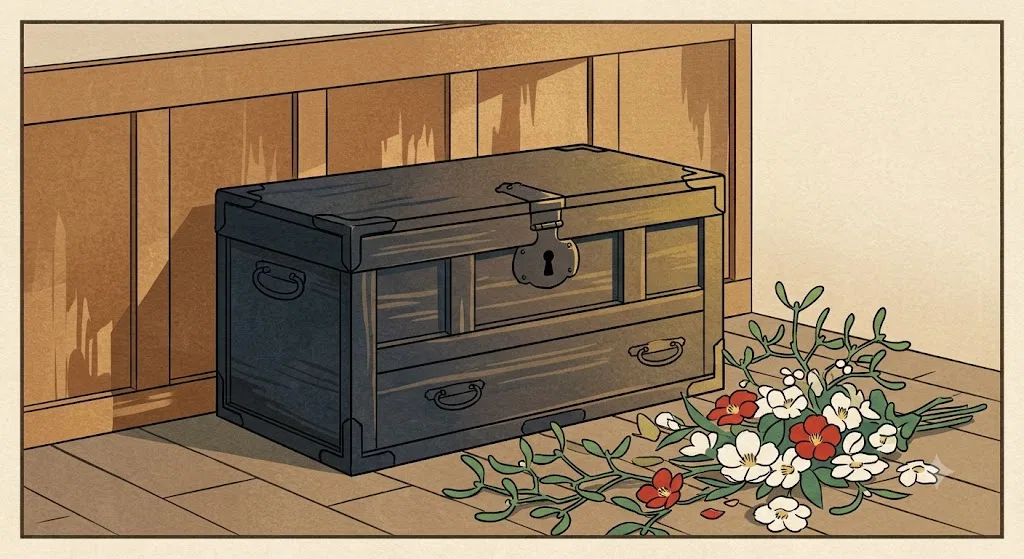
Exton’s story differs from that popular song in an important way. The Rutland version preserved in local historical material says there was Christmas merrymaking at the old family hall, with amateur theatricals. In one scene, a funeral had to be represented, and a young lady was lowered into an oak chest to personate the dead girl. When the scene ended, the lid was raised and she was found dead. This is not quite the vanished bride of the song; it is a theatrical accident later drawn into the orbit of the Mistletoe Bough.[Internet Archive]archive.orgOpen source on archive.org.
That variant gives Exton its distinctive place in Rutland folklore. It is less romantic than the bride-in-the-attic version, and more like a family memory of a festive performance gone fatally wrong. It also carries a moral aftershock: the story says private theatricals were never again performed in the house, because the death was read as a judgement on gaiety and disregard of serious subjects. That moralising ending feels very much like the way a household tragedy could be reshaped into religious and social warning.[Internet Archive]archive.orgOpen source on archive.org.
Why several houses claim the tale
The Mistletoe Bough is not unique to Exton. Older discussions and later summaries connect versions of the story with several English houses, including Bramshill in Hampshire, Marwell Hall near Winchester, Bawdrip in Somerset, Malsanger near Basingstoke and other country-house settings. The point is not that all these places can be equally “the” original scene, but that the legend was unusually easy to localise. A large old house, a locked chest, a family tragedy, and a Christmas gathering were enough to make the tale feel at home.[Internet Archive]archive.orgOpen source on archive.org.
The Rutland Magazine and County Historical Record treated this multiplicity with useful caution. Its reproduced discussion says that “four or more old houses” had such a story allocated to them, that the details varied, and that a “family resemblance” ran through them all. It also notes that debate in Notes and Queries had produced interesting facts but no wholly satisfactory result about where, or whether, the incident truly happened.[Internet Archive]archive.orgOpen source on archive.org.
This makes Exton’s claim stronger in local colour than in documentary proof. On the plus side, the Exton version is not merely a vague “it happened here” claim. It comes with names and transmission: the account says the tradition was handed down from Dorothy Noel, born in 1693, daughter of the Rev. W. Noel of Ridlington, niece to the first Baron Noel, and later Mrs Reynolds. The chronology offered by the account places the alleged event somewhere between her childhood and young adulthood, with 1700 to 1713 suggested by inference.[Internet Archive]archive.orgOpen source on archive.org.
On the cautionary side, this is still a reported family tradition, not a parish burial entry, coroner’s record, household diary or contemporary newspaper report. It reaches readers through antiquarian correspondence and later local historical repetition. That does not make it worthless; many ghost legends survive in exactly this way. But it means the tale should be described as a tradition associated with Exton Hall, not as a verified death at the estate.[Internet Archive]archive.orgOpen source on archive.org.
The biggest internal problem is the claim that private theatricals were never again performed at the house. The same Rutland Magazine discussion points out that, according to a query in an earlier issue, a play was acted at Exton in 1750. The writer explicitly says this weakens the Exton claim in the eyes of several commentators. That small contradiction is valuable because it keeps the page honest: the legend was already being tested, doubted and argued over by local historians, not simply repeated as fact.[Internet Archive]archive.orgOpen source on archive.org.
What Exton’s version adds to Rutland folklore
Exton’s value to Rutland’s haunted map is not that it proves the Mistletoe Bough happened there. Its value is that it shows how a national English legend could be absorbed into a small county’s estate memory. Rutland does not need a huge catalogue of spectacular apparitions for its haunted history to matter. At Exton, one travelling motif brings together the county house, the old aristocratic family, Christmas custom, religious anxiety and the ruins of a vanished hall.[Historic England]historicengland.org.ukHistoric England Exton Park, Exton and HornHistoric England Exton Park, Exton and Horn
The estate history helps explain why the legend found such fertile ground. Historic England traces Exton through medieval ownership, the Haringtons, the sale to Sir Baptist Hicks in 1613, and its later descent through the Noel family and the Earls of Gainsborough. The parish church of St Peter and St Paul, close to the hall, contains notable monuments to the Haringtons and Noels. In a place so visibly marked by family continuity, a story said to have passed down through a Noel relative feels plausible as family folklore even when the event itself remains unproved.[Historic England]historicengland.org.ukHistoric England Exton Park, Exton and HornHistoric England Exton Park, Exton and Horn
Exton’s version also changes the emotional emphasis of the tale. The common bride-in-the-chest story is about absence: the bride vanishes, searchers fail, and the body is discovered only years later. The Exton theatrical version is about immediate horror: everyone knows where the young woman was placed, and the shock comes when the performance ends and make-believe death has become real. That makes the Rutland variant less like a mystery and more like a cautionary legend about play, performance and the dangerous crossing of boundaries.[Internet Archive]archive.orgOpen source on archive.org.
For haunted-history readers, the “ghost” in the Exton story is therefore partly literal and partly cultural. Some modern catalogues place Exton under phantom-bride or haunted-house headings, but the strongest historical material is not a detailed apparition report with named witnesses. It is the persistence of a death legend attached to a house, a chest and a festive season. The haunting lies in repetition: the story keeps returning whenever Exton Hall, Christmas ghost lore or the Mistletoe Bough are discussed.[Paranormal Database]paranormaldatabase.comParanormal Databasephantom brides Location: Exton (RutlandParanormal Databasephantom brides Location: Exton (Rutland
The tale’s wider afterlife reinforces that point. The Mistletoe Bough was not confined to antiquarian notes. It became a popular song, appeared in print culture, and reached early cinema: the British Film Institute identifies Percy Stow’s 1904 The Mistletoe Bough as a nine-minute Clarendon Film Company production and describes it as an early screen version of the Christmas ghost story. That national afterlife helps explain why local claims such as Exton’s remained attractive. A house that could claim the Mistletoe Bride was not just claiming a death; it was claiming a place in a story many people already knew.[BFI]bfi.org.ukfilm 1 mistletoe bough 1904film 1 mistletoe bough 1904
How credible is the Exton claim?
The fairest answer is that Exton has a memorable and relatively well-developed local variant, but not a securely proven historical case. The evidence is stronger than a one-line tourist rumour because it appears in local historical discussion, names a family route of transmission, and gives a plausible early eighteenth-century social setting. Yet it is weaker than a documented incident because it lacks a contemporary record of the death and because the legend belongs to a known family of tales claimed by several houses.[Internet Archive]archive.orgOpen source on archive.org.
A useful way to read the evidence is in three layers:
- The place is real and historically suitable. Exton Old Hall was an early seventeenth-century country house on a major Rutland estate, later ruined by fires, with the kind of architecture and family setting that made such legends believable.[Historic England]historicengland.org.ukHistoric England Exton Park, Exton and HornHistoric England Exton Park, Exton and Horn
- The local variant is specific. The Rutland account gives a Christmas theatrical scene, an oak chest, a young woman found dead, and a claimed Noel-family chain of memory through Dorothy Noel.[Internet Archive]archive.orgOpen source on archive.org.
- The origin remains disputed. Antiquarian writers recognised rival houses, variant details and contradictions, including the awkward point that theatricals apparently continued at Exton after the supposed ban.[Internet Archive]archive.orgOpen source on archive.org.
For a Rutland haunted-history page, that balance is more interesting than pretending certainty. Exton Hall should be presented as Rutland’s Mistletoe Bough site: a place where a famous English legend became localised through estate tradition. It should not be presented as the proven origin of the ballad or as a confirmed ghost story in the modern evidential sense. The most trustworthy version is atmospheric but careful: Exton may not have hidden the Mistletoe Bride of the song, but it did preserve one of the most distinctive English variants of the bride-in-the-chest legend.
Amazon book picks
Further Reading
Books and field guides related to Did Exton Hall Hide the Mistletoe Bride?. Use these as the next step if you want deeper reading beyond the article.
The lore of the land
Discusses major legends including traditions like the Mistletoe Bride.
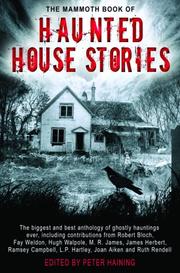
The Mammoth Book of Haunted House Stories
Appeals to readers of classic haunted-house tales.
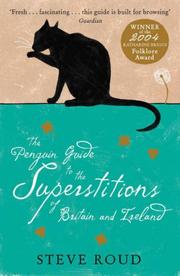
The Penguin Guide to the Superstitions of Britain and Ireland
Provides background on British seasonal and supernatural traditions.
eBay marketplace picks
Marketplace Samples
Live-tested eBay searches with available results related to this page.
Endnotes
1.
Source: archive.org
Link:https://archive.org/stream/rutlandmagazine00socigoog/rutlandmagazine00socigoog_djvu.txt
2.
Source: Wikipedia
Title: Legend of the Mistletoe Bough
Link:https://en.wikipedia.org/wiki/Legend_of_the_Mistletoe_Bough
3.
Source: bfi.org.uk
Title: film 1 mistletoe bough 1904
Link:https://www.bfi.org.uk/resources-events-teachers/resources-teachers/gothic-classroom/film-1-mistletoe-bough-1904
4.
Source: exton.org
Link:https://www.exton.org/uploads/exton-walk.pdf?v=1760533254
5.
Source: exton.org
Link:https://www.exton.org/uploads/a-history-of-exton.docx?v=1519822349
6.
Source: ia800106.us.archive.org
Link:https://ia800106.us.archive.org/27/items/b29001250_0007/b29001250_0007.pdf
7.
Source: Wikipedia
Title: Exton Hall
Link:https://en.wikipedia.org/wiki/Exton_Hall
8.
Source: youtube.com
Title: Christmas Special
Link:https://www.youtube.com/watch?v=t3-By7BH_1I
Source snippet
Mistletoe Bough - Jon Boden...
9.
Source: youtube.com
Title: Mistletoe Bough
Link:https://www.youtube.com/watch?v=PltsSp-JmvM
10.
Source: youtube.com
Title: Mistletoe Bough
Link:https://www.youtube.com/watch?v=sTM7fZNxLiY
11.
Source: rutlandheritageandarts.wordpress.com
Title: Rutland Heritage and Arts Exton | Rutland Heritage and Arts
Link:https://rutlandheritageandarts.wordpress.com/2015/05/13/exton/
12.
Source: historicengland.org.uk
Title: Historic England Exton Park, Exton and Horn
Link:https://historicengland.org.uk/listing/the-list/list-entry/1000960
13.
Source: extonpark.co.uk
Link:https://www.extonpark.co.uk/
14.
Source: historichouses.org
Link:https://www.historichouses.org/house/exton-park/weddings/
15.
Source: victorianweb.org
Link:https://victorianweb.org/mt/parlorsongs/46.html
16.
Source: paranormaldatabase.com
Title: Paranormal Databasephantom brides Location: Exton (Rutland)
Link:https://www.paranormaldatabase.com/reports/bride.php
17.
Source: historicengland.org.uk
Title: Searching Folly
Link:https://historicengland.org.uk/listing/the-list/results/?%3F%3F%3Fcurrent=n_0_n¤t=n_17_n&q=Folly&size=n_24_n
18.
Source: historicengland.org.uk
Title: Old Hall ruins, Exton Park
Link:https://historicengland.org.uk/listing/heritage-at-risk/search-register/list-entry/46283
19.
Source: historicengland.org.uk
Title: har 2016 entries additions removals
Link:https://historicengland.org.uk/content/docs/har/har-2016-entries-additions-removals/
20.
Source: historicengland.org.uk
Title: Combe Abbey, Combe Fields
Link:https://historicengland.org.uk/listing/the-list/list-entry/1000408
21.
Source: historicengland.org.uk
Title: Hall and Chapel, Exton and Horn
Link:https://historicengland.org.uk/listing/the-list/list-entry/1307327
22.
Source: historicengland.org.uk
Title: list entry
Link:https://historicengland.org.uk/listing/the-list/list-entry/1000380
23.
Source: historicengland.org.uk
Link:https://historicengland.org.uk/content/docs/har/har-2023-entries-additions-removals/
24.
Source: historicengland.org.uk
Link:https://historicengland.org.uk/content/heritage-counts/pub/2024/designated-assets-protected-areas-built-environment/
25.
Source: historicengland.org.uk
Link:https://historicengland.org.uk/images-books/publications/slavery-and-british-country-house/slavery-british-country-house-web/
26.
Source: munairmak.wordpress.com
Title: legend of the mistletoe bough
Link:https://munairmak.wordpress.com/2015/04/08/legend-of-the-mistletoe-bough/
27.
Source: mistletoematters.wordpress.com
Title: urban mythletoe the story of the mistletoe bride
Link:https://mistletoematters.wordpress.com/2012/12/04/urban-mythletoe-the-story-of-the-mistletoe-bride/
28.
Source: handedon.wordpress.com
Title: exton park rutland
Link:https://handedon.wordpress.com/2013/10/17/exton-park-rutland/
29.
Source: afolksongaweek.wordpress.com
Title: week 123 the mistletoe bough
Link:https://afolksongaweek.wordpress.com/2013/12/28/week-123-the-mistletoe-bough/
30.
Source: historicoccult.wordpress.com
Title: the mistletoe bough 1904
Link:https://historicoccult.wordpress.com/2015/12/16/the-mistletoe-bough-1904/
31.
Source: bookmunch.wordpress.com
Link:https://bookmunch.wordpress.com/2013/11/11/a-gentle-atmospheric-collection-of-stories-the-mistletoe-bride-other-haunting-tales-by-kate-mosse/
32.
Source: accumulationofthings.com
Title: percy stow
Link:https://accumulationofthings.com/100/tag/percy-stow/
33.
Source: victorianweb.org
Title: George Cruikshank
Link:https://victorianweb.org/art/illustration/cruikshank/r12.html
34.
Source: youtube.com
Title: The Mistletoe Bough
Link:https://www.youtube.com/watch?v=XLa5t44f9Mg
35.
Source: sianellisillustration.co.uk
Title: the mistletoe bough
Link:https://sianellisillustration.co.uk/tag/the-mistletoe-bough/
36.
Source: artic.edu
Link:https://www.artic.edu/artworks/107863/ginevra
37.
Source: letterboxd.com
Title: the mistletoe bough
Link:https://letterboxd.com/film/the-mistletoe-bough/
38.
Source: moonmausoleum.com
Title: The Mistletoe Bough
Link:https://moonmausoleum.com/the-mistletoe-bough/
39.
Source: storytellingresearchlois.com
Title: Thomas Haynes Bayly
Link:https://www.storytellingresearchlois.com/2015/12/thomas-haynes-bayly-mistletoe-bough.html
40.
Source: romeartlover.it
Link:https://www.romeartlover.it/Rogers.html
Additional References
41.
Source: upload.wikimedia.org
Link:https://upload.wikimedia.org/wikipedia/commons/1/1d/Carols%3B_their_origin%2C_music%2C_and_connection_with_mystery-plays_%28IA_carolsoriginmusi00phil%29.pdf
42.
Source: upload.wikimedia.org
Link:https://upload.wikimedia.org/wikipedia/commons/e/e1/Stories_of_famous_songs_%28IA_cu31924022375277%29.pdf
43.
Source: instagram.com
Link:https://www.instagram.com/p/DQGjWHHk1o0/
44.
Source: eng-poetry.ru
Link:https://eng-poetry.ru/english/Poem.php?PoemId=23737
45.
Source: gazetteer.org.uk
Link:https://gazetteer.org.uk/place/Exton_Hall%2C_Rutland_319162
46.
Source: britishlistedbuildings.co.uk
Link:https://britishlistedbuildings.co.uk/england/exton-and-horn-rutland
47.
Source: facebook.com
Link:https://www.facebook.com/groups/300541346364753/posts/928107000274848/
48.
Source: electricscotland.com
Link:https://electricscotland.com/history/antiquary/antiquary03.pdf
49.
Source: owsleburyhants.blogspot.com
Link:https://owsleburyhants.blogspot.com/2016/01/the-legend-of-mistltoe-bough.html
50.
Source: imslp.org
Link:https://imslp.org/wiki/The_Mistletoe_Bough_%28Bishop%2C_Henry_Rowley%29
Topic Tree