Within Haunted Sutherland
Why Do Sutherland's Coasts Breed Ghost Stories?
Sandwood Bay's sailor ghosts and mermaid stories belong to a wider north-west coast of shipwreck, remoteness and dangerous weather.
On this page
- Sandwood Bay's ghosts and mermaids
- Shipwreck, weather and coastal fear
- Cape Wrath, Durness and the edge of Britain
Page outline Jump by section
Introduction
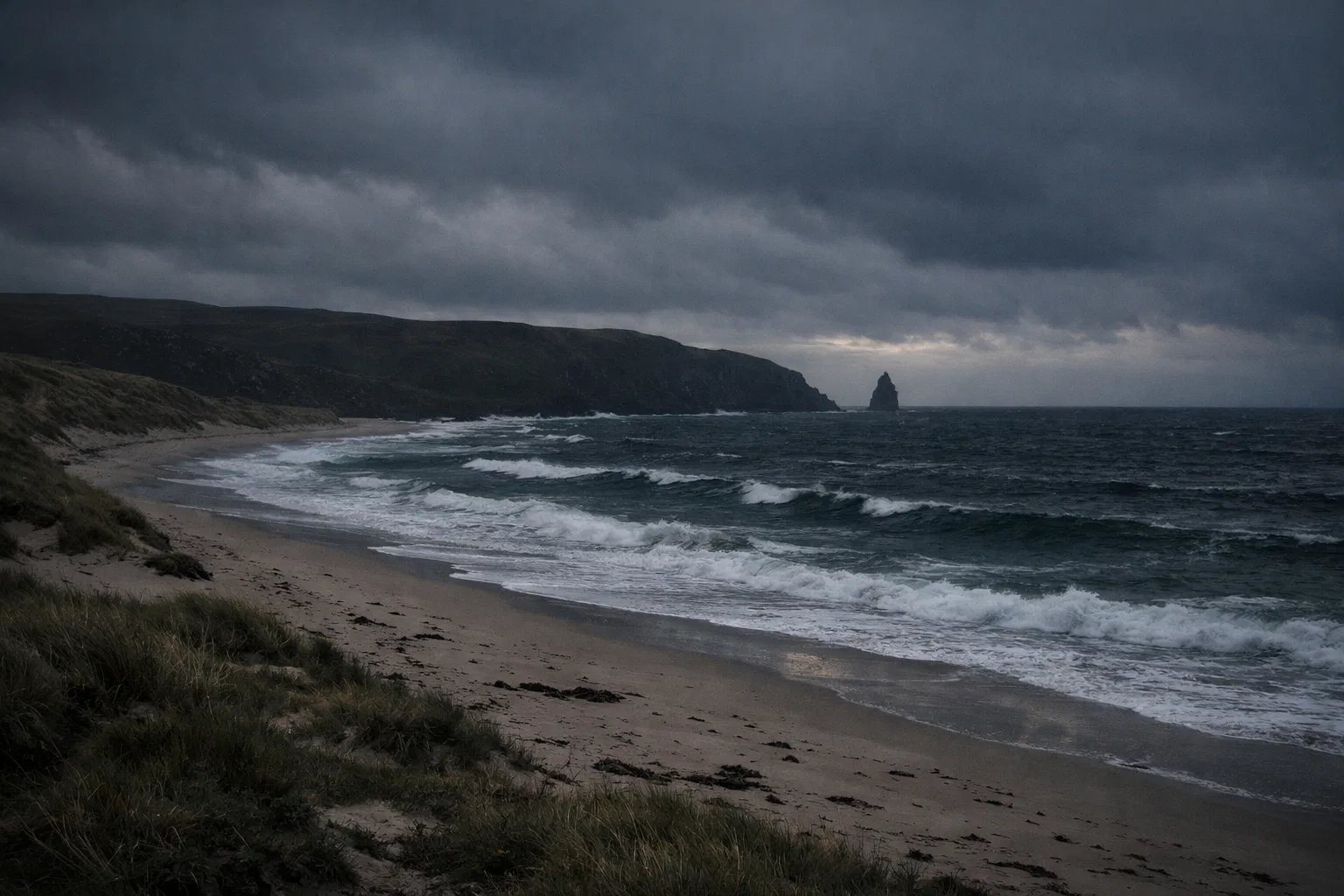
Sandwood Bay’s haunted reputation comes from a very Sutherland kind of loneliness: a mile of pale sand, a freshwater loch behind the dunes, Atlantic weather in front, and Cape Wrath only a few miles to the north. The best-known stories are the ghostly sailor said to knock at the old cottage on stormy nights, the mermaid reportedly seen by Alexander Gunn in 1900, and the older memory of shipwrecks buried under the sand. None of these should be treated as proven supernatural events. They are local legends, traveller accounts and repeated folklore shaped by a coast where wreck, fog, distance and silence are part of the real landscape. Sandwood matters because it shows how Sutherland’s coastal ghost stories work: the sea supplies danger, remoteness supplies imagination, and abandoned buildings give the story somewhere to wait.[John Muir Trust]johnmuirtrust.org1639 stories from sandwood1639 stories from sandwood
Sandwood Bay’s Ghosts and Mermaids
Sandwood Bay lies on the far north-west coast of historic Sutherland, near Kinlochbervie and south of Cape Wrath. It is not a roadside attraction. The common walking route starts near Blairmore and crosses about four miles of moorland before the beach appears, backed by dunes and Sandwood Loch and watched by the sea stack Am Buachaille. That physical delay is part of the legend’s force. Visitors arrive after leaving cars, settlements and easy shelter behind; by the time they reach the shore, the place already feels separated from ordinary time.[John Muir Trust]johnmuirtrust.orgOpen source on johnmuirtrust.org.
The most repeated haunting is attached to the old cottage near the bay. John Muir Trust, which manages Sandwood Estate, summarises the tradition as a sailor ghost who appears on stormy nights, rapping at the door and looking through the windows. In one version from the 1940s, two crofters followed the figure and heard him shout that everything on the beach was his and that they should leave. The story is dramatic, but its evidential status is folkloric: it comes to us as a repeated local tale rather than as a named, dated investigation with signed witness statements.[John Muir Trust]johnmuirtrust.org1639 stories from sandwood1639 stories from sandwood
The sailor’s power lies in how neatly he fits the setting. A knocking figure outside a remote cottage is frightening because the question is practical before it is supernatural: who would be outside in such weather, so far from help? The ghost is usually explained as a shipwrecked mariner, which connects the apparition to the bay’s remembered role as a place of wrecks. Whether or not anyone saw such a figure, the story gives a human face to the otherwise anonymous dead imagined beneath the sands.[walkhighlands]walkhighlands.co.ukOpen source on walkhighlands.co.uk.
Sandwood’s other famous legend is the mermaid. The usual account says that on 5 January 1900, local crofter or farmer Alexander Gunn was on the shore with his collie when the dog reacted in terror. Gunn then saw a strange figure on a rock ledge above the tide: not simply a seal, according to the story, but a mermaid-like being with reddish-yellow hair, greenish-blue eyes and a body about seven feet long. Later retellings say Gunn maintained the account until his death in 1944, with MacDonald Robertson preserving or repeating the story from a 1939 meeting.[Wikipedia]WikipediaSandwood BaySandwood Bay
As folklore, the mermaid belongs to a wider British and northern coastal tradition in which sea-women can be beautiful, dangerous, prophetic or linked with storms and drowning. At Sandwood, however, the tale is unusually specific: a named witness, a winter date, a dog’s reaction, and a particular ledge by the shore. Those details make it memorable, but they do not turn it into proof. A sceptical reading would note the likelihood of seal misidentification, distance, glare, sea conditions and later embellishment. A folkloric reading would ask why the story endured: because the figure appears exactly where land-based certainty gives way to the unknowable sea.[Wikipedia]WikipediaOpen source on wikipedia.org.
Shipwreck, Weather and Coastal Fear
Sandwood Bay’s ghost stories are hard to separate from shipwreck memory. Walkhighlands describes the bay as exposed to Atlantic breakers and notes that it was the scene of many shipwrecks, with remains now buried under the sand; it also links the improvement in safety to the building of Cape Wrath lighthouse in 1828. The John Muir Trust uses similar language, calling attention to the pre-lighthouse wreck tradition and the beach’s nickname as a “Ship Graveyard”.[walkhighlands]walkhighlands.co.ukOpen source on walkhighlands.co.uk.
The lighthouse is crucial because it marks the point where a supernatural landscape also becomes an engineered one. Cape Wrath Lighthouse was built by Robert Stevenson in 1828, according to the Northern Lighthouse Board, and stands on one of the most exposed north-western headlands of mainland Britain. Once the light existed, the coast was still dangerous, but it was no longer quite so blind. In ghost-story terms, that matters: the legends look backwards to a darker coast before systematic warning, when wrecks could be imagined as almost inevitable.[Northern Lighthouse Board]nlb.org.ukcape wrathcape wrath
A key historical source often cited in Sandwood writing is Seton Gordon’s 1935 book Highways and Byways in the West Highlands. Modern summaries and travel-history pages repeat Gordon’s observation that he was struck by the number of wrecks lying in the sand and that some appeared almost buried beyond the highest tide. Undiscovered Scotland also notes an important caution: its own writers had not found traces of the wrecks Gordon described. That tension is useful. It shows how Sandwood’s shipwreck reputation sits between observation, memory, erosion, burial and retelling.[Google Books]books.google.comOpen source on google.com.
This is why the sailor ghost feels more like a mechanism than an isolated anecdote. The story turns several real coastal fears into one figure:
- Storm exposure: the bay faces the Atlantic, and bad weather can make a safe-looking beach feel suddenly hostile.
- Delayed help: the four-mile walk in means that shelter, rescue and witnesses are not close at hand.
- Buried evidence: wrecks said to be under the sand create the sense of a hidden history beneath the visitor’s feet.
- Abandoned shelter: the old cottage or ruined buildings give the imagination a stage: windows, doors, footsteps, knocking, and the fear of someone outside.
The result is not a “haunted beach” in the theatrical sense of a place with scheduled sightings. It is a place where geography does much of the storytelling. Sandwood’s emptiness, rather than undermining the legend, is what allows it to breathe.
Cape Wrath, Durness and the Edge of Britain
Sandwood’s legends belong to the far north-west corner of Sutherland, where Cape Wrath, Durness, Kinlochbervie and the scattered coastal routes form a landscape of edges. Cape Wrath is often described as the north-westernmost point of mainland Britain, and access remains awkward: on foot from the south, or by a combination of ferry and rough road from the Durness side when conditions and access allow. The wider area has also been shaped by crofting, depopulation, military use and difficult travel, all of which reinforce its reputation as a threshold rather than a settled tourist coast.[Wikipedia]WikipediaCape WrathCape Wrath
Sandwood Estate itself covers 4,703 hectares of wild and crofted land, according to the John Muir Trust. The Trust’s description stresses awe, scale, wildlife and the way the beach dwarfs visitors. That is important for a haunted-history page because the supernatural here is not attached to a busy inn or a castle corridor. It is attached to scale: a human being feels small against the dune system, the loch, the cliffs, the stack and the open sea.[John Muir Trust]johnmuirtrust.orgOpen source on johnmuirtrust.org.
The abandoned and semi-abandoned human traces around Sandwood deepen that feeling. Sandwood’s stories often mention old cottages, shepherding landscapes and the sense that earlier lives have retreated from the bay. The wider Sandwood area also contains bothies and remains of past settlement, including Strathchailleach, associated in modern walking culture with the hermit James MacRory-Smith, known as Sandy, who lived there for decades in the later twentieth century. These details do not prove ghost stories, but they do explain why visitors read the landscape as inhabited by memory even when it appears empty.[Wikipedia]WikipediaSandwood BaySandwood Bay
Durness and Cape Wrath also help place Sandwood within Sutherland’s wider haunted map. This is not the castle-haunting Sutherland of Dunrobin, Ardvreck or Carbisdale, where stories cling to rooms, towers and family histories. It is coastal Sutherland: more exposed, less theatrical, and more dependent on weather, distance and maritime risk. The ghosts here are not aristocratic women in locked chambers. They are sailors, mermaids, wreck victims and unexplained figures seen at the edge of visibility.

Why the Legends Became Locally Famous
Sandwood Bay became famous partly because the stories are simple, vivid and easy to retell. A sailor knocking in a storm is instantly understandable. A mermaid seen by a named local man on a winter day has the shape of an old witness account. Buried wrecks give both tales a dark historical floor. Unlike some haunted places, Sandwood does not need a complex backstory; the setting itself supplies the mood.[johnmuirtrust.org]johnmuirtrust.org1639 stories from sandwood1639 stories from sandwood
Modern access has also helped the legends travel. Walking websites, conservation bodies, travel features and folklore blogs all present Sandwood as remote but reachable. That combination is perfect for ghostlore: the place is difficult enough to feel like an achievement, but accessible enough for visitors to carry the stories home. Walkhighlands frames the route as the easiest and most popular way in, while still warning that it is longer and harder than many expect. The result is a beach that feels lonely even when it is well known.[walkhighlands]walkhighlands.co.ukOpen source on walkhighlands.co.uk.
There is also a strong contrast between beauty and threat. Sandwood is repeatedly described as one of Scotland’s most beautiful remote beaches, yet the same accounts mention wrecks, hard weather and supernatural stories. That contrast makes the folklore stick. A bleak ruin can look haunted without explanation, but a magnificent beach needs a darker undertow if it is to become part of haunted history. Sandwood’s legends provide that undertow without overwhelming the real appeal of the place.[John Muir Trust]johnmuirtrust.orgOpen source on johnmuirtrust.org.
The stories also survive because they are flexible. A visitor interested in folklore can focus on the mermaid; a walker can notice the lonely cottage; a maritime-history reader can follow the shipwreck thread; a sceptic can see how seals, weather, isolation and expectation might shape perception. Sandwood’s ghostlore does not depend on everyone believing the same thing. It depends on the place making several explanations feel possible at once.
How Credible Are the Sandwood Stories?
The most careful answer is that Sandwood Bay has strong folklore but limited hard evidence for supernatural events. The geography, estate history, lighthouse history and walking access are well supported by official or practical sources. The shipwreck reputation is widely repeated and partly anchored by Seton Gordon’s twentieth-century description, though visible remains are now uncertain or absent to modern visitors. The sailor ghost and mermaid stories are best treated as local legends preserved through retelling rather than as verified apparitions.[johnmuirtrust.org]johnmuirtrust.orgOpen source on johnmuirtrust.org.
That does not make the stories worthless. For haunted history, credibility is not only a question of whether a ghost can be proven. It is also a question of what the legend preserves. At Sandwood, the stories preserve fear of wreck, respect for weather, unease around abandoned shelter, and the old coastal habit of imagining the sea as alive with beings who may not mean humans well. The mermaid and the sailor are different kinds of figure, but both express the same boundary: land is temporary, the sea is older, and the shore is where the two argue.
Sceptical explanations should be taken seriously. Seals can look uncannily human at a distance. Wind can make knocks, cries and footstep-like sounds around ruined buildings. Isolation can sharpen expectation, especially when a visitor already knows the place is reputedly haunted. Oral tradition can also tidy a vague incident into a better story over time. In Sandwood’s case, the sensible position is not to debunk the legends out of existence, but to recognise that natural conditions help explain why this particular coast produces such persuasive supernatural narratives.[Wikipedia]WikipediaOpen source on wikipedia.org.
What Sandwood Adds to Sutherland’s Haunted Coast
Sandwood Bay gives Sutherland’s haunted geography something its castles cannot: a haunting without walls. Ardvreck and Dunrobin turn history into apparitions through ruins, rooms and family tradition. Sandwood turns exposure itself into folklore. The “haunted place” is not just the cottage, the rocks or the beach, but the whole approach: the walk from Blairmore, the sudden opening of the bay, the loch behind the dunes, the sea stack offshore, and Cape Wrath beyond.
That is why Sandwood sits naturally beside Sutherland’s other lonely coastal legends rather than simply repeating them. It shows how a county’s ghost stories can grow from terrain as much as from buildings. The far north-west coast has all the ingredients: dangerous water, sparse settlement, weather that changes the mood of a place in minutes, and a history in which people travelled, worked, wrecked and disappeared at the margins of recorded detail.
For readers tracing haunted Sutherland, Sandwood Bay is best understood as a coastal legend cluster. Its sailor ghost gives shipwreck memory a voice. Its mermaid gives the sea a face. Its buried wrecks and remote path give both stories a physical setting. Whether approached as folklore, local atmosphere, maritime memory or a sceptical case study in how lonely places generate strange reports, Sandwood remains one of Sutherland’s most evocative haunted landscapes.
Amazon book picks
Further Reading
Books and field guides related to Why Do Sutherland's Coasts Breed Ghost Stories?. Use these as the next step if you want deeper reading beyond the article.
Scottish Ghost Stories
Complements stories of haunted coasts and supernatural encounters.

eBay marketplace picks
Marketplace Samples
Live-tested eBay searches with available results related to this page.

Endnotes
1.
Source: Wikipedia
Title: Sandwood Bay
Link:https://en.wikipedia.org/wiki/Sandwood_Bay
2.
Source: Wikipedia
Link:https://en.wikipedia.org/wiki/Mermaid
3.
Source: books.google.com
Link:https://books.google.com/books/about/Highways_and_Byways_in_the_West_Highland.html?id=sFIGAQAAIAAJ
4.
Source: Wikipedia
Title: Cape Wrath
Link:https://en.wikipedia.org/wiki/Cape_Wrath
5.
Source: Wikipedia
Title: Cape Wrath Lighthouse
Link:https://en.wikipedia.org/wiki/Cape_Wrath_Lighthouse
6.
Source: Wikipedia
Title: Sandwood Bay
Link:https://de.wikipedia.org/wiki/Sandwood_Bay
7.
Source: johnmuirtrust.org
Title: 1639 stories from sandwood
Link:https://www.johnmuirtrust.org/whats-new/news/1639-stories-from-sandwood
8.
Source: johnmuirtrust.org
Link:https://www.johnmuirtrust.org/about-us/where-we-work/sandwood
9.
Source: walkhighlands.co.uk
Link:https://www.walkhighlands.co.uk/sutherland/sandwood-bay.shtml
10.
Source: nlb.org.uk
Title: cape wrath
Link:https://www.nlb.org.uk/lighthouses/cape-wrath/
11.
Source: walkhighlands.co.uk
Link:https://www.walkhighlands.co.uk/sutherland/sandwood-bay-cape-wrath.shtml
12.
Source: walkhighlands.co.uk
Title: Walk Report
Link:https://www.walkhighlands.co.uk/Forum/viewtopic.php?f=9&t=90624
13.
Source: walkhighlands.co.uk
Link:https://www.walkhighlands.co.uk/cape-wrath-trail.shtml
14.
Source: walkhighlands.co.uk
Link:https://www.walkhighlands.co.uk/Forum/viewtopic.php?f=9&t=94540
15.
Source: walkhighlands.co.uk
Title: Walk Report
Link:https://www.walkhighlands.co.uk/Forum/viewtopic.php?f=9&t=20821
16.
Source: walkhighlands.co.uk
Title: Sandwood Bay to Cape Wrath
Link:https://www.walkhighlands.co.uk/maps/map9_40bd.shtml
17.
Source: facebook.com
Link:https://www.facebook.com/JohnMuirTrust/posts/am-buachaille-meaning-the-shepherd-is-a-breathtaking-sea-stack-guarding-sandwood/1452048633622982/
18.
Source: facebook.com
Link:https://www.facebook.com/northernlighthouseboard/photos/m-a-r-c-h-l-i-g-h-t-h-o-u-s-e-cape-wrath-lighthouse-is-situated-at-the-most-nort/595437125941313/
19.
Source: trove.scot
Link:https://www.trove.scot/place/4722
20.
Source: youtube.com
Title: Sandwood Bay
Link:https://www.youtube.com/watch?v=TWXZxgU0FDA
21.
Source: johnmuirtrust.org
Title: 2033 sandwood bay under threat
Link:https://www.johnmuirtrust.org/whats-new/news/2033-sandwood-bay-under-threat
22.
Source: britainexpress.com
Title: cape wrath
Link:https://www.britainexpress.com/scotland/Highlands/countryside/cape-wrath.htm
23.
Source: wikishire.co.uk
Title: Cape Wrath Lighthouse
Link:https://wikishire.co.uk/wiki/Cape_Wrath_Lighthouse
24.
Source: wikishire.co.uk
Title: Sandwood Bay
Link:https://wikishire.co.uk/wiki/Sandwood_Bay
25.
Source: kids.kiddle.co
Title: Sandwood Bay
Link:https://kids.kiddle.co/Sandwood_Bay
26.
Source: tripadvisor.com
Title: Sandwood Bay
Link:https://www.tripadvisor.com/Attraction_Review-g551902-d568371-Reviews-or40-Sandwood_Bay-Kinlochbervie_Caithness_and_Sutherland_Scottish_Highlands_Scotla.html
Additional References
27.
Source: theguardian.com
Title: The Guardian To the lighthouse
Link:https://www.theguardian.com/travel/2020/jun/17/cape-wrath-cycling-challenge-scotland-uk-toughest-bike-ride
Source snippet
Since its inception, cyclists who reach the lighthouse and provide proof—originally the lighthouse keeper’s signature, now a selfie—are g...
28.
Source: youtube.com
Title: Sandwood Bay Scotland’s Most Haunted Beach
Link:https://www.youtube.com/watch?v=C7DPbSJLPJo
Source snippet
Haunted Scotland: Ghosts of the Highlands, Brodie Castle, Skye, Sandwood Bay & Paranormal Legends...
29.
Source: britainexpress.com
Link:https://www.britainexpress.com/scotland/Highlands/Sutherland/Sandwood-Bay.htm
30.
Source: wikidata.org
Link:https://www.wikidata.org/wiki/Q15207438
31.
Source: lighthousedigest.com
Link:https://www.lighthousedigest.com/Digest/database/uniquelighthouse.cfm?value=1381
32.
Source: lighthouseaccommodation.co.uk
Link:https://lighthouseaccommodation.co.uk/listings/cape-wrath-lighthouse/
33.
Source: jncc.gov.uk
Link:https://jncc.gov.uk/jncc-assets/GCR/gcr-site-account-229.pdf
34.
Source: facebook.com
Link:https://www.facebook.com/groups/scotlandfromtheroadside/posts/10160660076212280/
35.
Source: facebook.com
Link:https://www.facebook.com/groups/704609660332475/posts/1792756611517769/
36.
Source: amazon.co.uk
Link:https://www.amazon.co.uk/Highways-Byways-Highlands-Seton-Gordon/dp/1874744327?tag=searcht-20
Topic Tree