Why Does Kinross shire Feel So Haunted?
Kinross-shire’s haunted reputation is quieter than that of Edinburgh, Glamis or the Highlands, but it has a concentrated eerie geography: a royal prison on an island, a ruined laird’s castle with a “Grey Lady” tradition, a village remembered for witch trials, a sacred healing well, and a loch whose stories gather around imprisonment, illness, pilgrimage...
Page outline Jump by section
Introduction
The evidence is uneven. Some Kinross-shire stories are well anchored in official heritage records, early antiquarian publications or modern historical writing; others survive mainly as local legend or paranormal retelling. That makes the county more interesting, not less: its ghost stories show how ordinary places become haunted when later generations attach emotion, injustice and atmosphere to ruins, water, court records and remembered names.
Where historic Kinross-shire sits on the haunted map
Historic Kinross-shire is a very small inland Scottish county lying between Perthshire and Fife, with Loch Leven at its heart. The Association of British Counties describes it as the second-smallest county after Clackmannanshire, consisting of a low plain surrounded by hills, while the Gazetteer of British Place Names notes its position between Perthshire and Fife and identifies Loch Leven as the largest loch in the Scottish lowlands.[Association of British Counties]abcounties.comAssociation of British Counties Kinross-shire | Association of British CountiesAssociation of British Counties Kinross-shire | Association of British Counties
For a haunted-history page, the historic county boundary matters because stories do not always follow modern council lines. Today many sources place these sites in Perth and Kinross, but the older county focus is narrower: Kinross, Milnathort, Loch Leven, Scotlandwell, Crook of Devon, Burleigh Castle and the surrounding villages. Wikishire also notes that Kinross-shire includes a small detached part and is dominated by Loch Leven, whose islands contain both Lochleven Castle and St Serf’s religious landscape.[Wikishire]wikishire.co.ukWikishire Kinross-shireWikishire Kinross-shire
This geography shapes the county’s supernatural texture. Kinross-shire does not read like a catalogue of haunted pubs and theatrical apparitions. Its strongest atmosphere comes from water, islands, boundary roads, ruins, church ground, witchcraft accusations and memories of people trapped by power: a queen in a castle, accused villagers in a courtroom, pilgrims seeking cures, and later visitors projecting unease onto half-ruined places.
Lochleven Castle: the queen, the island and the ghost story
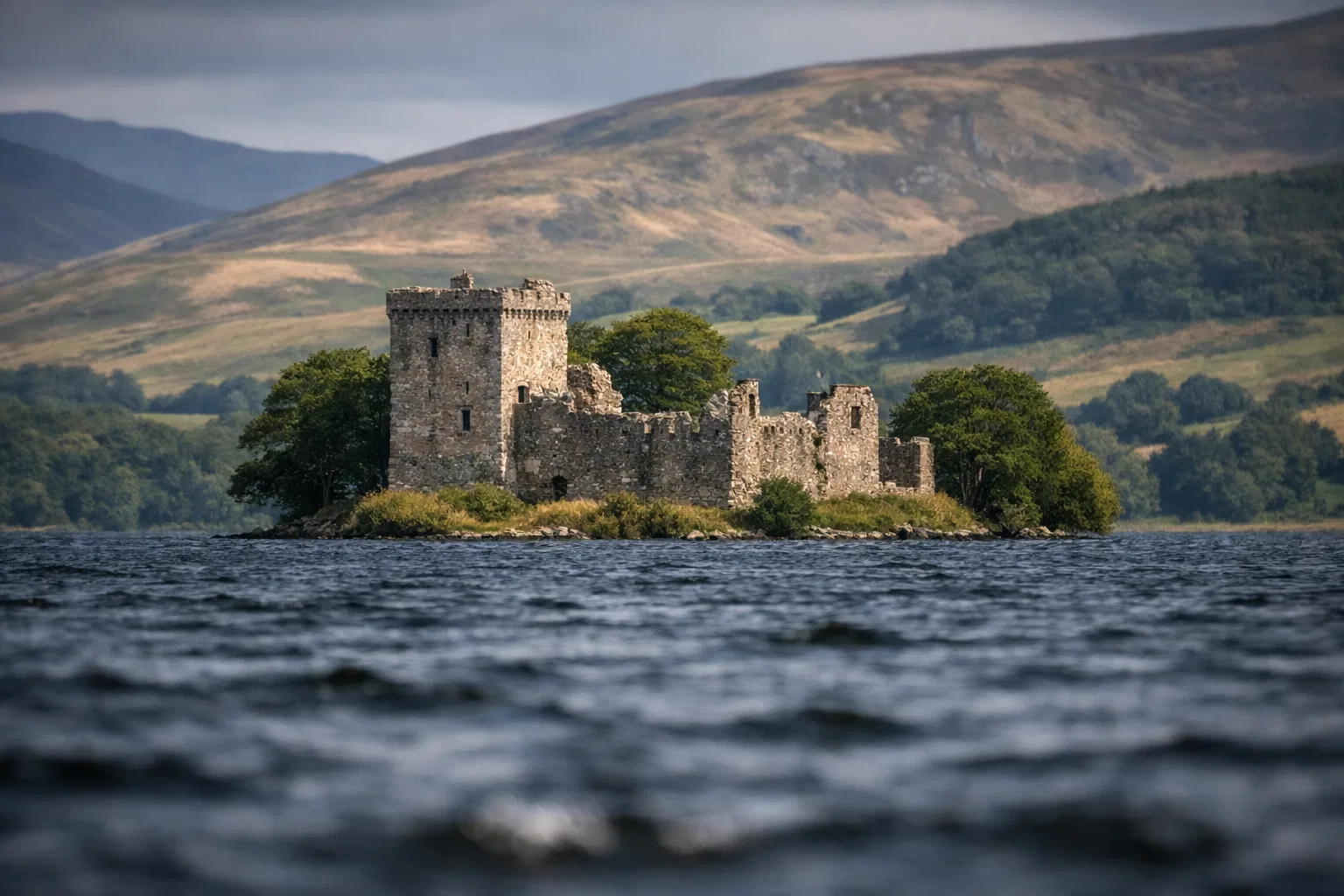
Lochleven Castle is the most important haunted place in Kinross-shire because its historical story is unusually strong. Historic Environment Scotland says Mary, Queen of Scots first visited Lochleven in 1561 as a guest of Sir William Douglas, but returned in 1567–68 as his prisoner. While held there, she suffered a miscarriage of twins, was compelled to abdicate in favour of her infant son James VI, and escaped across the loch in May 1568; by later that month she was in England and never saw Scotland again.[Historic Environment Scotland]historicenvironment.scotOpen source on historicenvironment.scot.
That history gives the castle a natural ghost-story charge. The Castles of Scotland, a specialist castle gazetteer, records the tradition that Mary’s ghost is said to haunt Lochleven Castle, linking the haunting directly to her imprisonment, abdication, miscarriage and escape. This is not the same as a documented apparition file with named witnesses and dated sightings; it is better understood as a castle legend built around a famous royal trauma.[The Castles of Scotland]thecastlesofscotland.co.ukOpen source on thecastlesofscotland.co.uk.
The setting helps explain why the story endures. The castle stands on Castle Island in Loch Leven, and Historic Environment Scotland notes that the island was much smaller before the loch was partially drained in 1836. In Mary’s day, the prison was a compact walled enclosure surrounded by water, not a convenient ruin beside a road. The floor above the hall served as Mary’s prison, a window was adapted into a private oratory, and the top floor is associated with her disguise before flight.[Historic Environment Scotland]historicenvironment.scotOpen source on historicenvironment.scot.
The sceptical reading is straightforward: Mary’s haunting is famous because Mary is famous. Castles associated with imprisoned queens, violent politics and dramatic escapes are almost expected to acquire a spectral afterlife. Yet Lochleven’s claim is not empty tourism invention. The historical core is securely documented, and the island setting gives visitors a clear imaginative route from fact to folklore: confinement, water, darkness, escape and permanent exile.

Burleigh Castle: “Grey Maggie” and the Balfour shadow
Burleigh Castle, near Milnathort, is Kinross-shire’s clearest conventional haunted-castle case. Historic Environment Scotland describes it as a Jacobean tower house with medieval roots, associated with the Balfours of Burleigh, royal visits and Jacobite rebellion. The surviving buildings include a square tower of around 1500 and a striking corner tower added in 1582 by Sir James Balfour of Pittendreich and Margaret Balfour.[Historic Environment Scotland]historicenvironment.scotOpen source on historicenvironment.scot.
The ghost tradition is much thinner than the official architectural history, but it is specific. Spooky Isles reports that Burleigh Castle is said to be haunted by a Grey Lady seen walking through the grounds of the former courtyard. The figure is locally called “Grey Maggie” and is linked, in the story, to Margaret Balfour, whose initials appear with Sir James Balfour’s and the date 1582 on the circular tower.[Spooky Isles]spookyisles.comSpooky Isles Haunted Burleigh Castle, Perth And Kinross | Spooky IslesSpooky Isles Haunted Burleigh Castle, Perth And Kinross | Spooky Isles
A useful way to read Burleigh is as a place where several kinds of “dark history” overlap. Historic Environment Scotland records a local tradition that the “Lord of Burleigh” killed a rival in jealous rage, closely reflecting the real case of Robert Balfour, who was tried for murder in 1707 after shooting a schoolteacher who had married the woman he loved. He escaped imprisonment, but later Jacobite activity contributed to the family’s loss of lands after the failed 1715 rising.[Historic Environment Scotland]historicenvironment.scotOpen source on historicenvironment.scot.
The ghost called Grey Maggie is not strongly evidenced as a historical witness tradition in the sources available online. It is a local haunting claim preserved in paranormal writing, while the better-supported material concerns the castle’s owners, architecture, royal connections and violent family history. That does not make the legend worthless. It shows how a name carved in stone can become a hook for apparition folklore: the visitor sees initials, a ruin, a lost family and an empty courtyard, and the ghost story supplies a face.
Crook of Devon: witch trials, memory and the making of a haunted village
Crook of Devon is not primarily a ghost-sighting site; it is a place where documented witchcraft persecution has become part of Kinross-shire’s eerie public memory. The most important early printed source is Robert Burns Begg’s “Notice of Trials for Witchcraft at Crook of Devon, Kinross-shire, in 1662”, published in the Proceedings of the Society of Antiquaries of Scotland in 1888, based on a manuscript copy of assize court minutes.[Society of Antiquaries of Scotland]journals.socantscot.orgNotice of Trials for Witchcraft at Crook of Devon, Kinross-shire, in 1662 | Proceedings of the Society of Antiquaries of Scotland…
Modern historical discussion by Dr Allan Kennedy, published through the University of Dundee’s Centre for Scottish Culture, places the Crook of Devon trials in the wider Scottish witch-hunt of 1661–62. He notes that roughly 4,000 people in Scotland were accused of witchcraft between 1563 and 1736, with perhaps 2,500 executed, and that Kinross-shire was drawn into the largest panic of all in 1662.[Dundee Scottish Culture]dundeescottishculture.orgDundee Scottish Culture The Crook of Devon Witches – Centre for Scottish CultureDundee Scottish Culture The Crook of Devon Witches – Centre for Scottish Culture
The Crook of Devon case is stark. Thirteen people were accused across four court sittings between April and October 1662. Kennedy names the accused and explains that almost all were convicted; the sentence was that they be strangled by the hangman and then burned to ashes at a place called the Lamlaires, west of Cruick Mill. Two escaped execution: Margaret Hoggin died before the case was decided, and Agnes Pittendreich’s proceedings were postponed because she was pregnant.[Dundee Scottish Culture]dundeescottishculture.orgDundee Scottish Culture The Crook of Devon Witches – Centre for Scottish CultureDundee Scottish Culture The Crook of Devon Witches – Centre for Scottish Culture
The haunting here is moral rather than apparitional. The stories of Satanic meetings, harmful charms, “witch’s marks” and night gatherings came from confessions that Kennedy argues are best explained by coercive interrogation, especially sleep deprivation, rather than by actual occult activity. In other words, the “supernatural” record is itself evidence of fear, legal violence and social breakdown.[Dundee Scottish Culture]dundeescottishculture.orgDundee Scottish Culture The Crook of Devon Witches – Centre for Scottish CultureDundee Scottish Culture The Crook of Devon Witches – Centre for Scottish Culture
That distinction matters for readers of haunted history. Crook of Devon should not be romanticised as a spooky coven site. Its power lies in how a village landscape remembers injustice. The modern Witches’ Maze at Tullibole Castle, unveiled in 2012 as a memorial to those indicted or executed, turns the old witch-trial story into a place of reflection rather than spectacle.[Dundee Scottish Culture]dundeescottishculture.orgDundee Scottish Culture The Crook of Devon Witches – Centre for Scottish CultureDundee Scottish Culture The Crook of Devon Witches – Centre for Scottish Culture
Scotlandwell and St Serf’s Inch: holy water, islands and older folklore
Not every eerie Kinross-shire tradition is a ghost story. Scotlandwell, on the eastern side of Loch Leven, belongs to the older world of sacred springs, healing water and pilgrimage. The Gazetteer of British Place Names describes Scotlandwell’s springs as famous, with an ornamental well and wash house, and says Red Friars maintained a hospital there between 1250 and 1587; thousands of pilgrims are said to have come to take the waters, with Robert the Bruce the most famous alleged visitor.[Gazetteer]gazetteer.org.ukGazetteer Kinross-shire, historiccounty | Gazetteer of British Place NamesGazetteer Kinross-shire, historiccounty | Gazetteer of British Place Names
The British Pilgrimage Trust likewise identifies Scotlandwell as a holy well and says the Trinitarian or Red Friars built a hospice there in 1238 to care for the sick and dying. It also gives a more cautious version of the Bruce tradition, saying he visited in an unsuccessful attempt to cure leprosy. That caution is important because modern research has challenged the long-standing claim that Bruce had leprosy at all.[British Pilgrimage Trust]britishpilgrimage.orgOpen source on britishpilgrimage.org.
Nearby St Serf’s Inch adds another layer: monastic seclusion. Trove, Historic Environment Scotland’s heritage portal, records St Serf’s Priory Church on Loch Leven as a medieval priory, also known as a Culdee monastery. Archaeological writing on St Serf’s Island describes a monastery on the island in Loch Leven, with an Augustinian community established around 1150 through the reform of an earlier religious community.[Trove]trove.scotOpen source on trove.scot.
These sites matter to a haunted Kinross-shire page because sacred landscapes often sit close to supernatural ones. Healing wells, abandoned religious islands and old burial ground traditions do not need a named ghost to feel uncanny. They preserve a different kind of folklore: belief in curative water, holy seclusion, perilous crossings and the blurred boundary between illness, sin, sanctity and story.
How credible are Kinross-shire’s hauntings?
Kinross shire(#endnote-7 “Endnote 7”) ’s haunted record is best read in three tiers.[gazetteer.org.uk]gazetteer.org.ukGazetteer Kinross-shire, historiccounty | Gazetteer of British Place NamesGazetteer Kinross-shire, historiccounty | Gazetteer of British Place Names
First are the historically secure events that later attracted ghostly atmosphere. Mary’s imprisonment at Lochleven Castle, her abdication, miscarriage and escape are strongly supported by official heritage accounts. The Crook of Devon witch trials are supported by an antiquarian publication of court material and by modern historical analysis. Burleigh Castle’s Balfour history, royal visits and later family downfall are supported by Historic Environment Scotland.[historicenvironment.scot]historicenvironment.scotOpen source on historicenvironment.scot.
Second are named local traditions with plausible roots but limited evidence. Mary’s ghost at Lochleven and Grey Maggie at Burleigh fall into this category. They are meaningful because they attach to documented people, places and emotional histories, but the accessible evidence does not show a strong chain of dated witness reports, psychical investigation records or contemporary newspaper testimony.[The Castles of Scotland]thecastlesofscotland.co.ukOpen source on thecastlesofscotland.co.uk.
Third are broader folklore landscapes: Scotlandwell’s healing water, St Serf’s Inch, old roads through Crook of Devon, ruins beside Loch Leven, and the memory of witchcraft panic. These are not “haunted” in the narrow sense of a repeatedly sighted apparition, but they are central to the county’s supernatural feel. They show how Kinross-shire’s eerie history is built from water, isolation, accusation and remembrance rather than from one famous ghost tour script.
Visiting the stories without flattening them
A reader planning an atmospheric Kinross-shire route would naturally begin at Loch Leven. The island crossing to Lochleven Castle gives the strongest sense of place: the loch, the ruined walls and the story of Mary’s confinement make the ghost tradition understandable even to sceptical visitors. The wider Loch Leven landscape also links easily to St Serf’s Inch, Scotlandwell and the heritage trail around the water.[Historic Environment Scotland]historicenvironment.scotlochleven castlelochleven castle
Burleigh Castle adds the classic ruin-and-apparition element. The Grey Maggie story is slight, but the place itself rewards attention: a medieval tower, a Jacobean corner tower, Balfour ambition, royal visitors, murder tradition and Jacobite forfeiture. It is a good example of how Scottish castle hauntings often grow from a mixture of architecture, family memory and a suggestive female figure rather than from a single verified incident.[Historic Environment Scotland]historicenvironment.scotOpen source on historicenvironment.scot.
Crook of Devon and Tullibole should be approached differently. The witch-trial story is not a picturesque Halloween accessory; it is a record of persecution. Its value for haunted history lies in the way it exposes the social machinery behind supernatural accusation. The modern memorial landscape gives the county a rare opportunity to connect folklore interest with ethical remembrance.[Dundee Scottish Culture]dundeescottishculture.orgDundee Scottish Culture The Crook of Devon Witches – Centre for Scottish CultureDundee Scottish Culture The Crook of Devon Witches – Centre for Scottish Culture
Conclusion
Kinross-shire is not a county of loud ghost legends. Its haunted history is quieter, older and more psychologically persuasive. Lochleven Castle offers the imprisoned queen and the island escape; Burleigh Castle offers the Grey Lady tradition against a background of Balfour power and violence; Crook of Devon preserves the terrible reality behind witchcraft folklore; Scotlandwell and St Serf’s Inch add healing water, holy isolation and monastic memory.
The most credible way to tell these stories is to separate fact from claim without draining them of atmosphere. The ghosts are traditions, not proven presences. The places, however, are real: a loch crossed in fear, a castle room turned into a prison, a village court that condemned neighbours, a well where the sick sought hope, and ruins where later generations found shapes for memory.
Amazon book picks
Further Reading
Books and field guides related to Why Does Kinross-shire Feel So Haunted?. Use these as the next step if you want deeper reading beyond the article.

eBay marketplace picks
Marketplace Samples
Live-tested eBay searches with available results related to this page.
Endnotes
1.
Source: journals.socantscot.org
Title: Society of Antiquaries of Scotland
Link:https://journals.socantscot.org/index.php/psas/article/view/6264
Source snippet
Notice of Trials for Witchcraft at Crook of Devon, Kinross-shire, in 1662 | Proceedings of the Society of Antiquaries of Scotland...
2.
Source: trove.scot
Link:https://www.trove.scot/place/27872
3.
Source: kinross.cc
Link:https://kinross.cc/flag/
4.
Source: youtube.com
Title: Exploring Loch Leven Castle
Link:https://www.youtube.com/watch?v=yMOt8TvfH_4
Source snippet
LOCHLEVEN CASTLE - The Place Mary Queen of Scots was Imprisoned - Scotland Walking Tour | 4K | 60FPS...
5.
Source: youtube.com
Title: LOCHLEVEN CASTLE
Link:https://www.youtube.com/watch?v=yYqk9AvtxgU
Source snippet
The Castle Girl...
6.
Source: historicenvironment.scot
Link:https://www.historicenvironment.scot/visit/all/lochleven-castle/history-and-stories/
7.
Source: historicenvironment.scot
Title: lochleven castle
Link:https://www.historicenvironment.scot/visit/all/lochleven-castle/
8.
Source: abcounties.com
Title: Association of British Counties Kinross-shire | Association of British Counties
Link:https://abcounties.com/counties/county-profiles/kinross-shire/
9.
Source: gazetteer.org.uk
Title: Gazetteer Kinross-shire, historiccounty | Gazetteer of British Place Names
Link:https://gazetteer.org.uk/place/Kinross-shire
10.
Source: wikishire.co.uk
Title: Wikishire Kinross-shire
Link:https://wikishire.co.uk/wiki/Kinross-shire
11.
Source: thecastlesofscotland.co.uk
Link:https://www.thecastlesofscotland.co.uk/the-best-castles/scenic-castles/lochleven-castle/
12.
Source: historicenvironment.scot
Link:https://www.historicenvironment.scot/visit/all/burleigh-castle/history-and-stories/
13.
Source: spookyisles.com
Title: Spooky Isles Haunted Burleigh Castle, Perth And Kinross | Spooky Isles
Link:https://www.spookyisles.com/haunted-burleigh-castle/
14.
Source: journals.socantscot.org
Link:https://journals.socantscot.org/index.php/psas/article/download/6264/6233/6222
15.
Source: dundeescottishculture.org
Title: Dundee Scottish Culture The Crook of Devon Witches – Centre for Scottish Culture
Link:https://dundeescottishculture.org/history/the-crook-of-devon-witches/
16.
Source: britishpilgrimage.org
Link:https://www.britishpilgrimage.org/places/holy-well-scotlandwell-kinross
17.
Source: journals.socantscot.org
Link:https://journals.socantscot.org/index.php/psas/article/view/6264/6233
18.
Source: Wikipedia
Title: Lochleven Castle
Link:https://en.wikipedia.org/wiki/Lochleven_Castle
19.
Source: Wikipedia
Title: Kinross shire
Link:https://ku.wikipedia.org/wiki/Kinross-shire
20.
Source: Wikipedia
Title: Burleigh Castle
Link:https://en.wikipedia.org/wiki/Burleigh_Castle
21.
Source: portal.historicenvironment.scot
Link:https://portal.historicenvironment.scot/apex/f?p=1505%3A300%3A%3A%3A%3A%3AVIEWTYPE%2CVIEWREF%3Adesignation%2CSM90271
22.
Source: portal.historicenvironment.scot
Link:https://portal.historicenvironment.scot/apex/f?p=1505%3A300%3A%3A%3A%3A%3AVIEWTYPE%2CVIEWREF%3Adesignation%2CLB46338
23.
Source: historicenvironment.scot
Link:https://www.historicenvironment.scot/visit/all/inchmahome-priory/
24.
Source: canmore.org.uk
Link:https://canmore.org.uk/site/27913/lochleven-castle
25.
Source: wikishire.co.uk
Title: St Serf’s Island
Link:https://wikishire.co.uk/wiki/St_Serf%27s_Island
26.
Source: wikishire.co.uk
Title: Great Britain and Ireland
Link:https://wikishire.co.uk/map/
27.
Source: genuki.org.uk
Title: Kinross shire
Link:https://www.genuki.org.uk/big/sct/ShennanBoundaries/Kinross-shire
28.
Source: en.wikisource.org
Title: Kinross shire
Link:https://en.wikisource.org/wiki/1911_Encyclop%C3%A6dia_Britannica/Kinross-shire
Additional References
29.
Source: youtube.com
Link:https://www.youtube.com/watch?v=g9icTI_wbQ0
Source snippet
Exploring Loch Leven Castle - Tiny FERRY to the Prison of Mary Queen of Scots...
30.
Source: youtube.com
Title: Mary, Queen of Scots’ Escape from Lochleven Castle
Link:https://www.youtube.com/watch?v=FK5LyRKAIgo
Source snippet
A DAY IN THE LIFE OF MARY QUEEN OF SCOTS: Loch Leven Castle History by Scottish history tour guides...
31.
Source: visitscotland.com
Link:https://www.visitscotland.com/nl-nl/things-to-do/attractions/castles/haunted
32.
Source: instagram.com
Link:https://www.instagram.com/p/DQce0l3iExZ/
33.
Source: visitscotland.com
Link:https://www.visitscotland.com/things-to-do/attractions/haunted-sites
34.
Source: kinrossmuseum.org.uk
Link:https://www.kinrossmuseum.org.uk/our_portmoak/Carlin_Magie_and_stories..pdf
35.
Source: facebook.com
Link:https://www.facebook.com/groups/scotlandsscenery/posts/9033829999969626/
36.
Source: electricscotland.com
Link:https://electricscotland.com/history/County-Folk-Lore-Fife.pdf
37.
Source: fifewalking.com
Link:https://fifewalking.com/find-a-walk/tayside/tullibole-witches-maze/
38.
Source: tumblr.com
Link:https://www.tumblr.com/archaicwonder/100949816649/ghosts-and-legends-of-huntingtower-castle-perth
Topic Tree
Follow this branch
Related pages 91
- Haunted Clackmannanshire
- Haunted Antrim
- Haunted Armagh
- Haunted Durham
- Haunted Londonderry
- +86 more in sidebar