Within Haunted Nairnshire
Why Is Rait Castle Said To Be Haunted?
Rait Castle turns a ruined medieval hall-house into Nairnshire's most vivid tale of betrayal, violence and a handless apparition.
On this page
- The ruined hall house near Nairn
- The banquet, betrayal and handless daughter
- Legend, clan memory and cautious evidence
Page outline Jump by section
Introduction
Rait Castle is said to be haunted because local tradition turns a real medieval ruin south of Nairn into a story of clan feud, betrayal, massacre and a young woman’s handless apparition. The core legend says that the Cummings or Comyns of Rait invited the Mackintoshes to a feast under the pretence of peace, intending to murder them at a signal. The laird’s daughter, in love with a Mackintosh, warned him without technically breaking her oath; after the plot failed, her father pursued her and cut off her hands as she tried to escape from an upper window. Ever since, the ruin has been associated with a blood-stained, handless female ghost. The story is one of Nairnshire’s most memorable hauntings, but its strongest value is folkloric rather than evidential: it preserves a dramatic clan-memory attached to an authentic, protected historic site.[Discover Highlands and Islands]discoverhighlandsandislands.scotOpen source on discoverhighlandsandislands.scot.
The ruined hall-house near Nairn
Rait Castle stands in the historic county of Nairnshire, a couple of miles south of Nairn and close to Ord Hill, in the Moray Firth landscape between the coastal town, Cawdor, Geddes and the old inland routes. Scotland’s People identifies Nairn, or Nairnshire, as a north-eastern Scottish county and notes that counties as local government areas were abolished in Scotland in 1975; for folklore, however, the historic county remains a useful frame because the story belongs to the old Nairnshire castle-and-clan landscape rather than to a modern council label.[Discover Highlands and Islands]discoverhighlandsandislands.scotOpen source on discoverhighlandsandislands.scot.
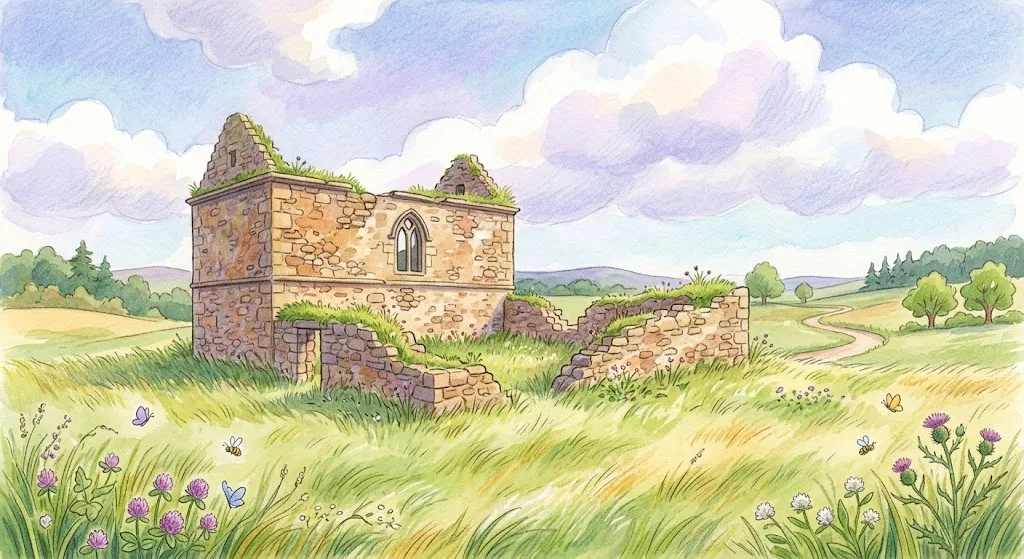
The building itself is not a fantasy backdrop invented for the ghost story. Historic Environment Scotland describes Rait Castle as a rare small masonry hall-house, probably dating from the late 13th or early 14th century. It was scheduled in 1959 and amended in 2002, and the protected monument includes the hall-house, courtyard, associated buildings and a possible chapel. The official description notes that the site is heavily overgrown, so the hall-house is the part most readily identifiable today.[Historic Environment Scotland]portal.historicenvironment.scotOpen source on historicenvironment.scot.
That physical setting helps explain why the legend has lasted. Rait is a compact, roofless and atmospheric ruin, with thick rubble walls, red sandstone dressings, a first-floor hall over cellarage, a round tower, a projecting latrine tower and a defended upper doorway. Historic Environment Scotland records a portcullis, drawbar-secured timber door, lancet windows with branched mullions and a fireplace within the first-floor hall. In other words, the story’s banquet, upper chamber and fatal window do not float in vague “castle” scenery: they are imagined through the surviving form of a fortified medieval residence.[Historic Environment Scotland]portal.historicenvironment.scotOpen source on historicenvironment.scot.
Rait’s documented history also gives the legend a plausible social setting, even where the details cannot be proved. The Thanedom of Rait is first recorded in 1238; early lords such as Sir Geirvaise de Rait and Sir Andrew de Rait took their name from the manor, and Historic Environment Scotland links them with the Wars of Independence and support for Edward I. The de Raits held the castle and lands until around 1404, after which the 15th-century lands of Rait were held by the Mackintoshes; the last recorded reference to a castle on the site is from 1596.[Historic Environment Scotland]portal.historicenvironment.scotOpen source on historicenvironment.scot.
For readers following haunted Nairnshire as a mapped county tradition, this matters because Rait is not merely “somewhere near Inverness”. Canmore places the site in the parish of Nairn, former county of Nairn, with National Grid Reference NH 89391 52527. The older county geography matters here: the tale is local to Nairnshire’s small but distinctive cluster of castle, chapel, clan and estate memories, even though visitors today may encounter it as part of a wider Highland or Moray Firth itinerary.[Canmore]canmore.org.ukCanmore Rait Castle | Place | trove.scotCanmore Rait Castle | Place | trove.scot
The banquet, betrayal and handless daughter
The fullest popular version of the haunting begins with a feud between the Cummings, also rendered Comyns or Cumings, and the Mackintoshes of Clan Chattan. In the modern heritage telling, the Mackintoshes believed they had a rightful claim to Rait. After skirmishing, the Cumming chief supposedly proposed a feast to “bury former animosities”, while secretly arranging that the Cummings would rise and kill their guests once a signal was given.[Discover Highlands and Islands]discoverhighlandsandislands.scotOpen source on discoverhighlandsandislands.scot.
The laird’s daughter is the emotional centre of the legend. Bound by an oath not to reveal the plot to any person, she is said to have gone to a boulder near the castle and spoken the plan aloud to the stone, knowing that her Mackintosh lover was hidden behind it. This device is a classic piece of folklore logic: she keeps the letter of the oath while defeating its purpose. The boulder is remembered in the tale as “The Stone of the Maiden”, making the landscape outside the castle part of the haunting rather than leaving all the drama inside the walls.[Discover Highlands and Islands]discoverhighlandsandislands.scotOpen source on discoverhighlandsandislands.scot.
Forewarned, the Mackintoshes attend the feast armed with dirks hidden in their plaids. One widely repeated version says the signal was the toast to “The Memory of the Dead”; another tradition, reported in a 19th-century Nairnshire Telegraph account reproduced by a Raitt family-history site, says a bullock’s head was brought into the hall as the sign for slaughter. The difference is important. It does not destroy the legend, but it shows that the story has circulated in more than one form, with the same moral pattern but changing theatrical details.[Raitt]raitt.orgOpen source on raitt.org.
When the Cummings rise, the ambush reverses. In the Bain-derived version now widely reproduced, the Mackintoshes draw first and kill the would-be attackers. The Cumming chief escapes the immediate slaughter and runs to his daughter’s chamber, convinced that she has betrayed him because he knows of her love for the young Mackintosh. She tries to flee through a window; he cuts off both her hands with a broadsword, and she falls to her death.[Tumblr]archaicwonder.tumblr.comAncient to Medieval (And Slightly Later) HistoryAncient to Medieval (And Slightly Later) History
The ghost tradition begins at this moment of punishment. Public heritage and ghost-lore retellings describe the apparition as the daughter of Cumming, appearing at or near the ruin at dusk in a blood-stained dress, wandering without hands or with bloody stumps. This is why Rait’s haunting is so sharply remembered: the ghost is not a vague “grey lady”, but a figure whose missing hands are tied directly to the moral machinery of the legend — oath, warning, betrayal, revenge and kinship violence.[Discover Highlands and Islands]discoverhighlandsandislands.scotOpen source on discoverhighlandsandislands.scot.
Why this ghost story became locally famous
Rait Castle’s handless ghost works so well as a local legend because it binds three memorable ingredients to one small ruin: a real fortified hall-house, a feud between named families, and a single shocking image that can be retold in a sentence. Many castle ghost stories rely on mood alone, but Rait’s has a clear plot. A peace feast is false; a daughter’s love frustrates murder; a father’s rage creates the haunting. That structure makes it easy to preserve orally, adapt in guidebooks and repeat on local-history websites.
The story also echoes older Highland and Scottish feud narratives in which hospitality is violated. A feast should be a place of truce, ritual and status; in the Rait legend it becomes a trap. The reversal of the ambush gives the story a grim justice, but the daughter’s mutilation complicates that justice. She saves the guests, yet pays the most visible price. That tension is the reason the ghost belongs to her rather than to the slain men. She becomes the figure through whom the whole feud is remembered.
Several details show how the legend moved from local tradition into print and then into modern heritage. George Bain’s History of Nairnshire, published in 1893 by the Nairn Telegraph Office, is a key source in the modern trail; the Internet Archive record identifies Bain’s book as an 1893 Nairnshire county history. Later retellings explicitly attribute the banquet-and-daughter version to Bain or reproduce material from him, while also folding in newspaper tradition and family-history interpretation.[Internet Archive]archive.orgOpen source on archive.org.
The story is also preserved through tourism-facing heritage. Discover Highlands and Islands introduces Rait as a place haunted by “romance, treachery, murder and a handless ghost”, then gives the feud narrative with the daughter, the warning stone, the hidden dirks and the blood-stained apparition. That kind of concise public retelling is one reason Rait has become Nairnshire’s most vivid haunted site: the official or semi-official visitor material does not need to prove a ghost to keep the tradition alive.[Discover Highlands and Islands]discoverhighlandsandislands.scotOpen source on discoverhighlandsandislands.scot.
There is also a family-memory strand. The Raitt family-history site gathers material on Rait Castle, the de Rait/Raitt name, visits to the ruin, and the castle’s owners and occupants. It treats the ghost story as part of the wider history of the name and estate, while also acknowledging tangled chronology and variant traditions around the Raits, Cawdors, Cummings and Mackintoshes. That is typical of durable local legends: they survive not only in ghost books, but in genealogy, estate memory, local newspapers, visitor lore and arguments over who held which lands.[Raitt]raitt.orgThe Raitt StuffThe Raitt Stuff
Legend, clan memory and cautious evidence
The haunting should be read carefully. There is good evidence for the site, its medieval importance, its protected status and its association with the de Raits and Mackintoshes. There is also a strong published tradition that the castle was associated with a violent feud and a handless female apparition. What is much weaker is proof that the banquet massacre and the daughter’s death happened exactly as told. Historic Environment Scotland’s designation record gives a sober historical outline of the castle and landholding, but it does not present the handless ghost story as documented fact.[Historic Environment Scotland]portal.historicenvironment.scotOpen source on historicenvironment.scot.
The chronology is one reason for caution. The official record says the de Raits held the castle and lands until 1404, when Sir Alexander Rait fled after slaying the Thane of Cawdor, and that the Mackintoshes held the lands in the 15th century. The legend, in many retellings, focuses on 1442 and the transition of Rait to Mackintosh control. Bain-derived accounts also discuss difficulties in reconciling the story with other statements about the Raits, Cawdor and dates around 1404. This does not make the legend worthless, but it warns against treating the narrative as a clean court record.[Historic Environment Scotland]portal.historicenvironment.scotOpen source on historicenvironment.scot.
The variants around the signal at the feast make the same point. In one telling, the agreed signal is a toast to the dead; in another, the entrance of a bullock’s head marks the moment for the attack. Both are vivid, ritualised signals suitable for oral tradition. Their coexistence suggests a story polished by retelling, where dramatic memory matters as much as precise reconstruction.[Raitt]raitt.orgOpen source on raitt.org.
A cautious reading therefore separates three layers. First, Rait Castle is a real medieval hall-house in former Nairnshire, with documented landholding changes and architectural remains. Second, a long-standing local and printed tradition links it to Comyn/Cumming and Mackintosh conflict, a treacherous banquet and a punished daughter. Third, the ghost itself belongs to belief, legend and atmosphere rather than verifiable historical evidence. The strongest interpretation is not “Rait is proven haunted”, but “Rait is one of Nairnshire’s clearest examples of a haunting created from feud memory and ruinous place”.[historicenvironment.scot]portal.historicenvironment.scotOpen source on historicenvironment.scot.
That careful approach does not make the story less interesting. It makes it more revealing. The handless ghost gives human form to anxieties about broken hospitality, divided loyalty, women caught between kinship and love, and the violence of inheritance disputes. The apparition’s missing hands are not just a gruesome flourish; they are the symbolic mark of a woman punished for acting, warning and intervening in a male feud.
How to understand Rait Castle within haunted Nairnshire
Within Nairnshire’s haunted geography, Rait Castle is best understood as the county’s compact castle-feud legend: smaller and less theatrical than Cawdor’s Shakespearean associations, but sharper in its local violence. It belongs with nearby haunted and uncanny Nairnshire places not because it offers modern witness files or psychical research evidence, but because it shows how a ruined building can become the fixed address for an old moral story.
The site’s physical condition reinforces that role. Rait is roofless, overgrown and partly difficult to read beyond the hall-house, while still retaining enough medieval structure to make the tale spatially persuasive. A visitor can imagine the defended doorway, the upper hall, the chamber, the window, the courtyard and the ground below. The ruin does not prove the ghost, but it gives the legend a stage that has survived long after the families and legal claims became obscure.[Historic Environment Scotland]portal.historicenvironment.scotOpen source on historicenvironment.scot.
The most responsible way to tell the haunting is therefore neither to debunk it flatly nor to sell it as fact. Rait Castle’s handless ghost is a folkloric tradition attached to a real Nairnshire monument, preserved through local history, family memory, heritage storytelling and ghost-lore retelling. Its power lies in the fit between story and place: a lonely hall-house, a claimed reconciliation that turns murderous, a daughter speaking to a stone, and the image of a handless figure wandering the ruins at dusk.

Amazon book picks
Further Reading
Books and field guides related to Why Is Rait Castle Said To Be Haunted?. Use these as the next step if you want deeper reading beyond the article.


The visions of Isobel Gowdie
First published 2010. Subjects: Witchcraft, History, Shamanism, Witchcraft, great britain, Magic, history.
eBay marketplace picks
Marketplace Samples
Live-tested eBay searches with available results related to this page.

Endnotes
1.
Source: raitt.org
Title: Rait Castle
Link:https://www.raitt.org/rait-castle-owners.html
2.
Source: raitt.org
Link:https://www.raitt.org/tours-of-rait-castle.html
3.
Source: archaicwonder.tumblr.com
Title: Ancient to Medieval (And Slightly Later) History
Link:https://archaicwonder.tumblr.com/post/42877719330/the-ghost-of-rait-castle-the-story-of-the-rait
4.
Source: archive.org
Link:https://archive.org/details/historyofnairnsh00bainuoft
5.
Source: raitt.org
Title: The Raitt Stuff
Link:https://www.raitt.org/william-raitt-history.html
6.
Source: raitt.org
Title: The Raitt Stuff
Link:https://www.raitt.org/raitt-locations.html
7.
Source: tumblr.com
Link:https://www.tumblr.com/archaicwonder/43235241980/the-witch-tree-the-lone-and-ancient-english-oak
8.
Source: tumblr.com
Link:https://www.tumblr.com/archaicwonder/43257192747/cup-and-ring-marks-in-achnabreck-kilmartin-glen
9.
Source: discoverhighlandsandislands.scot
Link:https://discoverhighlandsandislands.scot/en/story/rait-castle
10.
Source: portal.historicenvironment.scot
Link:https://portal.historicenvironment.scot/apex/f?p=1505%3A300%3A%3A%3A%3A%3AVIEWTYPE%2CVIEWREF%3Adesignation%2CSM1235
11.
Source: canmore.org.uk
Title: Canmore Rait Castle | Place | trove.scot
Link:https://canmore.org.uk/site/15163/rait-castle
12.
Source: en.wikisource.org
Link:https://en.wikisource.org/wiki/1911_Encyclop%C3%A6dia_Britannica/Nairnshire
13.
Source: canmore.org.uk
Link:https://canmore.org.uk/site/15162/geddes-st-marys-chapel
14.
Source: canmore.org.uk
Link:https://canmore.org.uk/site/15599/slagachorrie?GROUPCATEGORY=5&display=collection
15.
Source: canmore.org.uk
Link:https://canmore.org.uk/site/16841/
16.
Source: portal.historicenvironment.scot
Link:https://portal.historicenvironment.scot/apex/f?p=1505%3A300%3A%3A%3A%3A%3AVIEWTYPE%2CVIEWREF%3Adesignation%2CSM11805
17.
Source: portal.historicenvironment.scot
Link:https://portal.historicenvironment.scot/apex/f?p=1505%3A300%3A%3A%3A%3A%3AVIEWTYPE%2CVIEWREF%3Adesignation%2CLB14058
18.
Source: portal.historicenvironment.scot
Link:https://portal.historicenvironment.scot/apex/f?p=1505%3A300%3A%3A%3A%3A%3AVIEWTYPE%2CVIEWREF%3Adesignation%2CSM90105
19.
Source: portal.historicenvironment.scot
Link:https://portal.historicenvironment.scot/apex/f?p=1505%3A300%3A%3A%3A%3A%3AVIEWTYPE%2CVIEWREF%3Adesignation%2CSM3116
20.
Source: portal.historicenvironment.scot
Title: scot Battle of Bannockburn (BTL4)
Link:https://portal.historicenvironment.scot/apex/f?p=1505%3A300%3A%3A%3A%3A%3AVIEWTYPE%2CVIEWREF%3Adesignation%2CBTL4
21.
Source: portal.historicenvironment.scot
Link:https://portal.historicenvironment.scot/apex/f?p=1505%3A300%3A%3A%3A%3A%3AVIEWTYPE%2CVIEWREF%3Adesignation%2CLB52395
22.
Source: wikishire.co.uk
Link:https://wikishire.co.uk/wiki/Nairnshire
23.
Source: en.wikisource.org
Link:https://en.wikisource.org/wiki/1911_Encyclop%C3%A6dia_Britannica/Nairn
24.
Source: livebreathescotland.com
Title: rait castle
Link:https://www.livebreathescotland.com/rait-castle/
25.
Source: Wikipedia
Title: Rait Castle
Link:https://en.wikipedia.org/wiki/Rait_Castle
26.
Source: Wikipedia
Title: County of Nairn
Link:https://en.wikipedia.org/wiki/County_of_Nairn
27.
Source: undiscoveredscotland.co.uk
Link:https://www.undiscoveredscotland.co.uk/usfeatures/areas/nairnshire.html
28.
Source: atlasobscura.com
Title: rait castle
Link:https://www.atlasobscura.com/places/rait-castle
29.
Source: waterstones.com
Title: george bain
Link:https://www.waterstones.com/book/history-of-nairnshire/george-bain/9781025361727
30.
Source: thecastlesofscotland.co.uk
Link:https://www.thecastlesofscotland.co.uk/the-best-castles/scenic-castles/rait-castle/
Additional References
31.
Source: youtube.com
Title: Dark Miles II: The Haunted Road to the highlands
Link:https://www.youtube.com/watch?v=Hcss3aIOnlw
Source snippet
Most Haunted Places in Scotland | Human Voiced, No Ads...
32.
Source: facebook.com
Link:https://www.facebook.com/highlandpara/posts/a-quick-look-round-rait-castle/860776916088267/
33.
Source: facebook.com
Link:https://www.facebook.com/groups/735389799823006/posts/28185105164424766/
34.
Source: archiuk.com
Link:https://www.archiuk.com/cgi-bin/build_nls_historic_map.pl?is_sub=&latitude=57.571966&longitude=-3.787965&map_location=IV12+5JZ+IV125JZ+in+Nairn&os_series=7&postcode=IV12+5JZ&pwd=&search_location=IV12+5JZ%2C+IV125JZ+in+Nairn%2C+Highland%2C+Nairnshire%2C+Scotland
35.
Source: facebook.com
Link:https://www.facebook.com/outlanderphotographyscotland/posts/eerie-rait-castle-this-evening-the-castle-is-haunted-by-a-handless-woman-the-lai/915069422316294/
36.
Source: facebook.com
Link:https://www.facebook.com/groups/2686102378119843/posts/26880216808281729/
37.
Source: facebook.com
Link:https://www.facebook.com/emchalphotography/videos/legend-of-[cawdor-castle
38.
Source: abcounties.com
Link:https://abcounties.com/counties/county-profiles/nairnshire/
39.
Source: lutonparanormal.com
Link:https://www.lutonparanormal.com/hauntings/scotland/nairnshire/
40.
Source: sobt.co.uk
Link:https://sobt.co.uk/rait-castle/
Topic Tree