Why Does Selkirkshire Feel So Haunted?
Selkirkshire’s haunted history is quieter than the headline-grabbing ghost tourism of Edinburgh or the great castles of the Highlands, but it is unusually rich in older Border material: battlefield memory at Philiphaugh, the ruined Newark Castle above the Yarrow, fairy lore at Carterhaugh, the Brownie of Bodsbeck, and darker Covenanting legends around...
Page outline Jump by section
Why Selkirkshire’s ghost map follows rivers, woods and battle memory
The geography explains much of the atmosphere. Selkirkshire’s old identity as Ettrick Forest came from the wooded land between the Ettrick and the Tweed, once a royal hunting forest of oak, birch, hazel and deer before grazing and sheep farming changed the landscape. The Ettrick runs across much of the county, the Yarrow flows east from St Mary’s Loch, and the two meet near the ground associated with the Battle of Philiphaugh. That same river meeting helps bind together several traditions: Carterhaugh and Tam Lin, Newark Castle, Philiphaugh, and the wider Yarrow ballad country.[Gazetteer]gazetteer.org.ukOpen source on gazetteer.org.uk.
This matters because Selkirkshire’s supernatural stories are rarely just “a ghost in a room”. They often attach to thresholds: a forest edge, a river meeting, a battlefield, a ruined tower, a dungeon, a well, or a place where one order of life gives way to another. In folklore terms, that makes the county feel haunted even where the evidence is better described as legend, song or inherited story than as a modern witness case.
Newark Castle and Philiphaugh: Selkirkshire’s strongest haunting tradition
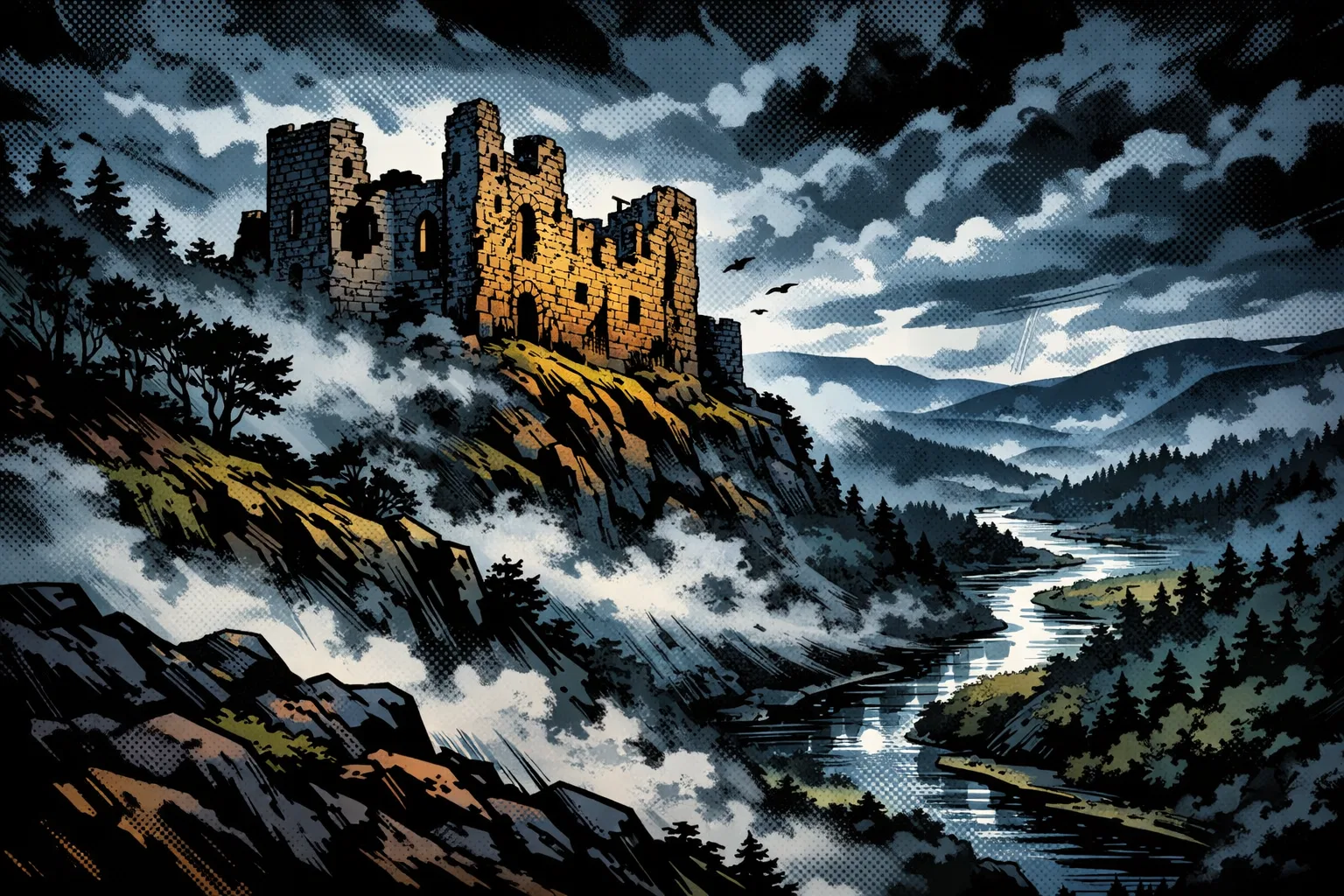
The most substantial haunted-place tradition in Selkirkshire centres on Newark Castle and the aftermath of the Battle of Philiphaugh. Newark Castle, now a ruined tower in the grounds of Bowhill near Selkirk, is a scheduled monument; Historic Environment Scotland identifies the wider Battle of Philiphaugh as nationally significant because it was the final battle of the Marquis of Montrose’s 1644–45 Royalist campaign and effectively ended organised Royalist hopes north of the border.[Historic Environment Scotland]portal.historicenvironment.scotOpen source on historicenvironment.scot.[Historic Environment Scotland]portal.historicenvironment.scotHistoric Environment Scotland Battle of Philiphaugh (BTL14Historic Environment Scotland Battle of Philiphaugh (BTL14
The battle was fought on 13 September 1645. Historic Environment Scotland describes Montrose’s Royalists as ill-prepared and outnumbered by David Leslie’s Covenanter army. The Royalist defeat was followed by the execution of captured soldiers, their families and servants near the battlefield; the HES battlefield boundary specifically includes Harewood Glen to Newark Castle as part of the probable westward route of the rout, and notes the tradition that camp followers were taken towards the castle before being slaughtered at Slain Men’s Lea.[Historic Environment Scotland]portal.historicenvironment.scotHistoric Environment Scotland Battle of Philiphaugh (BTL14Historic Environment Scotland Battle of Philiphaugh (BTL14
That is the historical core from which the haunting grows. Castle specialist Martin Coventry’s Castles of Scotland account describes Newark as a 15th-century tower built by the Douglases, later associated with the killing of about one hundred followers of Montrose, “mostly women”, in the barmkin after Philiphaugh; it also records that large quantities of bones and skulls were found in 1810 at Slain Men’s Lea.[The Castles of Scotland]thecastlesofscotland.co.ukOpen source on thecastlesofscotland.co.uk. HES is more cautious about the archaeology, noting that human remains were recorded in 1810 and were said to be those of some of Montrose’s army, while also saying that there are no unequivocal archaeological remains from the battle itself.[Historic Environment Scotland]portal.historicenvironment.scotHistoric Environment Scotland Battle of Philiphaugh (BTL14Historic Environment Scotland Battle of Philiphaugh (BTL14
The ghost story usually heard around Newark is therefore a memory-haunting rather than a neatly documented apparition case. Later accounts speak of cries, screams, or the restless dead associated with the massacre after Philiphaugh. The credibility question is important: the massacre and battle are historically grounded, but the reported sounds and apparitions belong to tradition and retelling. What gives the story weight is not proof of ghosts, but the way the alleged haunting follows a real episode of violence, a named place, a known date, and a landscape still marked by monuments, ruined masonry and local memory.
Carterhaugh and Tam Lin: not a ghost, but Selkirkshire’s great supernatural legend
Carterhaugh, near the meeting of the Ettrick and Yarrow waters, is the county’s most famous supernatural setting. It is associated with the ballad of Tam Lin, in which Janet enters the woods, encounters the fairy knight Tam Lin, and later rescues him from the Fairy Queen by holding him through a series of terrifying transformations on Halloween night. The National Library of Scotland presents Tam Lin as an old Scottish Borders folk tale, loved for centuries and centred on magic, danger and female courage; in its version, Carterhaugh woods near Yarrow are where Tam Lin is said to live.[Google Arts & Culture]artsandculture.google.comArts & Culture Myths and Tales from the Scottish Borders — Google Arts & CultureArts & Culture Myths and Tales from the Scottish Borders — Google Arts & Culture
For a haunted-history page, Tam Lin should be handled carefully. It is not a standard ghost story, and Tam Lin is not simply “a ghost”. He is usually a mortal man held by the fairy court, threatened with being paid as a levy to Hell, and freed by Janet’s courage. Yet the story belongs naturally in Selkirkshire’s eerie map because it makes Carterhaugh a charged supernatural place: a forbidden wood, a fairy domain, a site of enchantment, bodily transformation and rescue.[Google Arts & Culture]artsandculture.google.comArts & Culture Myths and Tales from the Scottish Borders — Google Arts & CultureArts & Culture Myths and Tales from the Scottish Borders — Google Arts & Culture
The tradition also shows why Selkirkshire’s folklore is unusually literary. Walter Scott’s collecting of Border ballads helped preserve and popularise supernatural material from the region, while later versions and retellings kept Carterhaugh visible to readers far beyond the Borders. The result is a place where the “haunting” is partly imaginative: visitors are not only looking for a reported apparition, but standing in a landscape that a famous ballad has taught generations to read as enchanted.
The Brownie of Bodsbeck and the older spirit world of Ettrick Forest
The Brownie of Bodsbeck belongs to a different kind of supernatural tradition: the household or farm spirit. In Scottish folklore, a brownie is usually a domestic helper, not a dead human ghost. The Ettrick Forest story tells of the last Brownie of Bodsbeck, who vanished after the mistress of the house placed milk and money in his haunts, effectively “hiring him away”; he was heard crying farewell to “bonnie Bodsbeck” before disappearing.[plover.net]plover.netHenderson's Folklore of the Northern CountiesHenderson's Folklore of the Northern Counties
This tradition is valuable because it preserves an older layer of Selkirkshire belief. The Brownie is not about murder or battlefield trauma, but about work, farms, payments, invisible labour and the uneasy relationship between a household and its unseen helper. Its disappearance after being treated like a hired servant is a familiar folklore motif: a spirit who accepts food as custom may leave forever when the relationship is turned into wages.
James Hogg, the Ettrick Shepherd, gave the title The Brownie of Bodsbeck to his 1818 tale, using local superstition and Covenanting history in a literary form. Hogg’s version complicates the supernatural by having the “brownie” role overlap with a hidden human Covenanter, which is exactly the kind of ambiguity that makes Borders folklore so durable: a story can be read as fairy belief, political allegory, rural memory and eerie entertainment at the same time.[Wikipedia]WikipediaThe Brownie of BodsbeckThe Brownie of Bodsbeck
Buckholm Tower: hounds, punishment and Covenanting guilt near Galashiels
Buckholm Tower, near Galashiels, has a more conventional ghost legend. The Clan Pringle Association preserves a tradition that the ruins are haunted by a former Laird of Buckholm, a Pringle from the later 17th century, with strange noises said to come from a dungeon-like cellar. The story presents the laird as cruel, violent and hostile to Covenanters, and says he was later tormented by unseen ghostly hounds.[pringle.info]pringle.infoBuckholm ghost story – The Clan Pringle AssociationBuckholm ghost story – The Clan Pringle Association
The detail that makes the legend memorable is its annual rhythm. According to the tradition, around the anniversary of the laird’s death a figure was seen fleeing towards the tower from baying spectral hounds, followed by banging at the door and sounds from the dungeon. A later section of the same account identifies the likely historical figure as Captain George Pringill, 5th Laird of Buckholm, who appears in records in the 17th century and died in 1693.[pringle.info]pringle.infoBuckholm ghost story – The Clan Pringle AssociationBuckholm ghost story – The Clan Pringle Association
This is not strong evidence for a haunting in a modern investigative sense. It is, however, a clear example of moral ghost-lore: the dead wrongdoer is punished by being forced to re-enact guilt. The hounds are especially fitting in a Border context, where pursuit, raiding, religious repression and rough justice are recurring themes. The claimed exorcism by a Galashiels minister, also preserved in the tradition, strengthens the story’s local character even as it places it firmly in the world of inherited legend rather than verified witness record.[pringle.info]pringle.infoBuckholm ghost story – The Clan Pringle AssociationBuckholm ghost story – The Clan Pringle Association
Old Gala House: from laird’s house to ghost-hunt venue
Old Gala House in Galashiels is one of the places where modern paranormal tourism has attached itself to a genuinely historic building. Historic Environment Scotland describes it as a laird’s house with development from the 16th to 19th centuries: a tower site from 1457, a secure peel tower house built in 1583 by Andrew Hoppringill or Pringle, later Pringle and Scott family associations, and a painted timber ceiling rediscovered in 1952 that commemorates the 1635 remodelling.[Historic Environment Scotland]portal.historicenvironment.scotOpen source on historicenvironment.scot.
Live Borders presents Old Gala House as a museum and gallery, once home to the Lairds of Galashiels, with more than 400 years of history.[Live Borders]liveborders.org.ukLive Borders Old Gala HouseLive Borders Old Gala House Commercial ghost-hunt listings now advertise overnight investigations there, citing reports of strange lights, children’s laughter, whistling and the sensation of a tall man leaning over visitors.[Haunted Rooms®]hauntedrooms.co.ukHaunted Rooms®Old Gala House Ghost Hunts, Galashiels, Scotland | Haunted Rooms®Haunted Rooms®Old Gala House Ghost Hunts, Galashiels, Scotland | Haunted Rooms®
The distinction matters. The building’s age and atmosphere are well supported; the ghost claims are promotional and experiential. Old Gala House therefore belongs in a Selkirkshire haunted-place guide, but with a lighter evidential weight than Philiphaugh or the long-established ballad traditions. Its value for readers is practical as well as folkloric: it shows how old Border buildings continue to gather ghost stories through events, staff reports, visitor experiences and the expectations created by ghost-hunt culture.
How credible are Selkirkshire’s hauntings?
Selkirkshire’s haunted record is best understood in three layers. The first layer is firm history: Philiphaugh happened, Newark Castle exists, Old Gala House is a documented historic building, and the Ettrick and Yarrow landscape is central to the county’s identity. The second layer is preserved tradition: Tam Lin, the Brownie of Bodsbeck and Buckholm’s ghostly hounds survive because writers, collectors, families and local historians passed them on. The third layer is modern paranormal interpretation: ghost hunts, reported sensations and claims of sounds or apparitions.
The strongest Selkirkshire case is not strongest because it proves a ghost, but because it connects a haunting claim to a documented trauma. Philiphaugh and Newark Castle carry the force of a real 1645 defeat, executions and later discoveries of human remains said to be linked to the battle. HES’s battlefield record supports the importance of the conflict and the tradition of post-battle killing, while also keeping archaeological claims cautious.[Historic Environment Scotland]portal.historicenvironment.scotHistoric Environment Scotland Battle of Philiphaugh (BTL14Historic Environment Scotland Battle of Philiphaugh (BTL14
The fairy and brownie traditions are credible in a different sense. They are not credible as evidence that fairies or brownies literally existed; they are credible as evidence of what people in the Borders told, feared, enjoyed and preserved. Tam Lin’s endurance over centuries, and the Brownie of Bodsbeck’s movement from oral tradition into literary culture, make them central to Selkirkshire’s supernatural identity even though they do not function like witness-led ghost reports.[Google Arts & Culture]artsandculture.google.comArts & Culture Myths and Tales from the Scottish Borders — Google Arts & CultureArts & Culture Myths and Tales from the Scottish Borders — Google Arts & Culture[plover.net]plover.netHenderson's Folklore of the Northern CountiesHenderson's Folklore of the Northern Counties
What to look for on a haunted Selkirkshire route
A reader exploring Selkirkshire’s eerie history would do best to follow the rivers and old routes rather than chase a single “most haunted” attraction. The Ettrick and Yarrow valleys hold the county’s strongest atmosphere: Carterhaugh for Tam Lin, the Meetings Pool area for the convergence of folklore and battlefield geography, Newark Castle for the Philiphaugh aftermath, and Selkirk itself as the county town tied to Scott, Hogg and Border memory.[Gazetteer]gazetteer.org.ukOpen source on gazetteer.org.uk.
Galashiels adds a different kind of material: Old Gala House for a historic laird’s residence now used as a museum and ghost-hunt venue, and Buckholm for a darker family-and-Covenanter legend preserved through Pringle tradition. These sites also show the range of “haunted Selkirkshire”: not only ruined castles and battlefields, but museums, old houses, clan stories and inherited tales of punishment.
The most honest way to experience the county is to let the stories remain partly unresolved. Newark’s cries, Buckholm’s hounds, Carterhaugh’s fairy procession and Bodsbeck’s departing brownie are not confirmed supernatural events. They are stories rooted in place, and their power comes from that rootedness: a small historic county where rivers, ruins, songs and old violence still give the landscape an uncanny voice.
Amazon book picks
Further Reading
Books and field guides related to Why Does Selkirkshire Feel So Haunted?. Use these as the next step if you want deeper reading beyond the article.
The Lore of Scotland
Excellent overview covering Border folklore, ghosts and fairy traditions.
The Border Reivers
Explains the violent Border culture underpinning many ghost stories.

Sir Walter Scott's Minstrelsy of the Scottish border
First published 1902. Subjects: Texts, Scots Ballads, English Ballads.
eBay marketplace picks
Marketplace Samples
Live-tested eBay searches with available results related to this page.
Endnotes
1.
Source: artsandculture.google.com
Title: Arts & Culture Myths and Tales from the Scottish Borders — Google Arts & Culture
Link:https://artsandculture.google.com/story/myths-and-tales-from-the-scottish-borders-national-library-of-scotland/6wWxxemLDPDSkQ?hl=en
2.
Source: plover.net
Title: Henderson’s Folklore of the Northern Counties
Link:https://plover.net/~agarvin/faerie/Henderson/index.html
3.
Source: Wikipedia
Title: The Brownie of Bodsbeck
Link:https://en.wikipedia.org/wiki/The_Brownie_of_Bodsbeck
4.
Source: pringle.info
Title: Buckholm ghost story – The Clan Pringle Association
Link:https://pringle.info/contents/buckholm-ghost-story/
5.
Source: tam-lin.org
Title: Minstrelsy of the Scottish Border: Tamlane
Link:https://www.tam-lin.org/library/scott_text.html
6.
Source: tam-lin.org
Link:https://www.tam-lin.org/scotland/carterhaugh.html
7.
Source: tam-lin.org
Link:https://tam-lin.org/
8.
Source: Wikipedia
Title: Newark Castle, Selkirkshire
Link:https://en.wikipedia.org/wiki/Newark_Castle%2C_Selkirkshire
9.
Source: Wikipedia
Title: Newark Castle (Selkirk)
Link:https://de.wikipedia.org/wiki/Newark_Castle_%28Selkirk%29
10.
Source: Wikipedia
Title: Battle of Philiphaugh
Link:https://en.wikipedia.org/wiki/Battle_of_Philiphaugh
11.
Source: Wikipedia
Link:https://en.wikipedia.org/wiki/Selkirkshire
12.
Source: Wikipedia
Title: Tam Lin
Link:https://en.wikipedia.org/wiki/Tam_Lin
13.
Source: Wikipedia
Link:https://en.wikipedia.org/wiki/Carterhaugh
14.
Source: Wikipedia
Title: Old Gala House
Link:https://en.wikipedia.org/wiki/Old_Gala_House
15.
Source: pringle.info
Link:https://pringle.info/contents/gala/
16.
Source: gazetteer.org.uk
Link:https://gazetteer.org.uk/search?place=Selkirkshire&type=em
17.
Source: portal.historicenvironment.scot
Link:https://portal.historicenvironment.scot/apex/f?p=1505%3A300%3A%3A%3A%3A%3AVIEWTYPE%2CVIEWREF%3Adesignation%2CSM1729
18.
Source: portal.historicenvironment.scot
Title: Historic Environment Scotland Battle of Philiphaugh (BTL14)
Link:https://portal.historicenvironment.scot/apex/f?p=1505%3A300%3A%3A%3A%3A%3AVIEWTYPE%2CVIEWREF%3Adesignation%2CBTL14
19.
Source: thecastlesofscotland.co.uk
Link:https://www.thecastlesofscotland.co.uk/the-best-castles/scenic-castles/newark-castle-bowhill/
20.
Source: portal.historicenvironment.scot
Link:https://portal.historicenvironment.scot/apex/f?p=1505%3A300%3A%3A%3A%3A%3AVIEWTYPE%2CVIEWREF%3Adesignation%2CLB31973
21.
Source: liveborders.org.uk
Title: Live Borders Old Gala House
Link:https://www.liveborders.org.uk/culture/museums/our-museums/old-gala-house/
22.
Source: hauntedrooms.co.uk
Title: Haunted Rooms®Old Gala House Ghost Hunts, Galashiels, Scotland | Haunted Rooms®
Link:https://www.hauntedrooms.co.uk/ghost-hunts/old-gala-house-scotland
23.
Source: portal.historicenvironment.scot
Title: scot Newark Castle, Philiphaugh
Link:https://portal.historicenvironment.scot/apex/f?p=1505%3A300%3A%3A%3A%3A%3AVIEWTYPE%2CVIEWREF%3Adecision%2C900077947
24.
Source: wikishire.co.uk
Link:https://wikishire.co.uk/wiki/Selkirkshire
25.
Source: sobt.co.uk
Title: old gala house
Link:https://sobt.co.uk/old-gala-house/
26.
Source: visionofbritain.org.uk
Link:https://www.visionofbritain.org.uk/place/21756
27.
Source: house-of-lynn.com
Title: Tam Lin
Link:https://www.house-of-lynn.com/Tam_Lin_Intro.html
28.
Source: gazetteer.org.uk
Link:https://gazetteer.org.uk/place/Selkirkshire
29.
Source: thedevilsdavenport.wordpress.com
Title: scottish folklore
Link:https://thedevilsdavenport.wordpress.com/category/scottish-folklore/
30.
Source: battlefieldstrust.com
Title: Battle of Philiphaugh
Link:https://www.battlefieldstrust.com/resource-centre/battleview.asp?BattleFieldId=74
31.
Source: scotlandstartshere.com
Link:https://scotlandstartshere.com/point-of-interest/old-gala-house/
32.
Source: hauntedrooms.co.uk
Link:https://www.hauntedrooms.co.uk/product/tulloch-castle-hotel-dingwall-ross-shire-scotland
33.
Source: artfund.org
Title: old gala house
Link:https://www.artfund.org/explore/museums-and-galleries/old-gala-house
34.
Source: tripadvisor.com
Title: Old Gala House
Link:https://www.tripadvisor.com/Attraction_Review-g186504-d2528175-Reviews-Old_Gala_House-Galashiels_Scottish_Borders_Scotland.html
35.
Source: thehaining.org
Link:https://www.thehaining.org/about/
36.
Source: historic-uk.com
Title: The Battle of Philiphaugh
Link:https://www.historic-uk.com/HistoryMagazine/DestinationsUK/The-Battle-of-Philiphaugh/
37.
Source: realcounties.com
Link:https://realcounties.com/county/selkirkshire/
38.
Source: thecastlesofscotland.co.uk
Title: Old Gala House | Galashiels
Link:https://www.thecastlesofscotland.co.uk/the-best-castles/grand-castles/old-gala-house/
Additional References
39.
Source: britishfantasysociety.org
Link:https://britishfantasysociety.org/10-fearsome-foes-from-scottish-folklore/
40.
Source: visitscotland.com
Link:https://www.visitscotland.com/things-to-do/attractions/haunted-sites
41.
Source: todoinscotland.com
Link:https://todoinscotland.com/the-courtyard-of-execution-haunting-in-the-scottish-borders
42.
Source: electricscotland.com
Link:https://electricscotland.com/history/borders/counties17.htm
43.
Source: battlefieldstrust.com
Link:https://www.battlefieldstrust.com/media/647.pdf
44.
Source: scotclans.com
Link:https://www.scotclans.com/pages/1645-battle-of-philiphaugh?srsltid=AfmBOopaYwxmu06f9XCSMtttAW4Z0Mh3q0RuwjPVKYwqPd6xgUHViyIq
45.
Source: electricscotland.com
Link:https://electricscotland.com/familytree/frank/burns_lives32.htm
46.
Source: thebottleimp.org.uk
Link:https://www.thebottleimp.org.uk/2016/12/fairies-faith-and-fatherland-in-james-hoggs-the-brownie-of-bodsbeck/
47.
Source: visitabdn.com
Link:https://visitabdn.com/blog/ghost-stories-19-haunted-places-in-aberdeen-and-aberdeenshire
48.
Source: nts.org.uk
Link:https://www.nts.org.uk/stories/ghosts-of-the-trust
Topic Tree
Follow this branch
Related pages 91
- Haunted Clackmannanshire
- Haunted Antrim
- Haunted Armagh
- Haunted Durham
- Haunted Londonderry
- +86 more in sidebar