Within Haunted Somerset
Who Haunts Somerset's Roads and Hilltops?
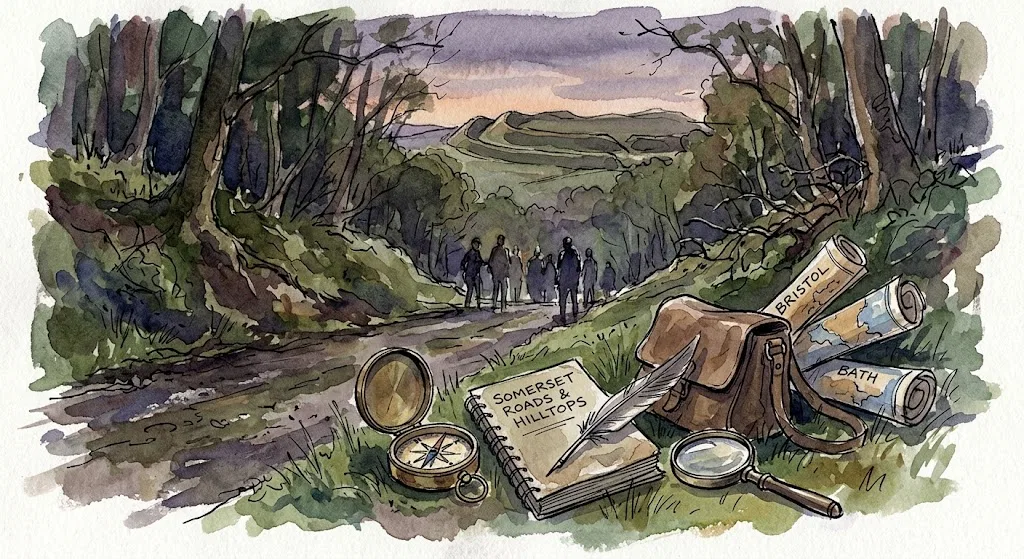
Somerset's road and hilltop legends turn dangerous routes, woodland bends and ancient earthworks into places of apparition.
On this page
- Sally in the Wood and roadside apparitions
- Brockley Combe and phantom travel stories
- Cadbury Castle and Arthurian riders
Page outline Jump by section
Introduction
Somerset’s haunted roads are less about grand castles and more about sudden appearances: a pale figure crossing a dark road, a coach heard where no coach should be, hoofbeats on a hilltop where legend says Arthur’s company still rides. The strongest stories cluster around three kinds of place: wooded routes near Bath and Brockley, where bends, darkness and local memory sharpen the imagination; and Cadbury Castle, where an ancient hillfort became tied to Arthurian riders returning by night. These accounts should be read as folklore, not proof. Their value lies in how they turn real Somerset landscapes into remembered danger zones: roads where people feared accidents, combes where old travel stories gathered, and hilltops where archaeology, place-names and romance made spectral riders feel almost inevitable. Visit Somerset’s own paranormal material shows how such stories now sit beside prisons, abbeys and caves in the county’s public haunted identity.[visitsomerset.co.uk]visitsomerset.co.ukParanormal TrailExplore the mystic and mysterious side of Somerset with our thrilling Paranormal Trail. From ancient abbeys to haunted pr…
This page stays with Somerset’s roads, wooded routes and high places rather than retelling the county’s wider catalogue of haunted prisons, castles, abbeys and inns. Its main question is simple: why do these particular roads and hilltops keep attracting ghost stories, and what can be said responsibly about the traditions behind them?
Why Somerset’s roads make convincing ghost country
Road ghosts work because they combine speed, poor visibility and surprise. A haunting in a house may unfold slowly, room by room, but a roadside apparition is usually brief: a figure runs out, a rider appears ahead, a coach is heard or seen for a moment, and then there is nothing to check. Somerset’s wooded lanes and limestone combes are well suited to this kind of story because they already feel transitional. They are not quite village, not quite open country; not quite safe, not quite wild.
That pattern matters when looking at the three main Somerset examples. Sally in the Wood is a named road tradition attached to the A363 near Bathford and Home Wood. Brockley Combe is a wooded valley road near Brockley, south-west of Bristol, where stories of phantom travel gather around an enclosed landscape. Cadbury Castle is not a road in the same way, but its restless riders are imagined moving across a hilltop and down towards neighbouring settlements, turning an ancient earthwork into a nocturnal route.[wshc.org.uk]wshc.org.ukWiltshire and Swindon History Centre Sally in the WoodWiltshire and Swindon History Centre Sally in the Wood
The stories are not equal in evidential weight. Sally in the Wood has a unusually useful local-history trail because researchers have tried to separate the supernatural tale from the likely real woman behind the name. Brockley Combe is more dependent on repeated local ghost-story retellings. Cadbury Castle has the deepest antiquarian and archaeological frame, but its mounted apparitions belong to Arthurian legend rather than verifiable witness history. The result is a small but revealing spectrum: from social memory, to local travel folklore, to national myth anchored in a Somerset hillfort.

Sally in the Wood and the girl at the roadside
The road known as Sally in the Wood lies near Bathford, on the A363 as it passes through Home Wood towards Bathford. The Wiltshire and Swindon History Centre describes the place as “just over the border” in the parish of Bathford, Somerset, while also stressing that the name and stories are closely linked with Monkton Farleigh in Wiltshire. That borderland quality is part of the tale’s appeal: it is a Somerset road story with Wiltshire parish and family-history threads running through it.[Wiltshire and Swindon History Centre]wshc.org.ukWiltshire and Swindon History Centre Sally in the WoodWiltshire and Swindon History Centre Sally in the Wood
The ghostly version most often repeated is a classic modern road apparition. A girl in white is said to run from the trees into the path of a vehicle. In one version discussed by the Wiltshire and Swindon History Centre, a young couple believe they have knocked down a white-clad girl, but the event slips into uncertainty when no ordinary injured person can be found. This is the kind of story that travels well because it uses the everyday fear of a driver: the split second in which a human figure appears where no one should be.[Wiltshire and Swindon History Centre]wshc.org.ukWiltshire and Swindon History Centre Sally in the WoodWiltshire and Swindon History Centre Sally in the Wood
What makes Sally in the Wood especially interesting is that there is also a more grounded explanation for the name. One local-history version identifies “Sally” with Sarah Gibson, baptised at Monkton Farleigh in 1732, married in 1762 to a gamekeeper connected with Warleigh Manor, and said after his death to have lived in a small hut in the woods through which the turnpike was driven in 1792. The same account presents her as a marginal, remembered woman rather than a confirmed ghost: someone poor, displaced and visible enough in local memory to become the seed of later legend.[Wiltshire and Swindon History Centre]wshc.org.ukWiltshire and Swindon History Centre Sally in the WoodWiltshire and Swindon History Centre Sally in the Wood
A later local paranormal-history discussion reaches a similar cautious conclusion: Sarah, or Sally, appears to have been a real woman associated with the woods, while the more dramatic “haunted death road” claims are much harder to substantiate. That distinction is important. The most credible layer is not that a ghost causes crashes, but that a named woman’s life, an isolated woodland dwelling and a later road through the area created the conditions for a haunting story to grow.[somersetandbathparanormal.co.uk]somersetandbathparanormal.co.ukDebunking the MythDebunking the Myth
Somerset Live’s account shows how the tale has been amplified in modern paranormal culture, including claims about fatal accidents, witchcraft and extreme haunting language. Such claims should be treated carefully: they show how the place is marketed and retold, not necessarily what can be historically verified. The older and more useful question is not “is Sally real?” but “how did a remembered woman become a roadside apparition?” On that point, Sally in the Wood is one of Somerset’s clearest examples of folklore forming around a real route and a half-preserved local biography.[somersetlive.co.uk]somersetlive.co.uksally in wood haunted bath 1965500sally in wood haunted bath 1965500
Brockley Combe and phantom travel stories
Brockley Combe is a wooded valley near Brockley in North Somerset, cutting into the western edge of the Lulsgate Plateau, with a minor road running along the combe and meeting the A370 near Brockley village. Its physical setting matters: a combe is naturally enclosed, and this one combines woodland, slope, bends and a road that feels older than the traffic using it.[Wikipedia]WikipediaOpen source on wikipedia.org.
The best-known haunting attached to the area is a phantom coach or carriage. Several ghost gazetteers and local retellings describe a spectral coach and horses associated with the road through or near Brockley Combe. The Paranormal Database lists a “swerving coach” on the road leading to Brockley Combe, while other retellings describe a ghostly carriage, sometimes with multiple alleged sightings and sometimes with a more dramatic headless driver or huntsman attached.[paranormaldatabase.com]paranormaldatabase.comOpen source on paranormaldatabase.com.
This is a familiar British folklore motif rather than a uniquely Somerset invention. Phantom coaches appear throughout the British Isles, often linked with dangerous travel, bad weather, old roads, death, or an imagined replay of disaster. Folklore writing on phantom coaches notes that real coach travel could be hazardous, with overturning, poor roads and robbery all part of the historical background against which ghostly coaches became plausible story-forms.[Icy Sedgwick]icysedgwick.comIcy Sedgwick All Aboard the Phantom Coaches of Folklore and LegendIcy Sedgwick All Aboard the Phantom Coaches of Folklore and Legend
Brockley Combe also has a “jilted girl” tradition, in which a young woman is said to have died after a romantic betrayal and then haunted the wooded area. This story is thinner as history: it is usually told without firm names, dates or documentary anchors. Its importance is therefore folkloric rather than evidential. It shows how the combe gathers several types of anxiety at once: the dangerous road, the vanishing traveller, the abandoned woman, the sudden figure in woodland.[Haunted Hosts]hauntedhosts.comHaunted Hosts The Jilted Girl of Brockley CombeHaunted Hosts The Jilted Girl of Brockley Combe
Compared with Sally in the Wood, Brockley Combe is harder to pin down. There is no equally clear Sarah Gibson figure at the centre of the story, and many accounts repeat ghost-lore rather than demonstrating a traceable origin. But that does not make the tradition meaningless. It makes it a good example of how a landscape can become “haunted” because several story-types suit it. A wooded combe with an old road is a natural theatre for phantom travel.
Cadbury Castle and Arthur’s restless riders
Cadbury Castle, near South Cadbury, is the most historically substantial place in this group, even though its rider legends are the most mythic. It is a large multivallate hillfort on Cadbury Hill, with evidence for long human use and later refortification. Historic England describes the South Cadbury monument as an outstanding example of its class, with archaeological and environmental evidence for the hillfort and for earlier and later activity on the hilltop.[Historic England]historicengland.org.ukOpen source on historicengland.org.uk.
The Atlas of Hillforts describes South Cadbury as a large, commanding hillfort on a limestone outcrop above the Somerset Levels, with wide views towards the Mendips and surrounding country. That visibility helps explain why the site became so powerful in legend. A hill that dominates the landscape is easy to imagine as a seat of power, a watch-place, or a sleeping stronghold waiting to wake.[Atlas of Hillforts]hillforts.arch.ox.ac.ukOpen source on ox.ac.uk.
The Arthurian association is old in print. John Leland, travelling in the Tudor period, recorded in 1542 a tradition connecting Cadbury with “Camallate” or Camelot. Modern summaries differ over how much Leland was reporting local tradition and how much he helped shape it, but the important point for haunted Somerset is that the association has been circulating for centuries, long enough for antiquarian interest, archaeology and folklore to reinforce each other.[Atlas of Hillforts]hillforts.arch.ox.ac.ukOpen source on ox.ac.uk.
The mounted ghost tradition gives that Arthurian association movement. In one version, Arthur and his knights ride out on Midsummer Eve, Midsummer Night, Christmas Eve, or every seventh year, crossing the hilltop and descending towards Sutton Montis, where their horses drink at a spring. Another strand places a ghostly Arthurian procession on the road between North Barrow and South Barrow. These are not ordinary “witness report” stories so much as calendrical legends: tales tied to special nights when the old world is imagined to break through.[The Modern Antiquarian]themodernantiquarian.comThe Modern Antiquarian Cadbury Castle (South Cadbury) (Hillfort) – Folklore byThe Modern Antiquarian Cadbury Castle (South Cadbury) (Hillfort) – Folklore by
The archaeology does not prove Arthur, and careful writers should not suggest that it does. What it does prove is that Cadbury is not a random romantic backdrop. It is a genuinely ancient and important hillfort, later reused, investigated and argued over. That makes the legend more durable. The ghostly riders feel attached to a place that already carries deep time, defensive earthworks and a long history of interpretation.[Heritage Gateway]heritagegateway.org.ukOpen source on heritagegateway.org.uk.
What the three traditions have in common
The haunted roads and riders of Somerset are not all the same kind of story, but they share a useful pattern. Each turns movement into haunting. Sally runs from the trees into the road. The Brockley coach moves through the combe as if repeating old travel. Arthur’s company rides from a hillfort towards water, village and legend. These are not static ghosts in locked rooms. They are apparitions of passage.
They also sit at the meeting point of folklore and historical landscape:
A named road becomes a biography. Sally in the Wood is strongest where it remembers Sarah Gibson, a woman plausibly connected with the woods and the turnpike landscape, rather than where it makes unsupported claims about one of Britain’s most haunted roads.[Wiltshire and Swindon History Centre]wshc.org.ukWiltshire and Swindon History Centre Sally in the WoodWiltshire and Swindon History Centre Sally in the Wood
A wooded route becomes a travel legend. Brockley Combe’s phantom coach belongs to a wider British tradition of spectral vehicles on risky or atmospheric roads, but the Somerset setting gives it local texture: the enclosed combe, the minor road, the sense of a route cut through older country.[Wikipedia]WikipediaOpen source on wikipedia.org.
A hillfort becomes a procession route. Cadbury Castle’s riders depend on the Arthurian imagination, but the place itself is archaeologically real, visually commanding and long associated with Camelot in local and antiquarian writing.[Historic England]historicengland.org.ukOpen source on historicengland.org.uk.
The common thread is not simply “people saw ghosts”. It is that Somerset’s landscape gives old fears and old memories somewhere to move. Roads carry the living, so ghost stories make them carry the dead, the lost, the legendary and the half-remembered too.

How credible are Somerset’s haunted-road stories?
The most responsible answer is mixed. There is good evidence for the places, good evidence for some historical background, and uneven evidence for the supernatural claims.
Sally in the Wood has the best historical core. Sarah Gibson appears in local-history reconstruction as a real person whose life may explain the place-name and some of the later unease around the woods. The girl-in-white road apparition is a folklore layer added to, or grown from, that memory. It should not be treated as a confirmed event, but it should not be dismissed as meaningless either. It preserves a social memory of a marginal woman, a lonely dwelling and a road driven through woodland.[Wiltshire and Swindon History Centre]wshc.org.ukWiltshire and Swindon History Centre Sally in the WoodWiltshire and Swindon History Centre Sally in the Wood
Brockley Combe has a weaker documentary base for specific apparitions, but a strong fit with wider folklore. The phantom coach, headless driver, huntsman and jilted girl motifs are familiar enough that caution is needed: repeated motifs can spread because they are good stories, not because they record a single event. Still, the persistence of the Brockley Combe tradition shows that local people and ghost-story collectors have long found the landscape convincing as haunted terrain.[Paranormal Database]paranormaldatabase.comOpen source on paranormaldatabase.com.
Cadbury Castle has the strongest historical and archaeological setting but the least literal kind of haunting. Arthur and his knights riding by night are part of legendary Somerset, not a claim that can be tested like a dated newspaper report. The hillfort’s real importance, its Tudor-recorded Camelot association and its commanding position above the surrounding country explain why the rider story has lasted.[Atlas of Hillforts]hillforts.arch.ox.ac.ukOpen source on ox.ac.uk.
A sceptical reading does not flatten these stories. It sharpens them. Drivers may misperceive shapes in poor light; wooded roads produce shadows, animal movement and sudden reflections; old roads inherit accident rumours; and ancient hilltops attract romantic interpretation. But folklore is rarely only about whether a sighting happened exactly as told. It is also about why a community keeps choosing that place as the place where the strange thing happens.
Why these stories still matter in Somerset
Somerset’s road and rider legends widen the county’s haunted map beyond the obvious visitor attractions. They show that ghost-lore does not need a prison cell, abbey ruin or castle room. A bend in a road, a combe under trees or a hillfort track can do the same work if people have enough memory, fear and imagination invested in it.
They also connect naturally with other Somerset haunting traditions without being swallowed by them. Sally in the Wood belongs beside the county’s haunted-road stories near Bath. Brockley Combe speaks to the same travel anxieties that make old inns, coaching routes and isolated lanes feel ghostly. Cadbury Castle links the road-and-rider theme to Somerset’s Arthurian landscape, with Glastonbury, South Cadbury and the villages around the River Cam forming a broader legendary geography.
The best way to approach these places is therefore neither blind belief nor flat dismissal. Sally in the Wood asks how a real woman may become a ghost story. Brockley Combe asks why certain routes feel haunted even when the evidence is mostly oral and repetitive. Cadbury Castle asks how an ancient hill can turn history into myth and myth into hoofbeats. Together, they make Somerset’s haunted roads feel less like a list of spooky spots and more like a moving map of local memory.
Amazon book picks
Further Reading
Books and field guides related to Who Haunts Somerset's Roads and Hilltops?. Use these as the next step if you want deeper reading beyond the article.
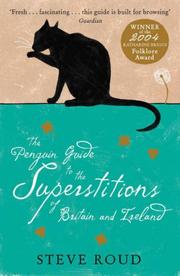
The Penguin Guide to the Superstitions of Britain and Ireland
Covers beliefs behind phantom riders and ghost roads.
eBay marketplace picks
Marketplace Samples
Live-tested eBay searches with available results related to this page.
Endnotes
1.
Source: visitsomerset.co.uk
Link:https://www.visitsomerset.co.uk/discover-somerset/inspiration/paranormal-somerset/paranormal-trail/paranormal-trail
Source snippet
Paranormal TrailExplore the mystic and mysterious side of Somerset with our thrilling Paranormal Trail. From ancient abbeys to haunted pr...
2.
Source: Wikipedia
Link:https://en.wikipedia.org/wiki/Brockley_Combe
3.
Source: somersetandbathparanormal.co.uk
Title: Debunking the Myth
Link:https://www.somersetandbathparanormal.co.uk/debunking-the-myth-sally-in-the-woods-bath
4.
Source: somersetlive.co.uk
Title: sally in wood haunted bath 1965500
Link:https://www.somersetlive.co.uk/news/history/sally-in-wood-haunted-bath-1965500
5.
Source: Wikipedia
Title: Cadbury Castle, Somerset
Link:https://en.wikipedia.org/wiki/Cadbury_Castle%2C_Somerset
6.
Source: visitsomerset.co.uk
Link:https://www.visitsomerset.co.uk/discover-somerset/inspiration/itineraries/4-days/somerset-paranormal-trail
7.
Source: visitsomerset.co.uk
Link:https://www.visitsomerset.co.uk/discover-somerset/inspiration/history-and-heritage/cadbury-castle
8.
Source: somersetlive.co.uk
Title: history teacher says saw ghost 8262644
Link:https://www.somersetlive.co.uk/news/somerset-news/history-teacher-says-saw-ghost-8262644
9.
Source: somersetandbathparanormal.co.uk
Title: Midsummer Spirits
Link:https://www.somersetandbathparanormal.co.uk/midsummer-spirits
10.
Source: wshc.org.uk
Title: Wiltshire and Swindon History Centre Sally in the Wood
Link:https://wshc.org.uk/sally-in-the-wood/
11.
Source: hillforts.arch.ox.ac.uk
Link:https://hillforts.arch.ox.ac.uk/records/EN3948.html
12.
Source: paranormaldatabase.com
Link:https://www.paranormaldatabase.com/somerset/somedata.php?pageNum_paradata=6
13.
Source: a41roadtohistory.blogspot.com
Title: the ghost coach of brockley
Link:https://a41roadtohistory.blogspot.com/2013/12/the-ghost-coach-of-brockley.html
14.
Source: icysedgwick.com
Title: Icy Sedgwick All Aboard the Phantom Coaches of Folklore and Legend
Link:https://www.icysedgwick.com/phantom-coaches/
15.
Source: hauntedhosts.com
Title: Haunted Hosts The Jilted Girl of Brockley Combe
Link:https://hauntedhosts.com/haunted-places/somerset/location/2584-the-jilted-girl-of-brockley-combe
16.
Source: historicengland.org.uk
Link:https://historicengland.org.uk/listing/the-list/list-entry/1011980
17.
Source: themodernantiquarian.com
Link:https://www.themodernantiquarian.com/site/49/cadbury-castle-south-cadbury
18.
Source: themodernantiquarian.com
Title: The Modern Antiquarian Cadbury Castle (South Cadbury) (Hillfort) – Folklore by
Link:https://www.themodernantiquarian.com/post/42021/folklore/cadbury-castle-south-cadbury
19.
Source: heritagegateway.org.uk
Link:https://www.heritagegateway.org.uk/Gateway/Results_Single.aspx?resourceID=19191&uid=199646
20.
Source: wikishire.co.uk
Link:https://wikishire.co.uk/wiki/Somerset
21.
Source: somersetheritage.org.uk
Link:https://www.somersetheritage.org.uk/record/55105
22.
Source: somersetheritage.org.uk
Link:https://www.somersetheritage.org.uk/record/54554
23.
Source: youtube.com
Title: Visit Somerset
Link:https://www.youtube.com/playlist?list=PLWw20ffVqCzn0DReqTLiaQnR-Md7fhGR_
24.
Source: youtube.com
Link:https://www.youtube.com/watch?v=c8Parcc8wHk
25.
Source: hauntedhosts.com
Link:https://hauntedhosts.com/haunted-places/somerset/location/2869-king-arthurs-procession-ghost/
26.
Source: hauntedhosts.com
Link:https://hauntedhosts.com/haunted-places/somerset/location/2583-brockley-church-ghost
27.
Source: hauntedhosts.com
Title: Sally in the Wood Ghost
Link:https://hauntedhosts.com/haunted-places/somerset/location/1384-sally-in-the-wood-ghost
28.
Source: baronofnorthcadbury.com
Title: Cadbury Castle
Link:https://baronofnorthcadbury.com/History-Library/Cadbury-Castle
29.
Source: haunted-britain.com
Title: Cadbury Castle
Link:https://www.haunted-britain.com/cadbury-castle.htm
30.
Source: haunted-houses.co.uk
Link:https://www.haunted-houses.co.uk/visit-somerset/
31.
Source: paranormaldatabase.com
Title: The Paranormal Database
Link:https://www.paranormaldatabase.com/reports/arthur.php
32.
Source: tessofthevale.com
Title: cadbury castle
Link:https://tessofthevale.com/2026/01/12/cadbury-castle/
Additional References
33.
Source: youtube.com
Title: Somerset Myths & Legends | English Folklore Documentary
Link:https://www.youtube.com/watch?v=2vTRAvhDb0g
Source snippet
The Grey Lady and the Ghosts of Dunster Castle | English Folklore...
34.
Source: academia.edu
Link:https://www.academia.edu/68415712/Post_Roman_Transitions
35.
Source: facebook.com
Link:https://www.facebook.com/ExtoursBobbie/posts/-an-all-new-extours-experience-cadbury-castlethis-april-we-introduce-something-d/894266300116583/
36.
Source: amazon.de
Link:https://www.amazon.de/-/en/BRITISH-FOLK-TALES-Katharine-Briggs/dp/0394739930?tag=searcht-20
37.
Source: facebook.com
Link:https://www.facebook.com/bristol.live/posts/a-true-crime-youtuber-has-documented-their-visit-to-what-is-considered-one-of-th/5469228496475622/
38.
Source: facebook.com
Link:https://www.facebook.com/groups/638416113618702/posts/1462145781245727/
39.
Source: facebook.com
Link:https://www.facebook.com/groups/638416113618702/posts/1462154434578195/
40.
Source: facebook.com
Link:https://www.facebook.com/groups/792274992649766/posts/878324314044833/
41.
Source: facebook.com
Link:https://www.facebook.com/SilentEarthLimited/posts/cadbury-castle-iron-age-hillfort-somersetsunsetdescribed-by-historic-england-on-/3242122372470279/
42.
Source: nightbringer.se
Link:https://nightbringer.se/nightbringer/a_cadburycastle.html
Topic Tree