Where Brecknockshire's Quiet Hauntings Begin
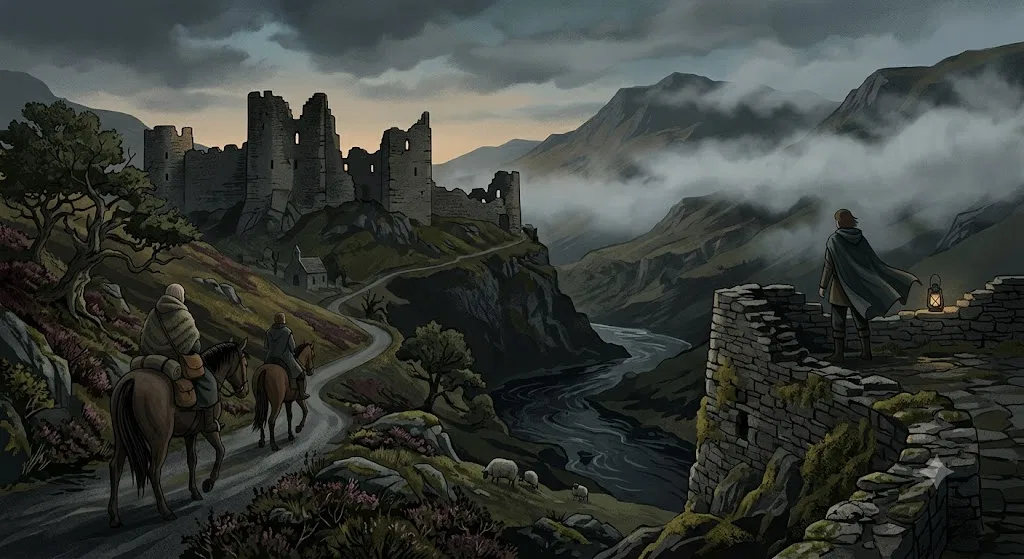
Brecknockshire’s haunted reputation is quieter than that of some Welsh counties, but it has a strong atmosphere: ruined Norman castles, mountain roads, old religious sites, lonely farms, and folklore rooted in lakes, lights, goblins, and borderland memory.
Page outline Jump by section
Introduction
For this page, “Brecknockshire” means the historic county also known as Breconshire or the County of Brecon. It sits in inland Mid Wales, centred on Brecon and the Usk valley, with the Black Mountains, Bannau Brycheiniog/Brecon Beacons and Fforest Fawr shaping both its landscape and its legends. Modern boundaries can confuse the picture: many places now appear under Powys or within national park tourism, but the historic-county frame keeps the focus on Brecon, Ystradgynlais, Builth Wells, Crickhowell, Hay-on-Wye, Talgarth and their surrounding uplands.[wikishire.co.uk]wikishire.co.ukOpen source on wikishire.co.uk.
Where the haunted map begins
Brecknockshire is a mountainous rural county, bounded historically by Radnorshire, Herefordshire, Monmouthshire, Glamorgan, Carmarthenshire and Cardiganshire. That matters for ghost stories because the county’s haunted geography is not a neat list of buildings. It is a landscape of approaches: roads over passes, river crossings, ruined castles above market towns, chapels on dark lanes, and estates that later became hotels, hospitals or tourist sites.[Wikishire]wikishire.co.ukOpen source on wikishire.co.uk.
The strongest haunted traditions in the county fall into three broad types. First are heritage hauntings, where castles, houses or inns use ghost stories as part of their public identity. Craig-y-Nos Castle is the clearest example. Second are local reports and newspaper stories, such as the supposed face photographed at Brecon Castle in 2016. Third are older folklore motifs, where the supernatural is less a “ghost sighting” than a traditional way of explaining lights, lakes, caves, rough places and uncanny journeys after dark.[visitwales.com]visitwales.comOpen source on visitwales.com.
That mix gives Brecknockshire a distinctive tone. Its ghost stories are not usually grand courtly legends of murdered queens or famous battlefield apparitions. They are more often stories of remote rooms, sanatorium memory, chapel lanes, old religious buildings, strange lights and the feeling that the mountains are older than ordinary explanation.
Craig-y-Nos Castle: Brecknockshire’s best-known haunted house
Craig-y-Nos Castle, near Penycae in the upper Swansea valley, is the county’s most prominent haunted attraction. Visit Wales describes it as “known as the most haunted castle in Wales”, and the Land of Legends Wales project links its ghostly reputation to its unusual layered history: the home of the celebrated opera singer Adelina Patti, then a tuberculosis hospital, and now a hotel and visitor destination.[Visit Wales]visitwales.comOpen source on visitwales.com.
The building’s documented history helps explain why it became such fertile ground for ghost stories. Coflein, the online record of the Royal Commission on the Ancient and Historical Monuments of Wales, describes Craig-y-Nos as a large castellated country house overlooking the River Tawe, originally built in 1842 for Rhys Davies Powell, then enlarged for Adelina Patti, including the theatre of 1891. The castle is listed, and the theatre and auditorium are Grade I listed, giving the place a rare architectural status as well as a Gothic presence.[Coflein]coflein.gov.ukOpen source on coflein.gov.uk.
The Patti connection gives the haunting tradition its theatrical glamour. Patti was one of the most famous singers of her age, and her private theatre at Craig-y-Nos was designed as a miniature opera house. Modern ghost tourism tends to make much of that contrast: applause, music and celebrity on one side; empty corridors, shuttered rooms and rumours of apparitions on the other. Visit Wales notes the theatre and the castle’s haunted reputation together, while Craig-y-Nos’s own history-tour material presents the site through its shift from celebrity home to hospital.[Visit Wales]visitwales.comVisit Wales Craig Y Nos Castle Grade 1 Listed TheatreVisit Wales Craig Y Nos Castle Grade 1 Listed Theatre
The hospital period gives the haunting stories a more serious undertone. After Patti’s death in 1919, the castle became the Adelina Patti Hospital, a sanatorium for tuberculosis patients, mainly children and young adults. UCL’s work on The Children of Craig-y-nos records that the book grew from a public engagement and oral-history project about life in the sanatorium between 1922 and 1959. Bannau Brycheiniog’s own account describes children staying for years under harsh treatments of the time, including immobilisation in plaster and sleeping outdoors on balconies for fresh-air therapy.[University College London]ucl.ac.ukOpen source on ucl.ac.uk.
That history does not prove ghosts. It does, however, explain why visitors may find the building emotionally charged. Craig-y-Nos has the ingredients from which modern haunted-house reputations are often made: a dramatic building, a famous former owner, preserved performance spaces, hospital memory, oral testimony, and an overnight hospitality setting where guests are primed to notice creaks, draughts and footsteps. The most careful reading is that Craig-y-Nos is both a genuine historic site and a highly developed haunted-tourism location, with its ghost stories shaped by architecture, memory and marketing as much as by witness claims.

Brecon Castle: a Norman ruin with a modern ghost photograph
Brecon Castle stands at the heart of the county town, where the rivers Usk and Honddu meet. The castle’s own hotel history describes it as founded in 1093 by Bernard de Neufmarché as a Norman stronghold in Brycheiniog, and other heritage accounts emphasise its strategic river position and repeated medieval conflict.[The Castle, Brecon]breconcastle.co.ukThe Castle, Brecon AboutThe Castle, Brecon About
Its haunted reputation is much thinner than Craig-y-Nos’s, but one modern episode gave it a place in local ghost discussion. In February 2016, the Brecon & Radnor Express reported that local history enthusiast Louie Evans had photographed what appeared to be the outline of a stern face at the fourteenth-century tower of Brecon Castle. The report presented the image as a possible “ghost of Brecon Castle”, but the framing was cautious and newsy rather than evidential: a local photograph, an eerie resemblance, and a castle already attractive to ghost hunters.[Brecon & Radnor Express]brecon-radnor.co.ukcaptured on camerathe ghost of brecon castle 77972captured on camerathe ghost of brecon castle 77972
The sceptical explanation is straightforward. Ruins create shadows, pareidolia and suggestive textures: the human brain is very good at seeing faces in stone, cloud, bark or smoke. Brecon Castle’s long history of conquest, siege and decay makes such an image feel meaningful, but the photograph by itself is not strong evidence of a haunting. Its value is folkloric and cultural: it shows how an ancient place can acquire a fresh ghost story through a phone camera, a local newspaper and the public appetite for haunted heritage.
Brecon Castle is still important to the county’s supernatural map because it anchors the haunted imagination in real medieval history. It was not merely “old”; it was a power centre in a contested borderland, later reduced and repurposed. That movement from fortress to ruin to hotel is exactly the kind of transformation that often invites ghost stories, even when the surviving accounts are sparse.
Older Brecknockshire folklore: lights, goblins and chapel roads
Brecknockshire’s deeper supernatural tradition is not confined to castles. In Wirt Sikes’s nineteenth-century collection British Goblins, the county appears in stories of the Pwca, fairy beings, corpse-candles and uncanny lights. The book’s contents explicitly connect Breconshire with “Puck Valley” and the Pwca, and one passage tells of Walter Watkins of the Neuadd, in a Brecknockshire parish, seeing a light near Taf Fechan Chapel while travelling on a dark night.[Project Gutenberg]gutenberg.orgOpen source on gutenberg.org.
These are not ghost stories in the modern hotel-brochure sense. They belong to an older Welsh supernatural system in which lights, sounds and presences could warn, mislead, mock or mark death. The “corpse-candle” tradition, known across Wales, is especially important: lights seen at night were sometimes interpreted as omens of a funeral or death. Sikes’s account places Brecknockshire within that wider Welsh pattern, but gives it local texture through named people, chapels and routes.[Project Gutenberg]gutenberg.orgOpen source on gutenberg.org.
The Pwca tradition also matters because it links Brecknockshire to one of the best-known British supernatural figures: Puck. Sikes records Breconshire material around “Puck Valley”, and later scholarly discussion has noted claims that Shakespeare’s Puck may have drawn, at least speculatively, on Welsh Pwca traditions concentrated in Brecknockshire. That claim should be treated carefully: it is a literary and folkloric suggestion, not a settled fact. What is safer to say is that Brecknockshire had a recognised Pwca tradition strong enough to attract antiquarian and folklorist attention.[Project Gutenberg]gutenberg.orgOpen source on gutenberg.org.
For haunted-history readers, the key point is that Brecknockshire’s old supernatural landscape was active outdoors. The uncanny was not always inside a locked room. It could appear beside a chapel, on a dark road, in a valley, near water, or in a place where a traveller was vulnerable to fear, weather, bad footing and imagination.
The “Black Doctor” of Brecon Priory
One of the more striking older ghost references comes from Theophilus Jones’s A History of the County of Brecknock. In a passage on the archdeaconry and Brecon’s religious buildings, Jones records that buildings near the old cloisters were known in later years as “y Doctor du” because of a tradition that the ghost of a man dressed in black haunted them. The buildings, he says, had been taken down about thirty years earlier.[Internet Archive]archive.orgOpen source on archive.org.
This is a valuable kind of source because it is not a modern ghost-hunt advertisement. It is an antiquarian county history preserving a local name and a remembered tradition. The detail is brief, but that brevity is part of its credibility as folklore: Jones is not building a theatrical tale, only noting that the site had a ghostly association strong enough to leave a name behind.
The “Black Doctor” story also shows how Brecknockshire hauntings attach themselves to altered places. The buildings were already gone or going when the tradition was recorded. The ghost, in that sense, marks absence: a vanished monastic or post-monastic space, remembered through a name, a colour, and the figure of a man in black. It is exactly the kind of fragment that local haunted history depends on, and exactly the kind that should be handled cautiously because the surviving account gives little more than the tradition itself.
Heol Fanog and the modern media haunting
No modern Brecon Beacons haunting has travelled further through media than Heol Fanog, often called Hellfire Farm or the Welsh Amityville. The farmhouse is usually described as remote, high in the Brecon Beacons, and became widely known through the Rich family’s claims of disturbing phenomena after they moved there in the late 1980s. WalesOnline’s 2023 account summarises the story as beginning with an unexpectedly high electricity bill and developing into the haunting later dramatised in podcasts and television.[Wales Online]walesonline.co.ukremote farmhouse thats been called 27185992remote farmhouse thats been called 27185992
This case needs careful handling because it sits between personal testimony, entertainment media and paranormal branding. Reports describe claims of poltergeist-like activity, possession fears, exorcisms and family distress, but most accessible accounts are retrospective and shaped by documentary or podcast retellings. The Abergavenny Chronicle’s 2024 feature notes the farmhouse’s reputation as “the Welsh Amityville” and “Hellfire Farm”, language that signals how strongly the story has been processed through horror comparison and media myth-making.[Abergavenny Chronicle]abergavennychronicle.comAbergavenny Chronicle Spooky SaturdayAbergavenny Chronicle Spooky Saturday
For a Brecknockshire page, Heol Fanog is important not because it can be verified as paranormal, but because it shows how a rural Welsh haunting can become a modern media property. Older folklore made meaning from corpse-lights and goblin roads; modern media makes meaning from bills, appliances, family testimony, exorcists, cameras and documentary reconstruction. Both forms depend on place, isolation and the feeling that ordinary explanation has failed.
The most balanced view is that Heol Fanog is a significant contemporary haunting claim associated with the Brecon Beacons landscape, but its public reputation rests heavily on family accounts and later retellings. It belongs in the county’s haunted history as a modern legend, not as a settled case.
Llyn y Fan Fach: fairy folklore at the county edge
Llyn y Fan Fach lies in the Black Mountain area, associated especially with Myddfai and the famous Lady of the Lake legend. Strictly, the lake is often placed just beyond Brecknockshire’s western historic boundary in Carmarthenshire, but it belongs to the same mountain folklore zone and is closely tied to routes, views and traditions that visitors often approach through the Brecon Beacons/Bannau Brycheiniog.[National Botanic Garden of Wales]botanicgarden.walesNational Botanic Garden of Wales The legend of the Lady of the Lake demystifiedNational Botanic Garden of Wales The legend of the Lady of the Lake demystified
The legend tells of a young farmer who encounters a beautiful woman from the lake, marries her under a condition, then loses her after he breaks the terms of their marriage. The story is also linked to the Physicians of Myddfai, whose healing knowledge is traditionally said to descend from this fairy or otherworldly union. The National Botanic Garden of Wales summarises the tradition as a widely claimed link between the Physicians and a fairy from Llyn y Fan Fach; the Fforest Fawr Geopark account presents it as a story told and retold around identifiable landscape features.[National Botanic Garden of Wales]botanicgarden.walesNational Botanic Garden of Wales The legend of the Lady of the Lake demystifiedNational Botanic Garden of Wales The legend of the Lady of the Lake demystified
This is not a ghost story in the narrow sense, but it matters for Brecknockshire’s haunted map because it shows the region’s older supernatural language. Lakes are thresholds. Cattle, marriage rules, healing gifts and broken promises carry meanings that are older and stranger than a simple apparition. For readers interested in haunted Brecknockshire, Llyn y Fan Fach is best treated as a neighbouring folklore anchor: not the county’s own central ghost site, but part of the same upland imaginative world.
How credible are Brecknockshire’s hauntings?
Brecknockshire’s haunted material varies greatly in strength. Some sites have excellent historical documentation but weak paranormal evidence; others have vivid ghost claims but rely mainly on tourism copy, local journalism or retrospective media.
Craig-y-Nos Castle has strong historical grounding: its architecture, Patti theatre and sanatorium period are well documented by heritage bodies, UCL and national-park sources. Its ghost reputation is also prominent in tourism, but the specific apparition claims are harder to test. The result is a place where the history is solid, the atmosphere is powerful, and the haunting claims remain matters of tradition, witness experience and visitor expectation.[coflein.gov.uk]coflein.gov.ukOpen source on coflein.gov.uk.
Brecon Castle has equally strong historical grounding as a Norman site, but its modern ghost evidence is slight: a single reported photograph and the interpretive possibilities that come with old stonework. It is better understood as a haunted-feeling ruin with occasional local ghost claims than as a major documented haunting.[breconcastle.co.uk]breconcastle.co.ukThe Castle, Brecon AboutThe Castle, Brecon About
The older folklore is credible in a different way. A corpse-light or Pwca story is not evidence that such beings objectively exist; it is evidence that people in Brecknockshire and neighbouring Welsh communities had a rich language for uncanny experience. Folklore collections such as British Goblins preserve how people made sense of fear, death, darkness, landscape and sudden lights before modern explanations became dominant.[Project Gutenberg]gutenberg.orgOpen source on gutenberg.org.
Heol Fanog is the most contested modern case. It has a strong media footprint and a memorable rural setting, but its public record is dominated by personal claims and later retellings. That does not make it worthless; it makes it a modern legend whose importance lies in testimony, reception and the way the story has been packaged as “Hellfire Farm” or the “Welsh Amityville”.[Wales Online]walesonline.co.ukremote farmhouse thats been called 27185992remote farmhouse thats been called 27185992
Why Brecknockshire feels haunted
The county’s haunted appeal comes from the meeting of landscape and memory. Brecknockshire is not merely a container for ghost stories; its terrain helps generate them. Mountain weather closes in quickly. Roads cross exposed ground. Rivers cut through old settlements. Ruined castles stand close to inns and hotels. Religious sites leave fragments, names and foundations behind. In such places, the line between history and atmosphere is naturally thin.
That atmosphere should not be mistaken for proof. A careful haunted history of Brecknockshire has to hold two ideas together: many of the ghost claims are unverifiable, but the reasons they endure are real. Craig-y-Nos really did move from opera-house glamour to sanatorium hardship. Brecon Castle really did grow out of conquest and conflict. Folklorists really did record Brecknockshire traditions of lights, goblins and uncanny journeys. The Black Doctor really does survive as a named local ghost tradition in county history.[ucl.ac.uk]ucl.ac.ukOpen source on ucl.ac.uk.
For visitors, the most rewarding approach is to treat Brecknockshire’s hauntings as layered stories rather than simple scares. Craig-y-Nos offers the most accessible haunted destination; Brecon Castle gives the county town its medieval shadow; Heol Fanog shows how modern media can turn rural distress into legend; and the older folklore of the Pwca, corpse-candles and fairy lakes reveals a Brecknockshire where the supernatural once belonged to roads, weather, water and night.
Amazon book picks
Further Reading
Books and field guides related to Where Brecknockshire's Quiet Hauntings Begin. Use these as the next step if you want deeper reading beyond the article.

The Mammoth Book of Haunted House Stories
Appeals to readers exploring haunted places.
The Lore of Wales
Excellent introduction to traditions behind Brecknockshire hauntings.
eBay marketplace picks
Marketplace Samples
Live-tested eBay searches with available results related to this page.
Endnotes
1.
Source: gutenberg.org
Link:https://www.gutenberg.org/files/34704/34704-h/34704-h.htm
2.
Source: archive.org
Link:https://archive.org/stream/historyofcountyo02jone/historyofcountyo02jone_djvu.txt
3.
Source: ia800109.us.archive.org
Link:https://ia800109.us.archive.org/21/items/britishgoblinswe00sikerich/britishgoblinswe00sikerich.pdf
4.
Source: archive.org
Link:https://archive.org/download/britishgoblinswe00sikerich/britishgoblinswe00sikerich.pdf
5.
Source: gutenberg.org
Title: 55989 h
Link:https://www.gutenberg.org/files/55989/55989-h/55989-h.htm
6.
Source: visitwales.com
Link:https://www.visitwales.com/inspire-me/short-breaks/haunted-wales
7.
Source: wikishire.co.uk
Link:https://wikishire.co.uk/wiki/Brecknockshire
8.
Source: abcounties.com
Link:https://abcounties.com/counties/county-profiles/brecknockshire/
9.
Source: en.wikisource.org
Link:https://en.wikisource.org/wiki/1911_Encyclop%C3%A6dia_Britannica/Breconshire
10.
Source: brecon-radnor.co.uk
Title: captured on camerathe ghost of brecon castle 77972
Link:https://www.brecon-radnor.co.uk/news/captured-on-camerathe-ghost-of-brecon-castle-77972
11.
Source: coflein.gov.uk
Link:https://coflein.gov.uk/en/sites/25344
12.
Source: visitwales.com
Title: Visit Wales Craig Y Nos Castle Grade 1 Listed Theatre
Link:https://www.visitwales.com/attraction/castle/craig-y-nos-castle-535821
13.
Source: ucl.ac.uk
Link:https://www.ucl.ac.uk/news/2009/may/launch-children-craig-y-nos-tuberculosis-history
14.
Source: breconcastle.co.uk
Title: The Castle, Brecon About
Link:https://breconcastle.co.uk/about-us/
15.
Source: britainexpress.com
Link:https://www.britainexpress.com/wales/mid/castles/brecon-castle.htm
16.
Source: walesonline.co.uk
Title: remote farmhouse thats been called 27185992
Link:https://www.walesonline.co.uk/news/wales-news/remote-farmhouse-thats-been-called-27185992
17.
Source: abergavennychronicle.com
Title: Abergavenny Chronicle Spooky Saturday
Link:https://www.abergavennychronicle.com/news/spooky-saturday-a-look-behind-the-welsh-amityville-728349
18.
Source: botanicgarden.wales
Title: National Botanic Garden of Wales The legend of the Lady of the Lake demystified
Link:https://botanicgarden.wales/2016/10/legend-lady-lake-demystified/
19.
Source: Wikipedia
Link:https://en.wikipedia.org/wiki/Brecknockshire
20.
Source: Wikipedia
Link:https://simple.wikipedia.org/wiki/Brecknockshire
21.
Source: Wikipedia
Title: Brecon Castle
Link:https://en.wikipedia.org/wiki/Brecon_Castle
22.
Source: Wikipedia
Title: Llyn y Fan Fach
Link:https://en.wikipedia.org/wiki/Llyn_y_Fan_Fach
23.
Source: barmouthtowncouncil.gov.uk
Link:https://www.barmouthtowncouncil.gov.uk/myths
24.
Source: beacons-npa.gov.uk
Title: Powys Heritage and Cultural Audit Final
Link:https://www.beacons-npa.gov.uk/wp-content/uploads/oldsite/the-authority/working-in-partnership/tourism-new/sustainability-1/Powys%20Heritage%20and%20Cultural%20Audit%20Final.pdf
25.
Source: traveltrade.visitwales.com
Title: haunted wales
Link:https://traveltrade.visitwales.com/itineraries/heritage-and-culture/haunted-wales
26.
Source: visitwales.com
Title: 12 stunning castles visit bannau brycheiniog brecon
Link:https://www.visitwales.com/things-do/attractions/castles-and-heritage/12-stunning-castles-visit-bannau-brycheiniog-brecon
27.
Source: amateur-theatre-wiki.gwi.uni-muenchen.de
Title: Patti Theatre
Link:https://www.amateur-theatre-wiki.gwi.uni-muenchen.de/index.php/Patti_Theatre
28.
Source: wikishire.co.uk
Title: Historic Counties Standard
Link:https://wikishire.co.uk/wiki/Historic_Counties_Standard
29.
Source: medievalheritage.eu
Link:https://medievalheritage.eu/en/main-page/heritage/wales/brecon-castle/
30.
Source: brecon-radnor.co.uk
Title: br halloween ghost stories from around powys 83788
Link:https://www.brecon-radnor.co.uk/news/br-halloween-ghost-stories-from-around-powys-83788
31.
Source: abergavennychronicle.com
Link:https://www.abergavennychronicle.com/news/the-skirrid-inn-and-a-spooky-farmhouse-in-the-brecon-beacons-make-a-list-of-the-most-haunted-places-in-wales-646513
Additional References
32.
Source: youtube.com
Link:https://www.youtube.com/watch?v=FVIe09V3IUs
Source snippet
Craig Y Nos Castle,Wales (it's history and it's ghosts)...
33.
Source: youtube.com
Title: Dark History of Heol Fanog’s Witch Farm | Welsh Amityville Revealed
Link:https://www.youtube.com/watch?v=3eTh6rGAizo
Source snippet
I Stay In The Most HAUNTED Castle In Wales...
34.
Source: youtube.com
Title: Episode 396: Heol Fanog
Link:https://www.youtube.com/watch?v=5WQ_X2Gver4
Source snippet
Dark History of Heol Fanog's Witch Farm | Welsh Amityville Revealed...
35.
Source: youtube.com
Title: Craig Y Nos Castle,Wales (it’s history and it’s ghosts)
Link:https://www.youtube.com/watch?v=-nLfL98LnFU
Source snippet
Episode 396: Heol Fanog - The Welsh Amityville...
36.
Source: breconbeaconstourism.org
Link:https://www.breconbeaconstourism.org/event/an-evening-of-ghost-stories-at-treberfydd-house/
37.
Source: wikidata.org
Link:https://www.wikidata.org/wiki/Q547052
38.
Source: castlewales.com
Link:https://www.castlewales.com/brecon.html
39.
Source: paranormaleyeuk.co.uk
Link:https://www.paranormaleyeuk.co.uk/brecon-guildhall-ghost-hunt
40.
Source: facebook.com
Link:https://www.facebook.com/BBCCymruWales/posts/-welcome-to-britains-most-haunted-house-danny-robins-returns-to-investigate-a-ne/478522197641115/
41.
Source: instagram.com
Link:https://www.instagram.com/p/DQWACFPk8uZ/
Topic Tree
Follow this branch
Related pages 91
- Haunted Clackmannanshire
- Haunted Antrim
- Haunted Armagh
- Haunted Durham
- Haunted Londonderry
- +86 more in sidebar