Within Haunted Bedfordshire
How Did Clophill Become So Notorious?
Old St Mary's at Clophill shows how a ruined church, grave desecration and tabloid fear became Bedfordshire's darkest legend.
On this page
- The ruined hilltop church
- The 1963 graveyard scandal
- Folklore, film and sceptical readings
Page outline Jump by section
Introduction
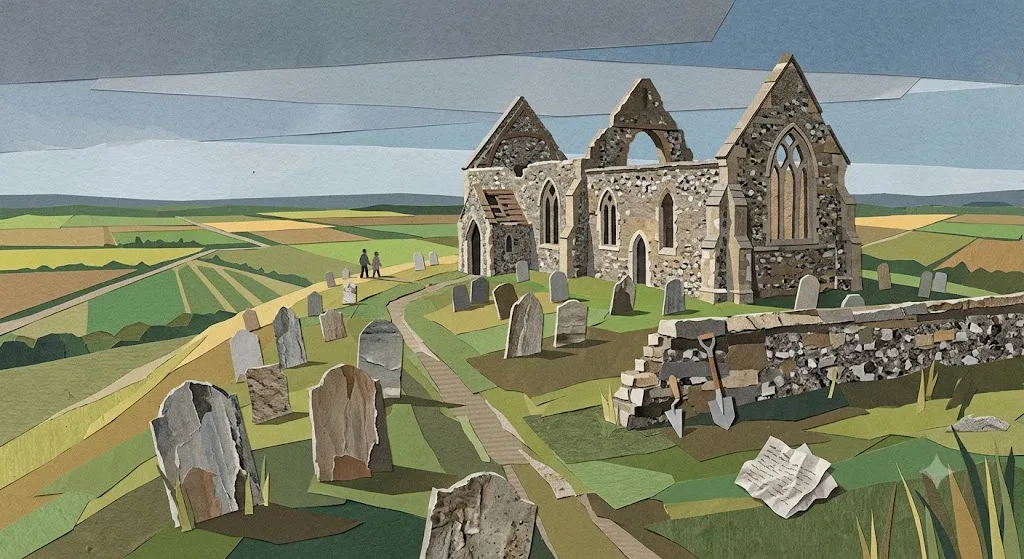
Clophill’s haunted church is not simply an old ruin with ghost stories attached. Old St Mary’s became Bedfordshire’s most notorious eerie landmark because a medieval hilltop church, abandoned churchyard, real grave desecration and dramatic newspaper language fused into one dark modern legend. The key event was the March 1963 scandal at the ruined church, when human remains from the grave of Jenny Humberstone, who died in 1770, were found disturbed and the scene was interpreted in the press as evidence of “black magic” or a “Black Mass”. Later retellings added ghost sightings, occult rumours, vandalism, film coverage and sceptical explanations. The result is a haunted-place tradition shaped less by a single ancient apparition than by modern fear: fear of desecration, youth mischief, occult influence, media exaggeration and a sacred site left vulnerable on the edge of a Bedfordshire village.[Weird In The Wade]weirdinthewade.blogOpen source on weirdinthewade.blog.
The ruined hilltop church
Old St Mary’s stands at the edge of Clophill, not in the centre of the modern village. That separation matters. The present parish church was built in the village in 1848–49 after the older church was judged too small and inconvenient for a growing population. The old building then became a mortuary chapel for the burial ground, with the chancel and porch removed and parts of the old church reused elsewhere. Bedfordshire Archives describe the old church as Perpendicular in style, dating broadly from around 1350, with a nave, chancel, south porch and west tower; the Church of England parish history notes that the hilltop church served Clophill for about 400 years before the new church took over.[Bedfordshire Archives]bedsarchives.bedford.gov.ukHosted By Bedford Borough Council: Old Saint Marys Church Clophill…
Its atmosphere was already striking before any twentieth-century scandal. Sir Stephen Glynne, visiting in 1854, called it a small abandoned church “on top of a very high hill”, a description that helps explain why later visitors found it so memorable: it is not tucked safely into a village street, but exposed, elevated and visually separate from everyday life. Bedfordshire Archives also record the practical decline of the building: repairs in 1901, theft of roof lead in 1956, removal of remaining fittings, and the ruinous state that followed.[Bedfordshire Archives]bedsarchives.bedford.gov.ukHosted By Bedford Borough Council: Old Saint Marys Church Clophill…
The site’s official status gives the story an important corrective. Old St Mary’s is not just a “haunted ruin” in folklore terms; Historic England lists it as a scheduled monument, while Central Bedfordshire Council describes it as a ruined church in Clophill, owned by the council and leased to the Clophill Heritage Trust. The council also notes that the trust restored the structure for visitors, consolidating the ruin and creating a viewing platform in the tower. This modern conservation work has helped shift the site away from dereliction and anti-social behaviour towards heritage, landscape and public access.[Historic England]historicengland.org.ukHistoric England Old St Mary's Church, ClophillHistoric England Old St Mary's Church, Clophill
That restoration is part of the story because abandonment itself helped make Clophill frightening. A ruined church, still surrounded by graves, is unusually vulnerable to trespass, rumour and ritual-looking vandalism. The Greensand Country information sheet describes Old St Mary’s as around 650 years old, a prominent feature on the Greensand Ridge, and a destination for visitors because of its views, wildlife and renovated tower. In other words, the same qualities that make it beautiful by day — isolation, height, age and open countryside — helped make it feel uncanny after dark.[kamino.fra1.cdn.digitaloceanspaces.com]kamino.fra1.cdn.digitaloceanspaces.comGreensand Info St Mary ChurchGreensand Info St Mary Church
One persistent piece of folklore claims that the old church was built “the wrong way round”, sometimes with the implication that it was somehow aligned against Christian custom. The parish history directly pushes back against that belief, saying the ruined church was “contrary to popular belief, the right way round”. This is a useful example of how Clophill works as folklore: a real architectural ruin becomes a screen onto which later visitors project a more sinister pattern.[stmaryschurchclophill.org]stmaryschurchclophill.orgHistory – St Mary’s Church, ClophillHistory – St Mary’s Church, Clophill
The 1963 graveyard scandal
The event that made Clophill nationally notorious took place in March 1963. Later summaries sometimes compress it into a simple claim that a “Black Mass” was held at the church, but the details are more complicated. A local account drawing on press coverage and later research describes two boys from Luton being seen with a human skull near the ruined church. When the rector, Rev. Leslie Barker, reached the site, the grave of Jenny Humberstone — a 22-year-old woman who died in 1770 — had been disturbed, bones were found scattered, and markings and cockerel feathers were reported inside the church.[Weird In The Wade]weirdinthewade.blogOpen source on weirdinthewade.blog.
The press framing was crucial. According to the same account, the Daily Mirror carried the story after the weekend discovery, and police comments were reported as suggesting “black magic practices”. That phrase gave the incident a ready-made narrative: this was no longer only grave desecration at a neglected rural church, but a supposed sign of hidden occult activity in modern Britain. Bill Ellis’s work on Satanism, new religions and the media is cited by later local researchers as suggesting that police and press interpretations may have owed more to popular ideas of black magic — including fiction such as Dennis Wheatley’s occult thrillers — than to specialist knowledge of ritual practice.[Weird In The Wade]weirdinthewade.blogOpen source on weirdinthewade.blog.
The Humberstone grave was not the only reported disturbance. Accounts of the 1963 incident say there were signs that several other graves had been interfered with, and that Jenny Humberstone’s remains were disturbed again after being reinterred. This second disturbance made the story harder to dismiss as a single act of teenage stupidity, even though later evidence complicated the idea of an organised occult group. The allegation that female graves were targeted also gave the case a lurid afterlife, though claims that Humberstone was selected because of healing, witchcraft or magical associations remain speculative rather than proven.[Weird In The Wade]weirdinthewade.blogOpen source on weirdinthewade.blog.
The panic widened in April 1963 when animal heads were found at Bluebell Wood near Caddington, south of Luton. Newspapers linked the discovery to Clophill because of the timing, the gruesome nature of the remains and the existing “black magic” frame. The connection was powerful as a story, but it was not the same as proof that one group carried out both acts. It shows how quickly a single Bedfordshire scandal could become part of a wider pattern in the public imagination: bones in a ruined church, animal remains in woodland, and talk of secret ritual all reinforced one another.[Weird In The Wade]weirdinthewade.blogOpen source on weirdinthewade.blog.
A later twist is especially important for credibility. Bedfordshire college students reportedly admitted that they had previously gone to the church, killed a cockerel, spread feathers and blood, and drawn a cross as what they later called a joke. They denied being responsible for the main March 1963 grave desecration. This does not solve the case, but it does change the reading. It suggests that some of the “ritual” evidence may have come from prankish, performative or copycat behaviour rather than from a coherent occult sect.[Weird In The Wade]weirdinthewade.blogOpen source on weirdinthewade.blog.
This is why Clophill should be treated as an occult panic as well as a haunted site. There was real desecration, real distress and real damage to human remains. But the leap from desecration to organised devil-worship was shaped by interpretation, press appetite and the cultural language available at the time. The horror of the incident was not invented; the certainty that it revealed a hidden black-magic cult is much less secure.
Why the story became Bedfordshire’s darkest legend
Clophill’s notoriety came from the collision of three things: a dramatic location, a violation of the dead, and a media-ready explanation. A lonely ruined church is already a strong Gothic image. A disturbed eighteenth-century grave adds genuine moral shock. Add the words “black magic”, and the site becomes memorable far beyond local parish history.
The church’s physical condition fed that process. Bedfordshire Archives note that the old church acquired an “unsavoury reputation” in the 1970s and 1980s because of dubious night-time practices, even while stressing that it could be a wonderful place to visit by day. That double identity — lovely viewpoint and feared nocturnal ruin — sits at the heart of Clophill’s appeal. It is not only a place where a story happened; it is a place whose appearance seems to confirm the story.[Bedfordshire Archives]bedsarchives.bedford.gov.ukHosted By Bedford Borough Council: Old Saint Marys Church Clophill…
National and local memory also did some of the work. The scandal came not long after the A6 murder near Deadman’s Hill, another notorious Bedfordshire case that drew national attention. Later retellings sometimes blur the geography and mood of these events, giving Clophill and its surrounding roads an unusually dark reputation for a small rural village. Careful handling matters here: the A6 murder is not itself the subject of the church haunting, but its nearness in time and place helped make the wider area feel ominous to readers and visitors already primed by press coverage.[Weird In The Wade]weirdinthewade.blogOpen source on weirdinthewade.blog.
The legend then became self-reinforcing. Once Old St Mary’s was known as a “black magic church”, it attracted curiosity, thrill-seekers, vandals and paranormal investigators. Rumour encouraged visits; visits encouraged more rumour. Later accounts mention further disturbances and ghost stories, but these sit on top of the 1963 scandal rather than replacing it. Clophill’s haunted identity is therefore unusually modern: it is a feedback loop between place, press, trespass and retelling.
That loop is also why the story feels darker than many older Bedfordshire ghost traditions. A white lady in a country house or a phantom coach on a road can be treated as romantic folklore. Clophill’s legend involves a named grave, disturbed remains and frightened living people. The haunting is not only about whether a spectre appears; it is about whether a community can protect its dead, its churchyard and its reputation.
Folklore, film and sceptical readings
The ghost stories attached to Old St Mary’s vary. Retellings mention hooded figures, shadowy presences, uncanny sounds, animal apparitions and bad luck following visits. These accounts are part of the site’s modern folklore, but they are generally less firmly documented than the 1963 desecration and the later conservation history. Their importance lies in how they show the scandal being translated into haunting language: once a place has been marked as desecrated, people begin to read ordinary darkness, ruined stone and graveyard silence through that expectation.
Popular media has kept that process alive. The 2013 British horror film The Paranormal Diaries: Clophill used the church’s reputation for occult and paranormal activity as its central premise, mixing factual interviews with a fictional found-footage storyline. Reviews and film listings repeatedly emphasised the way the film blurred real local legend with horror convention. That matters because film does not simply record folklore; it feeds it back to new audiences, turning a Bedfordshire parish scandal into a shareable haunted-location brand.[Wikipedia]WikipediaThe Paranormal Diaries: ClophillThe Paranormal Diaries: Clophill
The strongest sceptical reading does not require dismissing everything as “made up”. Instead, it separates layers. The medieval church is real. The abandonment and roof theft are documented. The grave desecration was real. Press and police interpretations of “black magic” were claims, not proof. Some ritual-looking material may have been produced by prankish or copycat behaviour. Later ghost reports belong to folklore and witness tradition rather than verified historical fact. This layered approach gives the story more, not less, power: it shows how a haunting can form around a genuine act of violation without every later embellishment being equally reliable.
The conservation story has also changed how the site can be understood. Old St Mary’s was removed from the Heritage at Risk Register in 2014 after a major restoration programme led by Clophill Heritage Trust, with English Heritage grants helping fund conservation of the ruins and a tower viewing platform. Central Bedfordshire Council now presents the site as a countryside and heritage destination, with Eco Lodges nearby, interpretation, a warden presence and improved security.[Historic England]historicengland.org.ukenglish heritage reveals heritage at risk in the east of england 2014english heritage reveals heritage at risk in the east of england 2014
That does not erase the haunted reputation, but it reframes it. The modern visitor is not encountering an abandoned danger zone in the same way that thrill-seekers did in the late twentieth century. They are encountering a protected historic ruin whose darkest legend remains part of its public identity. The panic has become heritage, but uneasily: the site is still remembered because of what was done there, what was said to have been done there, and what later generations wanted the story to mean.
How credible is the haunting?
Clophill is credible as a case of haunted reputation, not as proof of confirmed supernatural activity. The best-supported facts concern the building’s history, its abandonment, the 1956 roof-lead theft, the 1963 grave desecration, later vandalism and the twenty-first-century restoration. These are grounded in parish history, Bedfordshire Archives, local authority information and heritage records.[bedford.gov.uk]bedsarchives.bedford.gov.ukBedfordshire ArchivesHosted By Bedford Borough Council: Old Saint Marys Church Clophill…
The occult interpretation is more fragile. Contemporary reports described ritual-looking details, and later writers connected the case to broader British anxieties about black magic and Satanism. But the evidence does not securely establish an organised occult group, and admissions by students that some earlier ritual-like activity was a joke make simple sensational versions of the story unreliable. The responsible conclusion is that Clophill suffered real desecration which was then interpreted through the occult fears and media habits of its time.[Weird In The Wade]weirdinthewade.blogOpen source on weirdinthewade.blog.
The ghost stories are the most folkloric layer. They are valuable because they show how local memory works: a ruined church becomes haunted when people repeatedly approach it with fear, expectation and a story already in mind. That does not make witnesses dishonest. It means the site’s reputation shapes what people notice, how they describe it, and which experiences get repeated.
For Bedfordshire’s haunted history, Old St Mary’s is therefore a key case because it is not a simple ancient legend. It is a modern haunted place made from medieval stone, nineteenth-century abandonment, twentieth-century desecration, tabloid occult panic and twenty-first-century heritage management. Its darkness lies in that mixture: the church is beautiful, the scandal was real, the occult certainty is doubtful, and the folklore remains powerful because the hilltop ruin still looks like a place where the past has not quite settled.
Amazon book picks
Further Reading
Books and field guides related to How Did Clophill Become So Notorious?. Use these as the next step if you want deeper reading beyond the article.
The Penguin Guide to the Superstitions of Britain and Ireland
Offers background on supernatural beliefs relevant to Clophill.

eBay marketplace picks
Marketplace Samples
Live-tested eBay searches with available results related to this page.



Endnotes
1.
Source: bedsarchives.bedford.gov.uk
Title: Bedfordshire Archives
Link:https://bedsarchives.bedford.gov.uk/CommunityHistories/Clophill/OldSaintMarysChurchClophill.aspx
Source snippet
Hosted By Bedford Borough Council: Old Saint Marys Church Clophill...
2.
Source: stmaryschurchclophill.org
Title: History – St Mary’s Church, Clophill
Link:https://www.stmaryschurchclophill.org/history/
3.
Source: kamino.fra1.cdn.digitaloceanspaces.com
Title: Greensand Info St Mary Church
Link:https://kamino.fra1.cdn.digitaloceanspaces.com/greensands/app/uploads/2020/06/GreensandInfo-StMaryChurch.pdf
4.
Source: Wikipedia
Title: The Paranormal Diaries: Clophill
Link:https://en.wikipedia.org/wiki/The_Paranormal_Diaries%3A_Clophill
5.
Source: Wikipedia
Link:https://en.wikipedia.org/wiki/Clophill
6.
Source: Wikipedia
Title: St Mary’s Church, Clophill
Link:https://en.wikipedia.org/wiki/St_Mary%27s_Church%2C_Clophill
7.
Source: weirdinthewade.blog
Link:https://weirdinthewade.blog/2023/11/27/show-notes-links-and-transcript-for-the-black-magic-church/
8.
Source: historicengland.org.uk
Title: Historic England Old St Mary’s Church, Clophill
Link:https://historicengland.org.uk/listing/the-list/list-entry/1005392
9.
Source: centralbedfordshire.gov.uk
Title: Central Bedfordshire Council Countryside sites
Link:https://www.centralbedfordshire.gov.uk/directory_record/112627/st_marys_old_church
10.
Source: historicengland.org.uk
Title: english heritage reveals heritage at risk in the east of england 2014
Link:https://historicengland.org.uk/whats-new/news/english-heritage-reveals-heritage-at-risk-in-the-east-of-england-2014/
11.
Source: bedsarchives.bedford.gov.uk
Link:https://bedsarchives.bedford.gov.uk/CommunityHistories/Clophill/ClophillBefore1086.aspx
12.
Source: weirdinthewade.blog
Title: show notes and transcript for episode 10 the ghosts of st marys old church
Link:https://weirdinthewade.blog/2023/12/18/show-notes-and-transcript-for-episode-10-the-ghosts-of-st-marys-old-church/
13.
Source: planning.data.gov.uk
Link:https://www.planning.data.gov.uk/entity/13900561
14.
Source: greensandcountry.com
Title: clophill heritage trust
Link:https://www.greensandcountry.com/event/clophill-heritage-trust/
15.
Source: register-of-charities.charitycommission.gov.uk
Title: charitycommission.gov.uk CLOPHIL L HERITAGE TRUST
Link:https://register-of-charities.charitycommission.gov.uk/en/charity-search/-/charity-details/5011520/full-print
16.
Source: nationalchurchestrust.org
Title: Heritage At Risk
Link:https://www.nationalchurchestrust.org/HeritageAtRisk
17.
Source: dvdbeaver.com
Title: The Paranormal Diaries: Clophill
Link:https://www.dvdbeaver.com/film4/dvd_reviews_58/the_paranormaL_diaries_clophill.htm
18.
Source: filmstarts.de
Title: The Paranormal Diaries: Clophill
Link:https://www.filmstarts.de/kritiken/229619.html
19.
Source: ebay.co.uk
Title: Paranormal Diaries: Clophill
Link:https://www.ebay.co.uk/itm/224254647277?mkevt=1&mkcid=1&mkrid=710-53481-19255-0&campid=5339151051&customid=endnote-source&toolid=10001
Additional References
20.
Source: youtube.com
Title: Exploring Britain’s Most Evil Church (ft. Ghost Huns) | #422
Link:https://www.youtube.com/watch?v=tJhcUcFOCLM
Source snippet
Paranormal Investigation: St Mary's Church Clophill - Satanic Rituals & Witchcraft - TNWKS Ep.73...
21.
Source: youtube.com
Link:https://www.youtube.com/watch?v=65xWXodL9V8
Source snippet
Exploring Britain's Most Evil Church (ft. Ghost Huns) | #422...
22.
Source: youtube.com
Title: Part 1: CLOPHILL: The Church That Horrified a Nation (Documentary)
Link:https://www.youtube.com/watch?v=yDxpTvavSUM
Source snippet
Part 2: CLOPHILL The Church That HORRIFIED a Nation (Documentary)...
23.
Source: youtube.com
Title: TERRIFYING Hauntings In A Church Used For BLACK MAGIC
Link:https://www.youtube.com/watch?v=ATC9-o0JTqI
Source snippet
The Paranormal Diaries: Clophill Official Trailer 1 (2014) - Horror Movie HD...
24.
Source: youtube.com
Title: Part 2: CLOPHILL The Church That HORRIFIED a Nation (Documentary)
Link:https://www.youtube.com/watch?v=yyy8qS1VH98
Source snippet
TERRIFYING Hauntings In A Church Used For BLACK MAGIC...
25.
Source: youtube.com
Title: The Black Magic Church: The Dark History of Clophill
Link:https://www.youtube.com/watch?v=ikmqzZ3_MdM
Source snippet
Part 1: CLOPHILL: The Church That Horrified a Nation (Documentary)...
26.
Source: facebook.com
Link:https://www.facebook.com/lancashiretelegraph/posts/it-has-been-shamefully-neglected-but-is-not-beyond-saving-drone-footage-has-capt/1681403223406180/
27.
Source: tripadvisor.ca
Link:https://www.tripadvisor.ca/Tourism-g16835527-Clophill_Bedfordshire_England-Vacations.html
28.
Source: starburstmagazine.com
Link:https://www.starburstmagazine.com/features/interview-kevin-gates-paranormal-diaries-clophill/
29.
Source: amazon.de
Link:https://www.amazon.de/-/en/Bill-Ellis-ebook/dp/B08XN4WFGR?tag=searcht-20
Topic Tree