Why Is Yorkshire So Full of Ghosts?
Yorkshire is one of Britain’s richest counties for ghost stories because its legends sit on unusually deep layers of history: Roman York, medieval monasteries, ruined castles, old coaching inns, industrial towns, lonely moorland roads and seaside abbeys all carry stories of the restless dead.
Page outline Jump by section
What “Yorkshire” Means on a Haunted Counties Map
For this project, “Yorkshire” means the historic county: the large northern English county traditionally divided into the East Riding, North Riding and West Riding, with York at its centre. That matters because ghost stories do not obey today’s council borders. A legend may now be marketed as “North Yorkshire”, “West Yorkshire”, “South Yorkshire” or “East Riding”, but its older setting may belong to Yorkshire’s historic county identity and to one of the three Ridings. Wikishire describes the Ridings as ancient divisions whose boundaries meet at the walls of York, while Wikimedia Commons identifies Yorkshire as a historic county and historical region of England.[Wikishire]wikishire.co.ukRidings of YorkshireRidings of Yorkshire
Modern administrative changes, especially those that took effect in 1974, split much of historic Yorkshire across North Yorkshire, South Yorkshire, West Yorkshire, Humberside and Cleveland, with some areas transferred to other counties. For haunted-history reading, the practical approach is to keep the story’s old county setting in view while also recognising how visitors now encounter places through modern tourist boards, councils, National Trust regions and English Heritage listings.[Wikipedia]WikipediaOpen source on wikipedia.org.
This also explains why Yorkshire’s haunted map feels so varied. The North Riding gives the county ruined abbeys, castles, moorland roads, Dales traditions and the great ghost-city of York. The West Riding supplies manor-house spectres, industrial-age tragedies and modern poltergeist claims. The East Riding and Yorkshire coast add Holderness, the Wolds, Hull, Whitby, Scarborough and sea-facing ruins where folklore blends with tourism and Gothic literature.[Wikishire]wikishire.co.ukRidings of YorkshireRidings of Yorkshire
Why York Became Yorkshire’s Ghost Capital
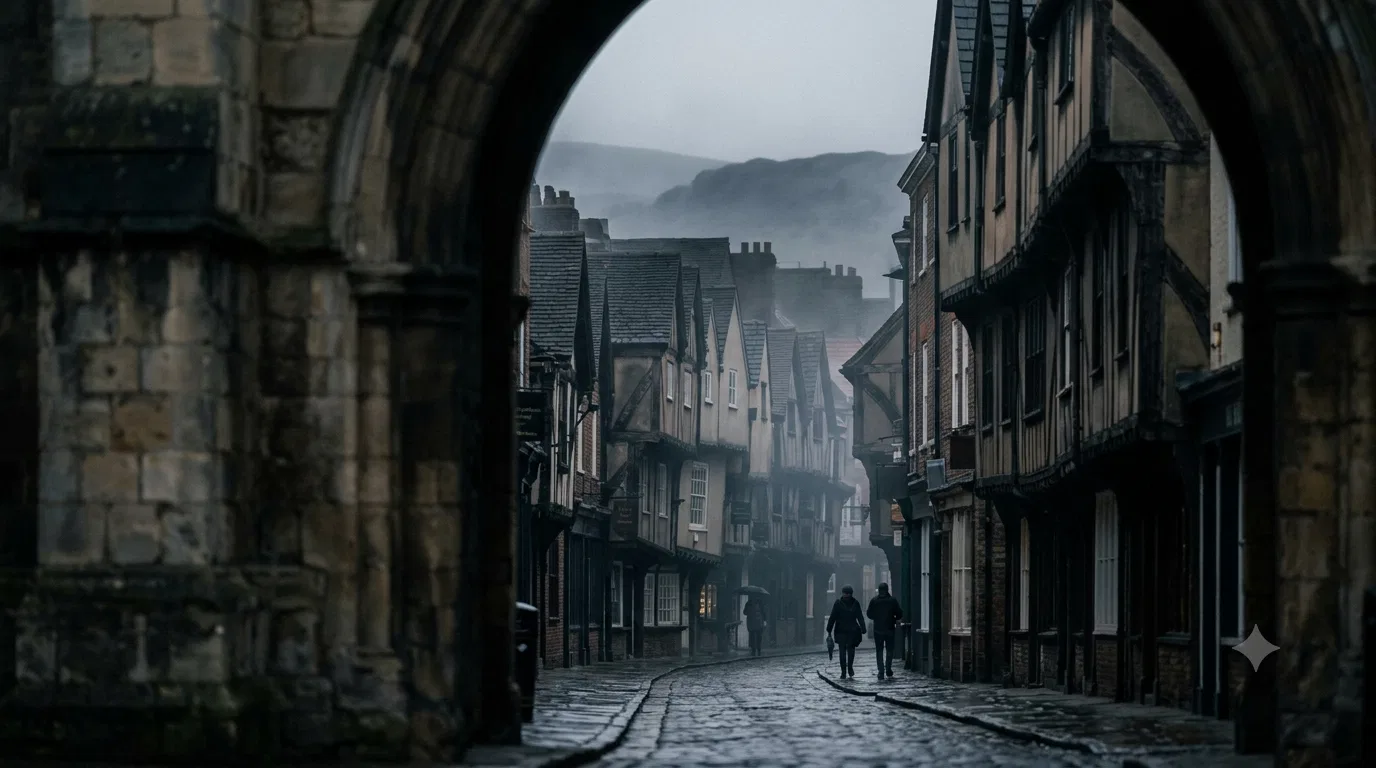
York’s haunted reputation rests on a rare combination: Roman remains under medieval streets, narrow passages, plague memories, old courts, prisons, churches, inns and an unusually strong guided-walk economy. Visit York openly markets the city through ghost walks and tours, describing it as a place where visitors are guided through “thousands of years of history, mystery, folklore and legends” in what is often promoted as “the most haunted city in Europe”.[Visit York]visityork.orgOpen source on visityork.org.
The key point is not that York has been proven to be more haunted than other cities. It is that York has become exceptionally good at preserving, performing and selling its ghost tradition. The Original Ghost Walk of York, the Bloody Tour of York and other tours make the old streets into a nightly stage, while the York Ghost Merchants have turned the city’s spectral identity into a distinctive craft-and-tourism culture.[theoriginalghostwalkofyork.co.uk]theoriginalghostwalkofyork.co.ukOpen source on theoriginalghostwalkofyork.co.uk.
The Roman soldiers beneath Treasurer’s House
The most famous York haunting is the Roman-soldier apparition at Treasurer’s House, a National Trust property near York Minster. The core modern story concerns Harry Martindale, an apprentice plumber who said that in 1953 he saw Roman soldiers and horses pass through the cellar while he was working below the house. The National Trust’s account stresses that the story gained attention after later excavations identified Roman remains beneath the site, including a major road in Eboracum, Roman York.[National Trust]nationaltrust.org.ukNational Trust The ghost stories of Treasurer's HouseNational Trust The ghost stories of Treasurer's House
The National Trust also records an earlier claimed experience from Joan Mawson, a housekeeper who said she heard horses’ hooves and saw Roman soldiers and horses in the cellar in February 1957. The house’s haunted reputation therefore rests on repeated testimony attached to a very specific underground location, rather than on a vague “old house” atmosphere. That does not verify the apparition, but it explains why the story is unusually memorable: the alleged sighting is tied to a known Roman landscape beneath the present building.[National Trust]nationaltrust.org.ukNational Trust The ghost stories of Treasurer's HouseNational Trust The ghost stories of Treasurer's House
For sceptical readers, the Treasurer’s House case is best treated as a classic “place memory” story: a modern witness account later mapped onto archaeology. It is powerful folklore because it gives York’s buried Roman city a visible, marching form. It also shows how ghost stories can become locally famous when a dramatic personal account meets a historically plausible setting.
York Castle Prison and haunted justice
York Castle Museum occupies former prison buildings on a site associated with justice and imprisonment for almost a thousand years. The museum’s own account notes that William the Conqueror built the first castle in 1068, that written references show it had a prison, and that the present prison exhibition focuses on former inmates including Dick Turpin and “the last woman to be burnt at the stake in Yorkshire”.[York Castle Museum]yorkcastlemuseum.org.ukOpen source on yorkcastlemuseum.org.uk.
This is the kind of place where ghost stories easily gather even when the strongest evidence is historical rather than paranormal. Cells, executions, condemned prisoners, debtors and public punishment create the emotional conditions for later tales of footsteps, presences and prison apparitions. York Museums Trust has also run haunted Halloween tours in which a prison gaoler recounts the darker history of the site alongside paranormal stories reported by staff in recent years.[yorkmuseumstrust.org.uk]yorkmuseumstrust.org.ukOpen source on yorkmuseumstrust.org.uk.
The useful distinction is between the documented prison history and the later haunted interpretation. Dick Turpin really was tried and executed in York, although local history sources stress that the romantic highwayman legend is far more polished than the violent historical man. Ghost tourism often feeds on that gap: the facts are grim enough, while the folklore gives them a lingering afterlife.[History of York]historyofyork.org.ukHistory of York Dick TurpinHistory of York Dick Turpin
Medieval Yorkshire Had Ghost Stories Before Modern Ghost Hunts
Yorkshire’s most important contribution to British ghost folklore may be the Byland Abbey ghost stories, written down around 1400 by an anonymous monk connected with Byland Abbey in North Yorkshire. English Heritage describes these twelve tales as an excellent example of medieval monastic ghost writing: the ghosts appear in fields, lanes and villages near the abbey and often ask the living for prayers so they can be released from Purgatory.[English Heritage]english-heritage.org.ukhaunted monasterieshaunted monasteries
The manuscript tradition is unusually strong. A modern transcription and translation project notes that the source is Royal MS 15 A XX and that a monk of Byland wrote the stories on blank pages in a manuscript that had belonged to the abbey. The stories are important because they seem close to oral storytelling: local places, abrupt encounters, recognisable anxieties and practical religious solutions.[ninazumel.com]ninazumel.comOpen source on ninazumel.com.
These are not Victorian fireside fantasies. They show a medieval Yorkshire in which the dead were imagined as still entangled with village life: blocking roads, speaking to neighbours, seeking absolution, warning the living or revealing unresolved sin. A modern reader may not share the medieval belief system, but the tales explain why Yorkshire’s later haunted abbeys feel so natural. Long before organised ghost walks, monks and villagers were already turning the local landscape into a map of troubled spirits.
Byland also helps to correct a common misunderstanding. Medieval ghosts were not always vague floating figures. In these stories they could be physical, noisy, troublesome, recognisable and theologically purposeful. They belonged to a Christian world in which haunting often meant unfinished moral business rather than simple horror.
Abbeys, Bells and Monastic Ruins
Yorkshire’s ruined religious houses are central to its haunted atmosphere because the Dissolution of the Monasteries left dramatic ruins across the county and because monastic life already carried strong ideas about death, prayer, burial and return. English Heritage’s account of Whitby Abbey notes its cliff-top Gothic power and its influence on Bram Stoker’s Dracula, while staff stories have included cold draughts, objects moving and unexplained taps on the shoulder.[English Heritage]english-heritage.org.ukoctober 2018 plan the scariest halloween everoctober 2018 plan the scariest halloween ever
Whitby is not just a ghost site; it is a Gothic amplifier. Its abbey ruins, churchyard, harbour, 199 steps and sea weather helped Stoker transform Yorkshire coastal scenery into world-famous vampire literature. Time’s account of Stoker’s Whitby research describes his use of the Subscription Library, local lore, the shipwreck story that fed into the Demeter episode, and a black dog motif connected with Yorkshire legend.[Time]time.comOpen source on time.com.
Local Whitby folklore also includes the tale of the submerged abbey bells. In the common version, bells removed after the Dissolution are loaded onto a ship, which sinks; on certain nights, the bells are said to be heard under the sea. The story is historically slippery but folklorically strong: it turns religious destruction into a sound that refuses to disappear.[The Whitby Guide]thewhitbyguide.co.ukThe Whitby Guide The Legend Of The Submerged Bells Of Whitby AbbeyThe Whitby Guide The Legend Of The Submerged Bells Of Whitby Abbey
Bolton Abbey, more properly the ruined Augustinian priory on the Bolton Abbey estate, has its own monastic ghost tradition. The Yorkshire Dales National Park has discussed the spooky story of an eerie ghost said to roam the site, while local-history material preserved by the Secret Library Leeds records newspaper discussion of a spectral monk at Bolton Abbey Rectory and presents it as an old tradition revived in the press.[Yorkshire Dales]yorkshiredales.org.ukYorkshire Dales Creepy Canons?Yorkshire Dales Creepy Canons?
These abbey stories often work in the same way. They do not usually provide hard evidence. Instead, they attach the shock of religious change, ruined architecture and local memory to recurring images: a monk crossing a precinct, bells sounding from impossible depths, a nun in a ruin, a presence near an old tomb. Their credibility is folkloric, but their emotional logic is clear.
Castles: Drummers, Headless Figures and Political Memory
Yorkshire’s castle ghosts tend to attach themselves to siege, imprisonment, secret passages and political violence. Scarborough Castle, on its North Sea headland, is a good example. English Heritage records that in 1312 Edward II’s favourite, Piers Gaveston, took refuge there during a baronial crisis before being forced to surrender; he was later taken south and executed at Blacklow Hill on 19 June 1312.[English Heritage]english-heritage.org.ukOpen source on english-heritage.org.uk.
Later ghost tradition turns that political humiliation into a headless apparition at Scarborough Castle. The historical connection is real — Gaveston was at Scarborough — but the ghost story is an interpretive afterimage, not a documented medieval claim. Its appeal is obvious: a powerful favourite falls from royal intimacy to violent death, and a dramatic coastal ruin supplies the stage.[Essex Ghost Hunters]essexghosthunters.co.ukOpen source on essexghosthunters.co.uk.
Richmond Castle has a different kind of haunted resonance. Its best-known legend is the drummer boy, a tale in which a boy is sent through a supposed tunnel between Richmond Castle and Easby Abbey, beating his drum so those above can follow his route; the drumming stops, and he is never seen again. Local walking accounts still point to a Drummer Boy stone and preserve the idea that ghostly drumming may be heard below ground.[Reluctant Explorers]thereluctantexplorers.comReluctant Explorers The Legend of the Richmond Drummer BoyReluctant Explorers The Legend of the Richmond Drummer Boy
Richmond also carries documented twentieth-century trauma. English Heritage records that sixteen conscientious objectors detained at Richmond Castle during the First World War were sent to France, sentenced to death for refusing orders, and then had their sentences commuted to ten years’ hard labour. The surviving cell-wall inscriptions and graffiti are not ghost stories, but they are a powerful reminder that a haunted castle may be eerie because real voices were confined there.[English Heritage]english-heritage.org.ukOpen source on english-heritage.org.uk.
The best way to read Yorkshire’s castle hauntings is therefore double-layered. The legend supplies the apparition: a headless favourite, a lost drummer, a spectral soldier. The site supplies the historical pressure: siege, royal power, punishment, military use, confinement and ruin.

Haunted Houses: Blue Ladies, Grey Ladies and Family Tragedies
Yorkshire’s manor-house ghosts often centre on women whose stories mix portraiture, family memory and moral legend. Temple Newsam in Leeds is the clearest case. Leeds City Council identifies the Blue Lady as one of the house’s spooky stories and says she is associated with Mary Ingram, a young woman who lived at the house in the late seventeenth century and whose portrait still hangs there.[Leeds City Council News]news.leeds.gov.uktragic true story behind house s famous phantomtragic true story behind house s famous phantom
The story says Mary was robbed by highwaymen near Garforth when she was about fourteen, losing a treasured necklace and later becoming obsessed with finding it. Leeds Museums’ learning material notes that the Blue Lady legend has taken on a life of its own among local schoolchildren, including mirror-rhyme versions that are better treated as urban folklore than as historical evidence.[MyLearning]mylearning.orgOpen source on mylearning.org.
This is exactly how a house ghost becomes locally durable. There is a named person, a portrait, a valuable object, a traumatic journey, a grand house and a repeatable story. The details may have been embroidered, but the legend gives visitors a human thread through a large historic property.
East Riddlesden Hall near Keighley, now cared for by the National Trust, is another major Yorkshire haunted-house setting. The National Trust describes it as a historic house and intimate garden on the edge of a West Yorkshire town; ghost-tour sources and local haunted gazetteers associate it with a Grey Lady, mysterious sounds and stories of a woman connected with a chamber in the hall.[nationaltrust.org.uk]nationaltrust.org.ukOpen source on nationaltrust.org.uk.
The Grey Lady type is widespread across Britain, so East Riddlesden’s value lies less in uniqueness and more in local texture. A seventeenth-century manor, Civil War-era associations, servants’ passages, chambers, ponds and old family narratives all make the site receptive to ghost tradition. The story should be presented as reported folklore, not as established biography.
Pontefract and the Modern Poltergeist Problem
Not all Yorkshire hauntings are ancient. The Black Monk of Pontefract, associated with 30 East Drive on the Chequerfield estate, is one of Britain’s better-known modern poltergeist cases. A contemporary popular account preserved in a PDF feature describes it as a twentieth-century British poltergeist case centred on a semi-detached house at 30 East Drive. Later summaries connect the events with the Pritchard family and alleged disturbances beginning in the 1960s.[30eastdrive.com]30eastdrive.comOpen source on 30eastdrive.com.
The case is famous because it does not look like a ruined abbey or ancestral castle. It is a post-war council-estate house, which makes the haunting feel more intrusive: the supernatural enters an ordinary domestic setting rather than a picturesque heritage ruin. That ordinariness is part of its power and part of its difficulty. Modern poltergeist cases often depend on family testimony, later retellings, media interest, paranormal investigators and sceptical counter-readings.
The Pontefract story has also been reshaped by television, film, ghost-hunting events and the wider market for “most haunted house” experiences. That does not mean the original witnesses were lying, but it does mean the story now exists in several layers: alleged household events, local rumour, paranormal literature, entertainment and visitor experience. Any responsible Yorkshire haunted-history page should keep those layers separate.
The best reader question is not “was it definitely real?” but “why did this case become so famous?” The answer is that it combined a named address, a family narrative, physical claims, a threatening monk-like figure, ordinary suburbia and later media visibility. It is Yorkshire folklore for the age of tabloids, television and overnight investigations.
Wharram Percy and Fear of the Restless Dead
Wharram Percy, a deserted medieval village in the Yorkshire Wolds, is not a conventional ghost-tour site, but it is one of the most important places in England for understanding fear of the revenant: the dead person believed capable of rising and troubling the living. English Heritage states that the village was probably founded in the ninth or tenth century, flourished between the twelfth and early fourteenth centuries, and was almost deserted by the early sixteenth century.[English Heritage]english-heritage.org.ukOpen source on english-heritage.org.uk.
In 2017, Historic England reported new scientific studies of medieval bones from Wharram Percy suggesting that corpses had been burnt and mutilated. Researchers argued that one possible explanation was that villagers had treated the bodies in ways intended to stop them rising from their graves and menacing the living.[Historic England]historicengland.org.ukarchaeological evidence living dead in mediaeval englandarchaeological evidence living dead in mediaeval england
The underlying academic study identified disarticulated human remains from a pit, with evidence including burning, knife marks and chop marks, and radiocarbon dates centred on the eleventh to thirteenth centuries. It also considered other explanations, so the “living dead” interpretation should be handled carefully: compelling, but still an interpretation of archaeological evidence rather than a written confession by medieval villagers.[ScienceDirect]sciencedirect.comOpen source on sciencedirect.com.
Wharram Percy matters because it gives Yorkshire’s ghost history a material edge. Most hauntings are stories told after the fact. Here, archaeology may show how fear of the restless dead affected treatment of bodies. For a public reader, it is one of the strongest bridges between folklore and evidence in the county.
Roads, Dales and Local Spirits
Yorkshire’s haunted geography is not confined to famous ticketed sites. Roads, moorland tracks, villages, caves and bridges carry smaller stories that often survive through local books, walking blogs, oral tradition and seasonal tourism. The Yorkshire Dales are especially rich in this kind of folklore because isolated routes, ruined religious houses, old corpse roads and dramatic weather make stories easy to attach to the land.[Reluctant Explorers]thereluctantexplorers.comReluctant Explorers Ghost Stories of the Yorkshire DalesReluctant Explorers Ghost Stories of the Yorkshire Dales
The Richmond drummer-boy route between Richmond Castle and Easby Abbey is a good example of a legend that has become walkable. Whether or not any tunnel existed in the form described, the story gives walkers a route, a sound, a disappearance and a memorial point. That is how many countryside ghost stories work: they turn landscape into narrative.
Knaresborough’s Mother Shipton tradition sits slightly to the side of ghost lore but belongs firmly within Yorkshire’s supernatural folklore. The official Mother Shipton’s Cave site presents it as England’s oldest tourist attraction, open since 1630, and as the legendary birthplace of England’s famous prophetess; it also explains the Petrifying Well as a mineral-rich natural feature that encrusts objects “as if by magic”.[Mother Shipton's Cave]mothershipton.co.ukOpen source on mothershipton.co.uk.
Mother Shipton is useful because she shows the difference between haunting, prophecy and wonder. The cave is not primarily a ghost site. It is a place where legend, geology and tourism have reinforced one another for centuries. On a wider Yorkshire haunted map, it belongs beside ghosts as part of the county’s supernatural imagination.
How Credible Are Yorkshire’s Haunted Sources?
Yorkshire’s ghost stories come from very different kinds of evidence, and they should not be treated as equal. Some are medieval texts, some are archaeological interpretations, some are official heritage retellings, some are local newspaper or tourism accounts, and some are commercial ghost-hunt claims. A careful reader can enjoy the stories more, not less, by noticing the difference.
The strongest historical foundations include the Byland Abbey manuscript tradition, the documented Roman and medieval archaeology beneath York, the known history of Scarborough Castle and Piers Gaveston, the prison history of York Castle, the First World War records at Richmond Castle and the Wharram Percy bone studies. These do not prove ghosts, but they do prove that the stories are attached to real places and real social memories.[ninazumel.com]ninazumel.comOpen source on ninazumel.com.
More cautious handling is needed for named apparitions such as Grey Ladies, Blue Ladies, phantom monks, haunted inns and poltergeist cases. These often depend on repeated local telling, staff anecdotes, visitor reports, commercial tours or later paranormal media. They are still culturally important, but their evidential status is folkloric rather than documentary.
A useful rule is to ask four questions:
- Is there a named historical person or event behind the haunting? Temple Newsam’s Blue Lady has Mary Ingram and a portrait tradition; Scarborough has Piers Gaveston; York Castle has real prisoners.
- How early is the source? Byland’s tales are medieval; many house ghosts are much later.
- Who preserves the account? A heritage body, academic paper, local archive, newspaper feature and commercial ghost-hunt page carry different weight.
- Has tourism reshaped the story? York’s ghost walks and Whitby’s Gothic reputation show how performance can keep folklore alive while also polishing it for visitors.
Why Yorkshire’s Ghost Stories Still Matter
Yorkshire’s haunted places are memorable because they are rarely just “spooky buildings”. They are stories about what communities struggle to put to rest. Roman soldiers under York speak to buried cities and long occupation. Byland’s ghosts reveal medieval fears about sin, Purgatory and the duties of the living to the dead. Whitby’s bells and abbey ruins turn religious loss into sound and silhouette. Temple Newsam and East Riddlesden Hall frame family trauma through female apparitions. Pontefract brings haunting into the modern home. Wharram Percy suggests that fear of the returning dead may have shaped physical treatment of bodies.
The county’s size also gives the tradition unusual range. Yorkshire can offer the urban ghost economy of York, the Gothic coastline of Whitby and Scarborough, the monastic quiet of Byland and Bolton Abbey, the industrial and domestic unease of the West Riding, and the open-road strangeness of the Dales and Wolds. Few counties can move so naturally from a medieval manuscript to a modern poltergeist case while staying within one historic boundary.
The most trustworthy way to enjoy haunted Yorkshire is to hold two ideas together. First, these are stories, claims and traditions, not confirmed supernatural facts. Secondly, they are not meaningless inventions. They preserve local memory, explain atmosphere, draw visitors into historic places and keep asking the same old question in different forms: what, in Yorkshire’s long past, has never quite gone away?
Amazon book picks
Further Reading
Books and field guides related to Why Is Yorkshire So Full of Ghosts?. Use these as the next step if you want deeper reading beyond the article.
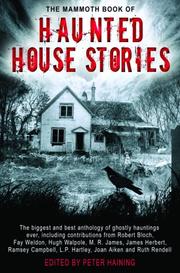
The Mammoth Book of Haunted House Stories
Supports interest in haunted buildings across Yorkshire.

eBay marketplace picks
Marketplace Samples
Live-tested eBay searches with available results related to this page.

Endnotes
1.
Source: 30eastdrive.com
Link:https://www.30eastdrive.com/wp-content/uploads/2014/03/FEAT-WHEN-LIGHTS-GO-OUT.pdf
2.
Source: commons.wikimedia.org
Title: Category:Maps of Yorkshire
Link:https://commons.wikimedia.org/wiki/Category%3AMaps_of_Yorkshire
3.
Source: Wikipedia
Link:https://en.wikipedia.org/wiki/Yorkshire
4.
Source: commons.wikimedia.org
Link:https://commons.wikimedia.org/wiki/Category%3AYorkshire
5.
Source: theoriginalghostwalkofyork.co.uk
Link:https://www.theoriginalghostwalkofyork.co.uk/
6.
Source: yorkmuseumstrust.org.uk
Link:https://www.yorkmuseumstrust.org.uk/whats-on/events/haunted-halloween-tour-adults-only-2/
7.
Source: ninazumel.com
Link:https://ninazumel.com/TwelveMedievalGhostStories/pages/english/
8.
Source: time.com
Link:https://time.com/5411826/bram-stoker-dracula-history/
9.
Source: mylearning.org
Link:https://www.mylearning.org/stories/myths-legends-and-ghosts-of-leeds
10.
Source: yorkshireghosttours.com
Title: the grey lady of east riddlesden hall keighley
Link:https://yorkshireghosttours.com/blog/the-grey-lady-of-east-riddlesden-hall-keighley
11.
Source: sciencedirect.com
Link:https://www.sciencedirect.com/science/article/pii/S2352409X1630791X
12.
Source: commons.wikimedia.org
Title: Category:Old maps of Yorkshire
Link:https://commons.wikimedia.org/wiki/Category%3AOld_maps_of_Yorkshire
13.
Source: commons.wikimedia.org
Title: Category:19th century maps of Yorkshire
Link:https://commons.wikimedia.org/wiki/Category%3A19th-century_maps_of_Yorkshire
14.
Source: commons.wikimedia.org
Title: Category:Historic counties of England
Link:https://commons.wikimedia.org/wiki/Category%3AHistoric_counties_of_England
15.
Source: commons.wikimedia.org
Title: Category:20th century maps of Yorkshire
Link:https://commons.wikimedia.org/wiki/Category%3A20th-century_maps_of_Yorkshire
16.
Source: commons.wikimedia.org
Title: File:Yorkshire Map.png
Link:https://commons.wikimedia.org/wiki/File%3AYorkshire_Map.png
17.
Source: commons.wikimedia.org
Title: File:Yorkshire & The Humber counties.png
Link:https://commons.wikimedia.org/wiki/File%3AYorkshire_%26_The_Humber_counties.png
18.
Source: commons.wikimedia.org
Title: File:Yorkshire British Isles.svg
Link:https://commons.wikimedia.org/wiki/File%3AYorkshire_-_British_Isles.svg
19.
Source: Wikipedia
Title: Treasurer’s House, York
Link:https://en.wikipedia.org/wiki/Treasurer%27s_House%2C_York
20.
Source: Wikipedia
Title: Datei:Yorkshire UK 1851 locator map.svg
Link:https://de.wikipedia.org/wiki/Datei%3AYorkshire_UK_1851_locator_map.svg
21.
Source: Wikipedia
Title: East Riddlesden Hall
Link:https://en.wikipedia.org/wiki/East_Riddlesden_Hall
22.
Source: Wikipedia
Title: Mother Shipton’s Cave
Link:https://en.wikipedia.org/wiki/Mother_Shipton%27s_Cave
23.
Source: Wikipedia
Title: Scarborough Castle
Link:https://en.wikipedia.org/wiki/Scarborough_Castle
24.
Source: yorkmuseumstrust.org.uk
Link:https://www.yorkmuseumstrust.org.uk/blog/reyahn-kings-object-of-the-week-dick-turpins-whistle/
25.
Source: yorkshire.com
Title: skipton castle ghosts
Link:https://www.yorkshire.com/skipton/guides/visiting/skipton-castle-ghosts?srsltid=AfmBOoqcAQCljBlDeReXfKXg7uVXZPdMaOuJK7LYVgVWKrOkxzpXKEFF
26.
Source: nationaltrust.org.uk
Title: National Trust The ghost stories of Treasurer’s House
Link:https://www.nationaltrust.org.uk/visit/yorkshire/treasurers-house-york/ghosts-of-treasurers-house
27.
Source: english-heritage.org.uk
Title: haunted monasteries
Link:https://www.english-heritage.org.uk/members-area/members-magazine/haunted-monasteries/
28.
Source: mothershipton.co.uk
Link:https://www.mothershipton.co.uk/the-story/
29.
Source: news.leeds.gov.uk
Title: tragic true story behind house s famous phantom
Link:https://news.leeds.gov.uk/news/tragic-true-story-behind-house-s-famous-phantom
30.
Source: wikishire.co.uk
Title: Ridings of Yorkshire
Link:https://wikishire.co.uk/wiki/Ridings_of_Yorkshire
31.
Source: wikishire.co.uk
Link:https://wikishire.co.uk/wiki/Yorkshire
32.
Source: visityork.org
Link:https://visityork.org/business-directory/category/tours-guides/ghost-walks-tours
33.
Source: visityork.org
Title: Visit York York, the ‘most haunted city in Europe’
Link:https://visityork.org/blog/most-haunted-city-in-europe-ghosts-witches-and-notorious-villains-visit-york
34.
Source: thebloodytourofyork.co.uk
Link:https://www.thebloodytourofyork.co.uk/
35.
Source: yorkcastlemuseum.org.uk
Link:https://www.yorkcastlemuseum.org.uk/york-castle-prison/
36.
Source: historyofyork.org.uk
Title: History of York Dick Turpin
Link:https://www.historyofyork.org.uk/themes/georgian/dick-turpin
37.
Source: english-heritage.org.uk
Title: october 2018 plan the scariest halloween ever
Link:https://www.english-heritage.org.uk/members-area/members-magazine/october-2018-plan-the-scariest-halloween-ever/
Published: october 2018
38.
Source: thewhitbyguide.co.uk
Title: The Whitby Guide The Legend Of The Submerged Bells Of Whitby Abbey
Link:https://www.thewhitbyguide.co.uk/the-submerged-bells/
39.
Source: yorkshiredales.org.uk
Title: Yorkshire Dales Creepy Canons?
Link:https://www.yorkshiredales.org.uk/creepy-canons/
40.
Source: english-heritage.org.uk
Link:https://www.english-heritage.org.uk/visit/places/scarborough-castle/history/
41.
Source: english-heritage.org.uk
Link:https://www.english-heritage.org.uk/learn/histories/lgbtq-history/piers-gaveston-hugh-despenser-and-the-downfall-of-edward-ii/
42.
Source: essexghosthunters.co.uk
Link:https://www.essexghosthunters.co.uk/haunted-places/north-yorkshire/scarborough-castle
43.
Source: historynewsnetwork.org
Title: english heritage reveals most haunted sites
Link:https://www.historynewsnetwork.org/article/english-heritage-reveals-most-haunted-sites
44.
Source: thereluctantexplorers.com
Title: Reluctant Explorers The Legend of the Richmond Drummer Boy
Link:https://www.thereluctantexplorers.com/blog/tales-of-the-dales-the-drummer-boy
45.
Source: english-heritage.org.uk
Link:https://www.english-heritage.org.uk/visit/places/richmond-castle/history-and-stories/richmond-sixteen/
46.
Source: english-heritage.org.uk
Title: English Heritage Conscientious Objectors’ Stories
Link:https://www.english-heritage.org.uk/visit/places/richmond-castle/history-and-stories/c-o-stories/
47.
Source: news.leeds.gov.uk
Title: object of the week portrait of mary ingram
Link:https://news.leeds.gov.uk/news/object-of-the-week-portrait-of-mary-ingram
48.
Source: nationaltrust.org.uk
Link:https://www.nationaltrust.org.uk/visit/yorkshire/east-riddlesden-hall
49.
Source: ianjarviswriter.com
Title: the black monk of pontefract
Link:https://www.ianjarviswriter.com/post/2018/03/20/the-black-monk-of-pontefract
50.
Source: english-heritage.org.uk
Link:https://www.english-heritage.org.uk/visit/places/wharram-percy-deserted-medieval-village/history/
51.
Source: historicengland.org.uk
Title: archaeological evidence living dead in mediaeval england
Link:https://historicengland.org.uk/whats-new/news/archaeological-evidence-living-dead-in-mediaeval-england/
52.
Source: english-heritage.org.uk
Link:https://www.english-heritage.org.uk/visit/places/wharram-percy-deserted-medieval-village/history/research/
53.
Source: thereluctantexplorers.com
Title: Reluctant Explorers Ghost Stories of the Yorkshire Dales
Link:https://www.thereluctantexplorers.com/blog/ghost-stories-yorkshire-dales
54.
Source: mothershipton.co.uk
Link:https://www.mothershipton.co.uk/
55.
Source: facebook.com
Link:https://www.facebook.com/RealCounties/photos/yorkshire-is-divided-into-3-ridings-whose-boundaries-meet-at-the-walls-of-the-ci/840562768227292/
56.
Source: facebook.com
Link:https://www.facebook.com/groups/349999699675100/posts/1310536263621434/
57.
Source: facebook.com
Title: york castle museum goth in a coffin 1985
Link:https://www.facebook.com/disfunzionioscure/posts/york-castle-museum-goth-in-a-coffin-1985/1428950342565533/
58.
Source: visityork.org
Link:https://visityork.org/business-directory/the-bloody-tour-of-york
59.
Source: bitaboutbritain.com
Title: scarborough castle
Link:https://bitaboutbritain.com/scarborough-castle/
60.
Source: english-heritage.org.uk
Link:https://www.english-heritage.org.uk/about/search-news/english-heritage-unveils-mysterious-cctv-image-and-haunting-new-tales-from-historic-sites/
61.
Source: english-heritage.org.uk
Link:https://www.english-heritage.org.uk/members-area/members-magazine/stories-of-england-ghost-stories/
62.
Source: english-heritage.org.uk
Title: pr spooky bolsover
Link:https://www.english-heritage.org.uk/about/search-news/pr-spooky-bolsover/
63.
Source: english-heritage.org.uk
Link:https://www.english-heritage.org.uk/members-area/members-magazine/quizzes/2019-july-myths-and-legends/
64.
Source: english-heritage.org.uk
Link:https://www.english-heritage.org.uk/members-area/kids/medieval-monasteries/terrifying-tales/
65.
Source: english-heritage.org.uk
Title: Eight ghosts
Link:https://www.english-heritage.org.uk/about/search-news/eight-ghosts/
66.
Source: english-heritage.org.uk
Link:https://www.english-heritage.org.uk/members-area/members-magazine/podcast-extras/ghosts-and-ghouls/
67.
Source: english-heritage.org.uk
Link:https://www.english-heritage.org.uk/members-area/members-magazine/2021/october-2019-richmond-castle/
68.
Source: multoghost.wordpress.com
Title: byland abbey
Link:https://multoghost.wordpress.com/tag/byland-abbey/
69.
Source: thebloodytourofyork.co.uk
Link:https://www.thebloodytourofyork.co.uk/faqs/
70.
Source: tripadvisor.com
Title: Mother Shipton’s Cave
Link:https://www.tripadvisor.com/Attraction_Review-g504004-d211955-Reviews-Mother_Shipton_s_Cave-Knaresborough_North_Yorkshire_England.html
71.
Source: tripadvisor.com
Title: The Bloody Tour of York
Link:https://www.tripadvisor.com/Attraction_Review-g186346-d4067266-Reviews-The_Bloody_Tour_of_York-York_North_Yorkshire_England.html
72.
Source: chrisnickson.co.uk
Title: the blue lady
Link:https://chrisnickson.co.uk/2013/11/28/the-blue-lady/
73.
Source: thereluctantexplorers.com
Title: tales of the dales bolton abbey
Link:https://www.thereluctantexplorers.com/blog/tales-of-the-dales-bolton-abbey
74.
Source: yorkcastlemuseum.org.uk
Link:https://www.yorkcastlemuseum.org.uk/exhibition/york-castle-prison/
75.
Source: totallylocallyknaresborough.org
Title: mother shiptons cave
Link:https://totallylocallyknaresborough.org/mother-shiptons-cave/
76.
Source: mysticaltimesblog.com
Title: york castle museum ghost
Link:https://mysticaltimesblog.com/york-castle-museum-ghost/
77.
Source: atlasobscura.com
Title: the york ghost merchants
Link:https://www.atlasobscura.com/places/the-york-ghost-merchants
78.
Source: hauntedhappenings.co.uk
Link:https://www.hauntedhappenings.co.uk/york-castle-museum/
79.
Source: worldstrides.com
Title: york ghost merchants
Link:https://worldstrides.com/en-us/higher-ed/blog/york-ghost-merchants
80.
Source: millstonesandmoor.com
Link:https://millstonesandmoor.com/pages/explore-collective-mother-shipton-s-cave?srsltid=AfmBOooT88sTzs4s8n-Kk4DXQQCvbdSqJJ5cNRCZ_6SrHt_nPCH_GyIs
81.
Source: historicengland.org.uk
Link:https://historicengland.org.uk/education/schools-resources/educational-images/richmond-castle-richmond-north-yorkshire-plb-j870525
82.
Source: themilneryork.com
Link:https://www.themilneryork.com/things-to-do/york-castle-museum
83.
Source: worldhistory.org
Title: Piers Gaveston
Link:https://www.worldhistory.org/Piers_Gaveston/
84.
Source: neilturner.me.uk
Title: East Riddlesden Hall
Link:https://neilturner.me.uk/2024/04/10/east-riddlesden-hall/
85.
Source: yorkshiretreasures.co.uk
Link:https://www.yorkshiretreasures.co.uk/blog/ghosts
86.
Source: engole.info
Title: Blue Lady of Temple Newsam
Link:https://engole.info/blue-lady-of-temple-newsam/
87.
Source: thewhitbyguide.co.uk
Title: is scarborough haunted
Link:https://www.thewhitbyguide.co.uk/is-scarborough-haunted/
Additional References
88.
Source: youtube.com
Title: Paranormal Pontefract ghost stories & dark history from a West Yorkshire town
Link:https://www.youtube.com/watch?v=rsjb9rRiYP8
Source snippet
Bolling Hall Haunted History & The Ghost Who Saved a Town...
89.
Source: youtube.com
Title: The Treasurer’s House and Gray’s Court – Haunted York
Link:https://www.youtube.com/watch?v=s_m6sdlLN5o
Source snippet
The TRUE and TERRIFYING Story of 30 East Drive | Pontefract | The Black Monk...
90.
Source: youtube.com
Title: Bolling Hall Haunted History & The Ghost Who Saved a Town
Link:https://www.youtube.com/watch?v=fMbst7VyAuU
Source snippet
Yorkshire's Haunted Roads supernatural ghost stories...
91.
Source: youtube.com
Title: Yorkshire’s Haunted Roads supernatural ghost stories
Link:https://www.youtube.com/watch?v=lZiux_c8ZhI
Source snippet
The Treasurer's House and Gray's Court – Haunted York...
92.
Source: facebook.com
Link:https://www.facebook.com/templenewsamestate/posts/a-mysterious-figure-has-been-spotted-on-top-of-temple-newsam-house-come-on-down-/1248294960661302/
93.
Source: yorkghostmerchants.com
Link:https://www.yorkghostmerchants.com/our-story
94.
Source: nycroblog.com
Link:https://nycroblog.com/house-history-north-yorkshire/
95.
Source: abcounties.com
Link:https://abcounties.com/counties/county-profiles/yorkshire/
96.
Source: instagram.com
Link:https://www.instagram.com/reel/DZ9r5HLN60m/
97.
Source: facebook.com
Link:https://www.facebook.com/CUScarborough/posts/watch-out-for-that-beheaded-figure-in-and-around-scarborough-castle-ever-heard-t/1616459289175512/
Topic Tree
Follow this branch
Related pages 91
- Haunted Clackmannanshire
- Haunted Antrim
- Haunted Armagh
- Haunted Durham
- Haunted Londonderry
- +86 more in sidebar