Within Haunted Lanarkshire
What Haunts the Ruins of Bothwell Castle?
Bothwell Castle's ghost stories draw power from a real history of siege, damage and romantic folklore above the Clyde.
On this page
- The Castle Above the Clyde
- Sieges, Damage and the Black Douglases
- Bonnie Jean and Romantic Ruin Folklore
Page outline Jump by section
Introduction
Bothwell Castle’s haunting reputation rests on two different kinds of story. One is well evidenced: the red sandstone fortress above the River Clyde was violently fought over during the Wars of Independence, repeatedly captured, damaged, rebuilt and claimed by powerful families. The other is folkloric: the tale of Bonnie Jean, or Bonny Jane, a doomed young woman associated with Halloween, a false monk, the Clyde and the ruins opposite Blantyre Priory. Both matter, but they should not be treated as equally historical.
For readers exploring haunted Lanarkshire, Bothwell is a perfect example of how a real medieval ruin can become a stage for later ghost legend. Historic Environment Scotland describes the castle as a grand late-13th-century stronghold that frequently passed between English and Scottish hands, with Edward I’s siege of 1301 helping to leave the original plan unfinished. Its setting by a curve of the Clyde, its damaged donjon and its later Black Douglas associations give the site the physical drama that ghost stories need.[Historic Environment Scotland]historicenvironment.scotHistoric Environment Scotland Bothwell Castle | Historic ScotlandHistoric Environment Scotland Bothwell Castle | Historic Scotland
The Castle Above the Clyde
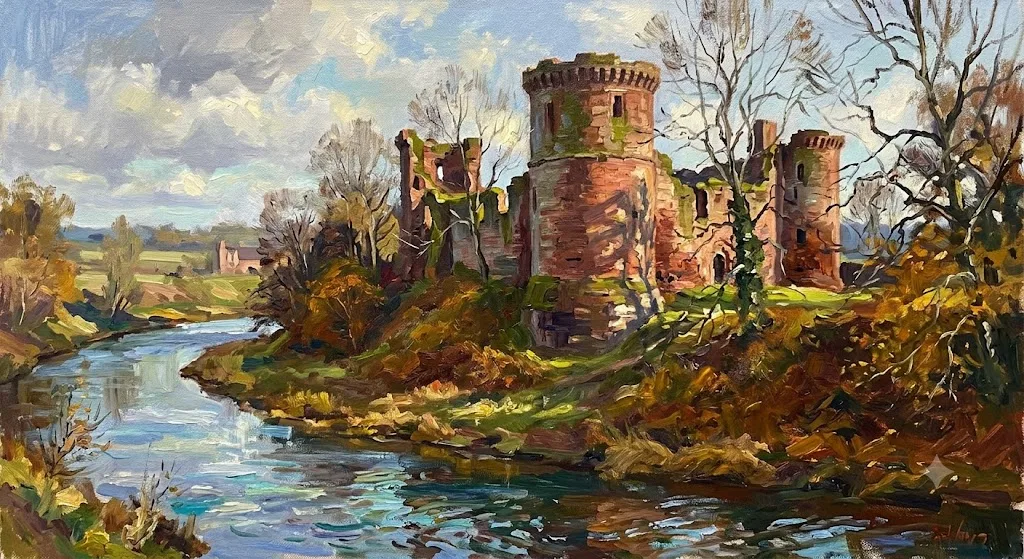
Bothwell Castle stands on the east bank of the River Clyde in South Lanarkshire, within historic Lanarkshire’s Clyde-valley landscape. Historic Environment Scotland’s scheduled monument record places it on a prominent terrace about 30 metres above sea level, with upstanding masonry, footings, earthworks and buried archaeological remains. That height matters to the atmosphere of the place: the castle is not just a ruin beside water, but a fortress looking down over a bend in the river, with Blantyre Priory facing it from the opposite bank.[Historic Environment Scotland]portal.historicenvironment.scotOpen source on historicenvironment.scot.
The surviving ruins also explain why Bothwell became so visually powerful in local memory. Visitors are directed to the 13th-century circular donjon, described by Historic Environment Scotland as without parallel in Scotland, and to the 14th-century chapel associated with the Black Douglases. The site is also linked to the Clyde Walkway and nearby woodland, so the ghost-story landscape is not confined to the walls: river, path, tower, chapel and opposite ruins all form part of the imaginative setting.[Historic Environment Scotland]historicenvironment.scotHistoric Environment Scotland Bothwell Castle | Historic ScotlandHistoric Environment Scotland Bothwell Castle | Historic Scotland
For haunted-history purposes, Bothwell’s importance is not that there is strong evidence of a paranormal event. It is that the location gathers the ingredients that often make a ghost tradition durable: a ruined medieval building, a dangerous river crossing, visible war damage, aristocratic names, a chapel, a prison tower and a romantic view across the Clyde. The story works because the place already looks as if it remembers violence.
Sieges, Damage and the Black Douglases
The most reliable “dark history” at Bothwell is not a murder legend but military history. The castle played a major role in the wars between Scotland and England in the early 14th century, when it was repeatedly besieged, captured, slighted and repaired. Historic Environment Scotland records Edward I’s 1301 attack as a set-piece siege involving a field army of 6,800 men; after capture, Bothwell remained an important English garrison until it fell to Edward Bruce after Bannockburn in 1314.[Historic Environment Scotland]portal.historicenvironment.scotOpen source on historicenvironment.scot.
Bothwell’s violence did not end there. The castle was reoccupied by the English in 1336 and used by Edward III as his headquarters in Scotland for the winter. In 1337 Andrew Moray of Bothwell retook it and partly dismantled the great tower. Historic Environment Scotland interprets that destruction not merely as practical military denial, but also as a symbolic act: Moray damaged the most visible sign of his own lordship to show loyalty to the Bruce cause.[Historic Environment Scotland]portal.historicenvironment.scotOpen source on historicenvironment.scot.
This matters for the ghost legends because the castle’s ruin is not a vague backdrop. Its brokenness is historically meaningful. The damaged donjon, the unfinished original plan and the later rebuilding all point to a place shaped by real political violence. A visitor does not need to believe in apparitions to understand why Bothwell feels haunted: its masonry records ambition interrupted by war.
The Black Douglases add another layer. After the castle’s dismantling, it appears to have been abandoned until about 1362, when Archibald Douglas, known as “the Grim”, acquired Bothwell through marriage to Joanna de Moray and began an ambitious rebuilding programme continued by his son. Historic Environment Scotland links this work to the rise of the Douglases as one of Scotland’s leading aristocratic families, and notes that re-establishing Bothwell as a lordly seat would have carried symbolic weight.[Historic Environment Scotland]portal.historicenvironment.scotOpen source on historicenvironment.scot.
That is why Bothwell’s ghost lore should be read alongside its medieval power politics. The castle is not haunted in tradition because one neat, documented tragedy can be proved. It is haunted because generations encountered a visibly wounded stronghold and filled the gaps between history, ruin and imagination.
Bonnie Jean and Romantic Ruin Folklore
The best-known ghost attached to Bothwell is Bonnie Jean, also called Bonny Jane. In popular retellings she is usually a young noblewoman caught between arranged marriage and forbidden love, who attempts to flee across or beside the Clyde and meets a tragic end. Some modern castle-haunting summaries say she appears on Halloween, often near the donjon or tower, tying the legend to the darkest turn of the year and to the castle’s most dramatic surviving feature.[Great Castles]great-castles.comOpen source on great-castles.com.
The important point is that Bonnie Jean is much easier to trace as literary-Gothic folklore than as medieval record. A major source for the story is Matthew Gregory Lewis’s “Bothwell’s Bonny Jane”, published in his 1801 collection Tales of Wonder. The collection is listed in archival records as an 1801 London publication by Lewis, and modern literary discussions identify “Bothwell’s Bonny Jane” as the opening item in the volume.[Internet Archive]archive.orgOpen source on archive.org.
Lewis’s version is full of Gothic machinery: storm, tears, a false religious helper, a midnight signal from Blantyre, a Brownie warning, a threatened young woman, a boat on the Clyde and a supernatural ferryman. In the poem, Jane hopes to escape an unwanted marriage and meet Edgar, but the monk from Blantyre Priory deceives her. The poem ends by saying that, on Halloween, the ferryman-fiend still carries the monk and Jane, while the phantom woman haunts Bothwell Tower and watches for the fatal light from Blantyre.[Regency History]regencyhistory.netRegency History Blog | Regency HistoryRegency History Blog | Regency History
That literary origin changes how the haunting should be understood. Bonnie Jean is not best presented as a securely documented medieval resident whose apparition was recorded by named witnesses. She is better understood as a romantic ruin legend, rooted in the landscape of Bothwell Castle and Blantyre Priory and strengthened by early-19th-century Gothic taste. The story is still valuable folklore, but its value lies in how it turns the Clyde-side ruins into a moral and emotional drama.
Why Blantyre Priory Matters to the Ghost Story
Bonnie Jean’s legend is not only a castle story. It also depends on the relationship between Bothwell Castle and Blantyre Priory across the Clyde. Historic Environment Scotland describes Blantyre Priory as a small early-13th-century monastery on the west bank of the river, with ruinous masonry and earthworks standing on a cliff above the Clyde. The priory was occupied by Augustinian monks and was a cell of Jedburgh Abbey.[Historic Environment Scotland]portal.historicenvironment.scotOpen source on historicenvironment.scot.
In Lewis’s Gothic retelling, the priory supplies the deceptive monk and the false signal light. That is an imaginative use of real geography: castle on one bank, religious ruin on the other, river between them. By 1801, when Lewis published Tales of Wonder, the priory was already ruinous, making it an ideal Gothic neighbour for Bothwell. A later Regency-history discussion of the poem notes that both castle and priory stood beside the Clyde and that the priory was badly ruined when Lewis published the ballad.[Regency History]regencyhistory.netRegency History Blog | Regency HistoryRegency History Blog | Regency History
This is where the legend becomes especially Lanarkshire in character. It is not a generic “lady in a tower” tale that could be dropped anywhere. Its movement depends on the local topography: Bothwell’s slope, the river, the sightline to Blantyre and the danger of crossing water at night. The ghostly effect comes from a real pair of ruins facing each other across the Clyde.

What Is Actually Said to Haunt Bothwell?
The haunting tradition around Bothwell is usually reported in three connected forms.
Bonnie Jean or Bonny Jane. She is the central figure: a young woman associated with love, coercion, betrayal and death. In the literary version, she is not simply a drowned maiden but part of a darker supernatural punishment tale involving a corrupt monk and a demonic ferryman. In popular ghost-lore versions, the story is often simplified into the apparition of a tragic woman seen around Halloween or near the tower.
The tower or donjon. Modern retellings often place the apparition around Bothwell Tower or above the donjon. This is significant because the donjon is not just scenic. It is the castle’s great military statement, the structure most visibly damaged by the medieval violence that shaped Bothwell. The ghost story therefore attaches itself to the strongest and most wounded architectural feature of the site.[Historic Environment Scotland]portal.historicenvironment.scotOpen source on historicenvironment.scot.
The Clyde crossing. In Lewis’s poem, the river is not background scenery but the place where the trap closes. The ferryman-fiend, the boat, the signal from Blantyre and the Halloween timing make the Clyde itself part of the haunting. This helps explain why the legend can feel larger than the castle walls: it belongs to the river corridor as much as to the ruin.[Regency History]regencyhistory.netRegency History Blog | Regency HistoryRegency History Blog | Regency History
There are also modern local and paranormal retellings that mention “numerous reports” of haunting at the castle, sometimes linked to photographs or supposed sightings. These are useful as evidence that the legend remains alive in local popular culture, but they are not strong proof of a historical apparition. For a careful haunted-history page, they should be treated as contemporary folklore and anecdote rather than verified witness evidence.[Blantyre Telegraph]theblantyretelegraph.comghost in the towerghost in the tower
How Credible Is the Haunting Tradition?
The historical credibility is strongest for the castle’s violence and weakest for the ghost as an observed phenomenon. Bothwell’s siege history, architectural importance, Douglas rebuilding and relationship to the Clyde are well supported by official heritage records. The castle’s repeated capture, damage and repair are central to its recognised national importance.[Historic Environment Scotland]portal.historicenvironment.scotOpen source on historicenvironment.scot.
Bonnie Jean’s credibility is different. The story is credible as a literary and folkloric tradition, not as a proven medieval incident. The strongest traceable form is the Gothic ballad by M. G. Lewis, published in 1801, and later retellings appear to echo or simplify that pattern. The poem itself frames the survival of the haunting as “legend”, which is a useful warning against reading it as court record, parish entry or contemporary witness testimony.[Internet Archive]archive.orgOpen source on archive.org.
That does not make the legend worthless. It makes it a different kind of evidence. Bonnie Jean shows how Bothwell was being reimagined during the period when ruined castles became picturesque, emotional and Gothic. Historic Environment Scotland notes that from the late 18th and early 19th centuries Bothwell became a popular Clyde destination for seekers of the picturesque, inspiring writers and artists including William Wordsworth, Paul Sandby and Charles Cordiner.[Historic Environment Scotland]portal.historicenvironment.scotOpen source on historicenvironment.scot.
In other words, the ghost story is part of Bothwell’s afterlife as a romantic ruin. The medieval castle supplied the stone, damage and prestige; the Gothic imagination supplied the doomed heroine, the false monk and the supernatural river crossing.
Why Bothwell Became Locally Famous
Bothwell Castle became a natural haunted landmark because it combines unusually strong historical substance with a visually suggestive setting. Many ghost stories fade because their locations are ordinary or poorly documented. Bothwell has the opposite problem: the real history is so dramatic that later storytellers had plenty to work with.
The castle was built on a grand scale, never completed as planned because of war, damaged in nationally significant sieges, rebuilt by one of Scotland’s most powerful families and later admired as a picturesque ruin. Its great tower was both military architecture and symbolic display, with Historic Environment Scotland placing it within a wider northern European context of elite castle-building while also stressing its innovative Scottish features.[Historic Environment Scotland]portal.historicenvironment.scotOpen source on historicenvironment.scot.
Its ghost legend then adds a more intimate drama to that public violence. Medieval siege history can feel large, political and impersonal. Bonnie Jean’s story makes the ruin personal: a young woman at a window, a forbidden love, a false signal, a night journey, a river and a fatal betrayal. That shift from armies to one doomed figure is one reason castle ghosts remain memorable.
For the Lanarkshire haunted-history branch, Bothwell is therefore not just “a castle with a ghost”. It is a case study in how haunting traditions form. A real ruin carries scars from war; a later literary culture turns those scars into atmosphere; local retelling keeps the figure alive as part of the county’s eerie tourist imagination.
Reading the Ruins Without Overclaiming
The most honest way to approach Bothwell is to hold the two stories together without confusing them. The medieval violence is documented. The ghost is tradition. The first explains why the place feels historically heavy; the second explains how later readers and visitors gave that heaviness a face.
A sceptical reading might say that Bonnie Jean is mainly a Gothic invention projected onto an already romantic ruin. That is a fair assessment of the evidence. But a folklore reading adds that invented or literary legends can still become locally meaningful when they attach convincingly to a landscape. Bothwell’s tower, the Clyde and Blantyre Priory give the story a geography that readers can still recognise.
That balance is what makes Bothwell one of Lanarkshire’s most effective haunted places. The castle does not need exaggerated claims to feel uncanny. Its ruined donjon, siege-scarred history and Halloween ballad are enough: a documented stronghold of medieval conflict, later transformed into a stage for one of the Clyde valley’s most memorable ghostly women.
Amazon book picks
Further Reading
Books and field guides related to What Haunts the Ruins of Bothwell Castle?. Use these as the next step if you want deeper reading beyond the article.
The time traveller's guide to medieval England
Adds historical background to the era that shaped Bothwell Castle.
The Penguin Book of Ghost Stories
Ideal follow-on reading for ghost-story enthusiasts.
eBay marketplace picks
Marketplace Samples
Live-tested eBay searches with available results related to this page.
Endnotes
1.
Source: great-castles.com
Link:https://great-castles.com/bothwellghost.html
2.
Source: archive.org
Link:https://archive.org/details/talesofwonder00lewi
4.
Source: great-castles.com
Link:https://great-castles.com/bothwell.html
5.
Source: archive.org
Title: BOOKS.YOSSR.CO M The Halloween Encyclopedia
Link:https://archive.org/download/kl_20211027/BOOKS.YOSSR.COM-The-Halloween-Encyclopedia.pdf
6.
Source: youtube.com
Title: Bothwell Castle
Link:https://www.youtube.com/watch?v=iqJUcjB9RGg
Source snippet
4 Bothwell Castle - Scotland | 8K 360° Drone Flight | Voiceover...
7.
Source: youtube.com
Title: Bothwell Castle
Link:https://www.youtube.com/watch?v=SbYUa00tTpI
Source snippet
5 Bothwell Castle “We Saw A Ghost “ Dog Friendly Day Out...
8.
Source: historicenvironment.scot
Title: Historic Environment Scotland Bothwell Castle | Historic Scotland
Link:https://www.historicenvironment.scot/visit-a-place/places/bothwell-castle/history/
9.
Source: portal.historicenvironment.scot
Link:https://portal.historicenvironment.scot/apex/f?p=1505%3A300%3A%3A%3A%3A%3AVIEWTYPE%2CVIEWREF%3Adesignation%2CSM90038
10.
Source: portal.historicenvironment.scot
Link:https://portal.historicenvironment.scot/apex/f?p=1505%3A300%3A%3A%3A%3A%3AVIEWTYPE%2CVIEWREF%3Adesignation%2CSM2251
11.
Source: historicenvironment.scot
Title: Historic Environment Scotland Bothwell Castle | Historic Scotland
Link:https://www.historicenvironment.scot/visit/all/bothwell-castle/
12.
Source: regencyhistory.net
Title: Regency History Blog | Regency History
Link:https://www.regencyhistory.net/blog/regency-halloween-tale
13.
Source: theblantyretelegraph.com
Title: ghost in the tower
Link:https://theblantyretelegraph.com/2019/09/25/ghost-in-the-tower/
14.
Source: blog.historicenvironment.scot
Title: the black douglases
Link:https://blog.historicenvironment.scot/2019/11/the-black-douglases/
15.
Source: historicenvironment.scot
Title: robert the bruce
Link:https://www.historicenvironment.scot/visit/things-to-see-and-do/robert-the-bruce/
16.
Source: portal.historicenvironment.scot
Link:https://portal.historicenvironment.scot/apex/f?p=1505%3A300%3A%3A%3A%3A%3AVIEWTYPE%2CVIEWREF%3Adesignation%2CLB5136
17.
Source: emilysscotland.wordpress.com
Title: bothwell castle
Link:https://emilysscotland.wordpress.com/2019/01/12/bothwell-castle/
18.
Source: blantyreproject.com
Title: Bothwell Castle
Link:https://blantyreproject.com/2016/05/bothwell-castle/
19.
Source: trove.scot
Link:https://www.trove.scot/place/44890
20.
Source: catalog.hathitrust.org
Link:https://catalog.hathitrust.org/Record/006635820
21.
Source: tripadvisor.com
Title: Bothwell Castle
Link:https://www.tripadvisor.com/Attraction_Review-g2232887-d3510268-Reviews-Bothwell_Castle-Uddingston_South_Lanarkshire_Scotland.html
22.
Source: youtube.com
Title: Bothwell Castle
Link:https://www.youtube.com/shorts/3oaGh7u7tEw
23.
Source: historyhit.com
Title: Bothwell Castle
Link:https://www.historyhit.com/locations/bothwell-castle/
24.
Source: Wikipedia
Title: Bothwell Castle
Link:https://en.wikipedia.org/wiki/Bothwell_Castle
Additional References
25.
Source: youtube.com
Title: Bothwell Castle: The Broken Tower and the Ghost by the Clyde
Link:https://www.youtube.com/watch?v=WhTHA5377kc
Source snippet
2 Bothwell Castle: Scotland's Magnificent Fortress on the Clyde...
26.
Source: youtube.com
Title: Bothwell Castle: Scotland’s Magnificent Fortress on the Clyde
Link:https://www.youtube.com/watch?v=Yn-iMdqkXbI
Source snippet
3 Bothwell Castle - Stronghold to the Black Douglas...
27.
Source: scispace.com
Link:https://scispace.com/pdf/oberon-s-henchman-or-the-legend-of-the-three-sisters-by-14lyvfs7cp.pdf
28.
Source: specialisthomephysiotherapy.com
Link:https://specialisthomephysiotherapy.com/bothwell-castle-a-historic-gem/
29.
Source: instagram.com
Link:https://www.instagram.com/reel/DYMCRgEs_qm/
30.
Source: facebook.com
Link:https://www.facebook.com/Paranormalhauntings/posts/beautiful-bothwell-castle-halloween-ghost-one-of-the-inhabitants-of-bothwell-cas/1344707573940206/
31.
Source: sobt.co.uk
Link:https://sobt.co.uk/blantyre-carvings/
32.
Source: sobt.co.uk
Link:https://sobt.co.uk/bothwell-castle/
33.
Source: electricscotland.com
Link:https://electricscotland.com/historic/castles/bothwell.pdf
34.
Source: thecastleguide.co.uk
Link:https://thecastleguide.co.uk/castle/bothwell-castle/
Topic Tree