Within Haunted Devon
Why Is Berry Pomeroy Castle So Haunted?
Berry Pomeroy Castle is Devon's signature haunted ruin, where family tragedy, ruined architecture and shifting legend meet.
On this page
- The ruined castle and mansion setting
- White Lady and Blue Lady traditions
- History, uncertainty and later retellings
Page outline Jump by section
Introduction
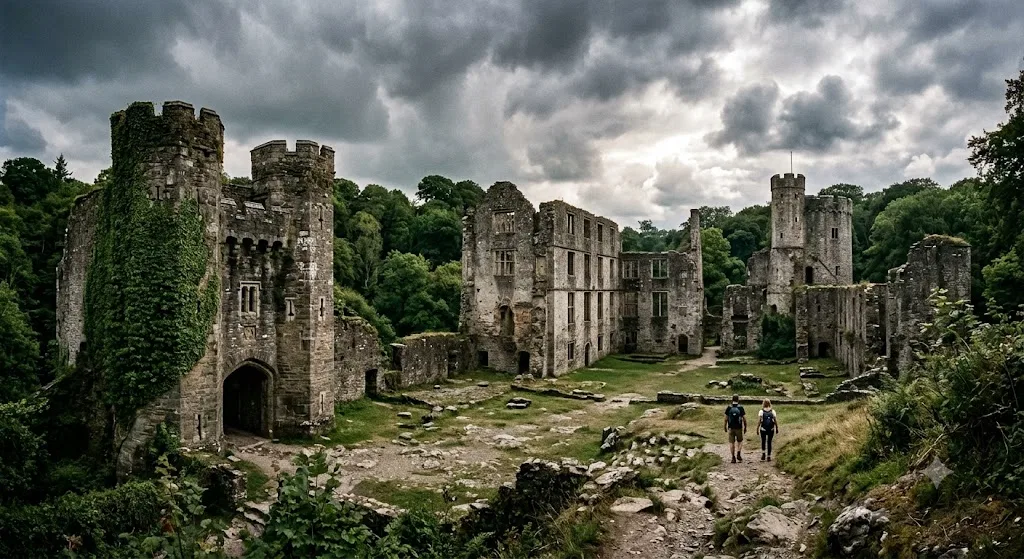
Berry Pomeroy Castle, near Totnes in South Devon, is often treated as Devon’s signature haunted ruin: a late medieval fortress wrapped around the remains of an unfinished Elizabethan mansion, standing above the wooded Gatcombe valley. Its best-known apparition is the White Lady, usually said to be Margaret Pomeroy, a beautiful young woman imprisoned and starved by a jealous sister in or near St Margaret’s Tower. The story is powerful, but the evidence is slippery. The castle’s documented history is real enough, yet the named White Lady tradition appears to have been shaped by Gothic fiction, local tourism, later guidebooks and repeated retelling rather than by a securely recorded family tragedy. English Heritage now presents Berry Pomeroy as a romantic ruin whose atmosphere fostered “blood-curdling ghost stories”, while its archaeological research has corrected older assumptions about the castle’s age and origins.[English Heritage]english-heritage.org.ukEnglish Heritage Visit Berry Pomeroy Castle | English HeritageEnglish Heritage Visit Berry Pomeroy Castle | English Heritage
That tension is what makes Berry Pomeroy so interesting. The White Lady is not simply a “sighting” story. She is a case study in how a Devon ruin became haunted: through family names, ruined towers, literary melodrama, uncertain genealogy, and the eerie persuasiveness of a place that already looks as though it ought to have ghosts.
The ruined castle that made the legend believable
Berry Pomeroy’s setting does much of the work. The visitor approaches a castle enclosed by late medieval defences, but inside the walls are the tall broken remains of a grand Tudor and Elizabethan house. English Heritage describes the mansion as begun about 1560 and enlarged around 1600, intended to become the most spectacular house in Devon, but never finished and abandoned by 1700. Once empty, stripped and decaying, it became exactly the sort of ruin that sightseers and artists found picturesque, melancholy and suggestive.[English Heritage]english-heritage.org.ukEnglish Heritage Visit Berry Pomeroy Castle | English HeritageEnglish Heritage Visit Berry Pomeroy Castle | English Heritage
The castle’s real history is already dramatic without needing a ghost. English Heritage says the Pomeroys probably built the fortress in the disturbed conditions of late 15th-century Devon, when local feuds linked to the Wars of the Roses made serious defence useful. In 1547, the impoverished Sir Thomas Pomeroy sold Berry Pomeroy to Edward Seymour, Duke of Somerset, brother of Jane Seymour and Lord Protector under Edward VI. The later mansion was mainly the work of Seymour descendants, especially Edward, Lord Seymour, and then Edward Seymour II, whose grand enlargement scheme made the ruin so visually impressive.[English Heritage]english-heritage.org.ukEnglish Heritage History of Berry Pomeroy Castle | English HeritageEnglish Heritage History of Berry Pomeroy Castle | English Heritage
This matters for the White Lady because the legend usually claims deep medieval or even Norman roots, yet the standing castle is not a Norman stronghold. English Heritage’s research page is unusually direct: Berry Pomeroy is now known to be a later 15th-century fortress on a previously unused site, adapted into a mansion between about 1560 and 1610; older claims that it was Norman in origin are described as misconceptions still repeated in many publications and websites.[English Heritage]english-heritage.org.ukEnglish Heritage Research on Berry Pomeroy Castle | English HeritageEnglish Heritage Research on Berry Pomeroy Castle | English Heritage
Historic England reaches a similar conclusion in its scheduled monument record. The earliest documentary reference to a castle at Berry Pomeroy occurs in 1496, and there is no firm evidence for occupation on the present site much before that date. The same record says the site was abandoned between 1688 and 1701, then stripped of valuable materials, before acquiring the reputation of a haunted romantic ruin visited over the next three centuries.[Historic England]historicengland.org.ukOpen source on historicengland.org.uk.
The White Lady therefore belongs less to the castle’s securely documented medieval life than to its afterlife as a ruin. The story grew in the space between visible decay and uncertain memory: a tower, a supposed dungeon, an old family name, and a landscape that seemed to invite tragic explanation.

The White Lady story people come looking for
The common version is simple and memorable. The White Lady is said to be Margaret Pomeroy, sometimes styled Lady Margaret de la Pomeroy. Her sister, usually called Eleanor or Elinor, becomes jealous of Margaret’s beauty or of a shared romantic attachment. Eleanor has Margaret shut away in the castle dungeons, where she starves to death. Her spirit is then said to haunt the dungeon, the tower, the stair, or the battlements, often appearing as a woman in white.
Modern tourism accounts still repeat this shape of the story. Visit Devon says Margaret Pomeroy is suspected to be one of the ghosts at the site, known as the White Lady, and that she was believed to have been imprisoned in the castle dungeons by a sister jealous of her beauty. The same Visit Devon article presents the Blue Lady separately, showing how the two female spectres have become the core of Berry Pomeroy’s haunted reputation.[Visit Devon]visitdevon.co.ukVisit Devon Explore Berry Pomeroy Castle… If you dareVisit Devon Explore Berry Pomeroy Castle… If you dare
Popular haunted-place retellings usually add emotional detail: the dungeon is cold, the sister is cruel, the death is slow, and the apparition is mournful or disturbing. Those details make the story easy to remember, but they also make it look like a Gothic plot rather than a historical record. The White Lady is not supported by a known contemporary account of a murdered Margaret Pomeroy. She is preserved mainly through later legend, fiction-inflected guidebook tradition and the accumulated authority of repetition.
One reason the story works so well is that “White Lady” ghosts are familiar across British folklore. They often attach themselves to castles, manor houses and ruins, especially where a woman is said to have suffered betrayal, imprisonment, lost love or family violence. Berry Pomeroy’s version is unusually site-specific because it names the Pomeroy family and places the suffering in a particular tower, but its emotional structure is recognisably part of a much wider ghost-story pattern.
Why St Margaret’s Tower became the haunted focus
The legend usually locates Margaret’s suffering in St Margaret’s Tower, one of the most important surviving parts of the Pomeroy fortress. That name gives the story a persuasive circularity: Margaret’s ghost haunts St Margaret’s Tower, so the tower feels as though it confirms the woman. But the relationship may be more complicated.
The Devon Historic Environment Record describes the castle as a spectacular ruin of 15th-century defences enclosing a Tudor mansion, with a two-storey gatehouse, an incomplete curtain wall and a mural tower at the north-east end. It also notes that archaeological investigations from 1980 to 1996 shed new light on the castle’s development.[Heritage Gateway]heritagegateway.org.ukHeritage Gateway English Heritage’s “things to see” guide emphasises the defensive nature of the gatehouse, including drawbridge arrangements, gun ports and features intended to repel attackers, which is a reminder that some spaces later imagined as prisons or dungeons had practical military functions.[English Heritage]english-heritage.org.ukEnglish Heritage Berry Pomeroy Castle Things to See and Do | English HeritageEnglish Heritage Berry Pomeroy Castle Things to See and Do | English Heritage
A sceptical strand in recent folklore writing argues that the supposed dungeon story may have been encouraged by later misreadings of the site. One detailed discussion links the White Lady legend to Edward Montague’s 1806 Gothic novel The Castle of Berry Pomeroy, and points out that the “dungeon” associated with St Margaret’s Tower is better understood in the context of the tower’s defensive fabric rather than as proof of Margaret’s imprisonment.[Superstition Sam]superstitionsam.comOpen source on superstitionsam.com.
This does not mean visitors invented every eerie feeling they have reported. It means the physical ruin has been interpreted through the story people already know. A barred opening, a dark stair, a hollow tower or a broken wall can seem to confirm the legend once the visitor has been told where Margaret suffered. Berry Pomeroy is a strong example of how architecture and folklore reinforce one another: the tower gives the ghost a location, and the ghost gives the tower a story.
Fiction, tourism and the making of Margaret Pomeroy
The strongest clue to the White Lady’s development is the 1806 Gothic novel The Castle of Berry Pomeroy, published under the name Edward Montague. Valancourt Books’ modern edition describes the novel as an adaptation of legends around the castle into a tale of horror, jealousy and revenge. In that plot, Lady Elinor de Pomeroy envies her sister Matilda, who has both the castle and the love of De Clifford; Elinor arranges for Matilda’s murder, and a spectral figure then drives the terror of the story.[Valancourt Books]valancourtbooks.comthe castle of berry pomeroy 1806the castle of berry pomeroy 1806
That is very close to the later White Lady legend, but not identical. The familiar ghost is Margaret, while Montague’s threatened sister is Matilda. The villainous sister’s name, Elinor, survives more clearly. This looks less like a clean historical memory and more like a story that has moved between fiction, local naming and oral retelling, changing as it went.
The Gothic setting matters too. Ruined castles were central to late 18th- and early 19th-century Gothic literature: they supplied secret chambers, imprisonments, family curses, hidden crimes and returning spectres. Berry Pomeroy was already an impressive ruin by the time this literary fashion was well established. A local castle with a dramatic name, old family associations and visible decay could easily be folded into the era’s taste for medievalised terror.
A later scholarly treatment strengthens this reading. Emma McEvoy’s Gothic Tourism includes a chapter specifically titled “Becoming a Haunted Castle: Literature, Tourism and Folklore at Berry Pomeroy”, placing the site within the wider culture of Gothic tourism rather than treating its legends as straightforward records of events. The book’s overview frames Gothic tourism as a field concerned with the relationship between literature, folklore, heritage management and visitor experience.[Springer]link.springer.comGothic Tourism | Springer Nature LinkGothic Tourism | Springer Nature Link
In other words, Berry Pomeroy did not simply become haunted because someone saw a ghost. It became haunted because the ruin, the printed Gothic tale, the local guide tradition and visitor expectation all worked together. Margaret Pomeroy is best understood as a legendary figure produced by that mixture.
The historical problem with Margaret and Eleanor
The biggest difficulty for a historical reading of the White Lady is the lack of firm evidence for the central people and event. The story requires a Margaret Pomeroy and an Eleanor or Elinor Pomeroy, sisters at Berry Pomeroy, one jealous enough to imprison the other until death. Yet modern discussions of the legend repeatedly note the absence of a secure genealogical basis for this pair.
The problem is sharpened by the castle’s corrected chronology. Since the present castle is late 15th century, not Norman, any version that places Margaret and Eleanor in a vague “Norman castle” setting is historically unstable. English Heritage specifically warns that the old Norman-origin story has been overturned by archaeological work, and Historic England states that there is no firm evidence for occupation on the present site much before the 1496 documentary reference.[English Heritage]english-heritage.org.ukEnglish Heritage Research on Berry Pomeroy Castle | English HeritageEnglish Heritage Research on Berry Pomeroy Castle | English Heritage
That does not make the legend worthless. Folklore often preserves emotional truths rather than archival ones. The White Lady may not record an identifiable murder, but she does express themes that cling strongly to ruined elite houses: inheritance, female confinement, jealousy, family rivalry, hidden suffering and the idea that aristocratic splendour concealed cruelty. Those are exactly the themes Gothic fiction loved, and exactly the themes a visitor can imagine while standing in a roofless mansion once planned as a display of Seymour ambition.
The careful conclusion is therefore twofold. As history, the White Lady is weak: no secure contemporary record proves Margaret’s imprisonment or Eleanor’s crime. As folklore, it is strong: it has a stable location, a memorable plot, repeated public retellings, and a setting whose documented abandonment makes the story feel emotionally plausible.
White Lady and Blue Lady: why the two legends blur
Berry Pomeroy is often advertised through two female apparitions: the White Lady and the Blue Lady. The White Lady is usually Margaret, the imprisoned sister. The Blue Lady is usually more dangerous, said to lure people, especially men, towards falls or fatal risk. Visit Devon repeats the distinction, saying the Blue Lady is treated as an omen of death and that no one is sure who she was in life.[Visit Devon]visitdevon.co.ukVisit Devon Explore Berry Pomeroy Castle… If you dareVisit Devon Explore Berry Pomeroy Castle… If you dare
The two stories are separate in modern tourist language, but they often blur in retellings. Both are female, tragic, colour-named, and attached to family wrongdoing. Both are said to move through towers, stairs or dangerous parts of the ruin. Both carry a warning: the White Lady warns of hidden suffering, while the Blue Lady warns of physical danger and fatal temptation.
This overlap is part of Berry Pomeroy’s haunted appeal, but it also shows why the evidence must be handled cautiously. When a site becomes famous as “one of the most haunted castles”, later reports tend to be sorted into the names people already know. A pale shape becomes the White Lady; a blue light or cold presence becomes the Blue Lady; a frightening stair becomes part of the existing legend. The named ghosts become categories for experience as much as fixed historical personalities.
For a Devon hauntings project, that makes Berry Pomeroy especially useful. It demonstrates how a haunted place gathers layers. The White Lady is not merely one tale among many; she is the organising legend that helps visitors read the ruin as a place of betrayal and sorrow.
How credible is the White Lady legend?
The White Lady of Berry Pomeroy is credible as a famous and durable Devon legend, but not as a verified historical event. The documented castle was built later than many older retellings imply; the supposed family tragedy is not securely evidenced; and the most recognisable plot has strong affinities with Gothic fiction, especially the 1806 Castle of Berry Pomeroy.[English Heritage]english-heritage.org.ukEnglish Heritage Research on Berry Pomeroy Castle | English HeritageEnglish Heritage Research on Berry Pomeroy Castle | English Heritage
The most reliable sources are strongest on the building, not the ghost. English Heritage, Historic England and the Devon Historic Environment Record provide the framework: a late 15th-century Pomeroy fortress, a Seymour mansion built and enlarged in the later 16th and early 17th centuries, abandonment by around 1700, stripping of materials, and later fame as a romantic ruin.[english-heritage.org.uk]english-heritage.org.ukEnglish Heritage History of Berry Pomeroy Castle | English HeritageEnglish Heritage History of Berry Pomeroy Castle | English Heritage Those facts explain why the site was ready to become haunted.
The ghost sources are different in nature. Tourism pages, haunted-place articles and folklore essays preserve how the legend is told, but they do not prove that Margaret existed as described. The more useful question is not “did the White Lady happen?” but “why did this particular story stick?” It stuck because Berry Pomeroy offers the perfect haunted grammar: a named noble family, a ruined tower, a dramatic valley, a vanished household, and a printed Gothic tradition that turned architectural emptiness into moral drama.
Why Berry Pomeroy still matters in Devon’s haunted landscape
Berry Pomeroy’s White Lady has lasted because she belongs so completely to the place. A ghost in white at a ruined Devon castle may sound familiar, even generic, until the details gather force: St Margaret’s Tower, the jealous sister, the unfinished mansion, the Pomeroys giving way to the Seymours, and the ruin becoming a magnet for artists, sightseers and ghost stories after abandonment. English Heritage even sells its guidebook by calling Berry Pomeroy the most romantic and reputedly the most haunted castle in Devon, while stressing that its romantic atmosphere fostered tales of hauntings around what had once been a living household.[English Heritage Shop]english-heritageshop.org.ukEnglish Heritage Shop Buy Guidebook: Berry Pomeroy Castle | English HeritageEnglish Heritage Shop Buy Guidebook: Berry Pomeroy Castle | English Heritage
That is the real value of the White Lady legend. It shows how Devon’s haunted history often grows from the meeting point between documented place and imaginative memory. Berry Pomeroy Castle is not a blank backdrop for a ghost story. It is a historically specific ruin whose abandonment, misreadings, literary afterlives and visitor traditions made one story feel inevitable.
The White Lady should therefore be read neither as proven apparition nor as disposable nonsense. She is a piece of Devon folklore with a long public life: uncertain as biography, vivid as legend, and inseparable from the ruined castle that gave her somewhere to appear.
Amazon book picks
Further Reading
Books and field guides related to Why Is Berry Pomeroy Castle So Haunted?. Use these as the next step if you want deeper reading beyond the article.
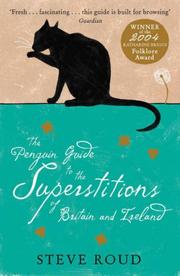
The Penguin Guide to the Superstitions of Britain and Ireland
Explains recurring ghost motifs such as White Ladies.

eBay marketplace picks
Marketplace Samples
Live-tested eBay searches with available results related to this page.

Endnotes
1.
Source: heritagegateway.org.uk
Title: Heritage Gateway
Link:https://www.heritagegateway.org.uk/gateway/Results_Single.aspx?resourceID=104&uid=MDV9051
2.
Source: link.springer.com
Title: Gothic Tourism | Springer Nature Link
Link:https://link.springer.com/content/pdf/10.1057/9781137391292.pdf
3.
Source: english-heritage.org.uk
Title: English Heritage Visit Berry Pomeroy Castle | English Heritage
Link:https://www.english-heritage.org.uk/visit/places/berry-pomeroy-castle/
4.
Source: english-heritage.org.uk
Title: English Heritage Research on Berry Pomeroy Castle | English Heritage
Link:https://www.english-heritage.org.uk/visit/places/berry-pomeroy-castle/history/research/
5.
Source: english-heritage.org.uk
Title: English Heritage History of Berry Pomeroy Castle | English Heritage
Link:https://www.english-heritage.org.uk/visit/places/berry-pomeroy-castle/history/
6.
Source: historicengland.org.uk
Link:https://historicengland.org.uk/listing/the-list/list-entry/1017855
7.
Source: visitdevon.co.uk
Title: Visit Devon Explore Berry Pomeroy Castle… If you dare
Link:https://www.visitdevon.co.uk/blog/post/explore-berry-pomeroy-castle-if-you-dare/
8.
Source: english-heritage.org.uk
Title: English Heritage Berry Pomeroy Castle Things to See and Do | English Heritage
Link:https://www.english-heritage.org.uk/visit/places/berry-pomeroy-castle/things-to-do/
9.
Source: superstitionsam.com
Link:https://superstitionsam.com/2022/05/21/the-power-of-folklore-the-ghosts-of-berry-pomeroy-castle/
10.
Source: valancourtbooks.com
Title: the castle of berry pomeroy 1806
Link:https://www.valancourtbooks.com/the-castle-of-berry-pomeroy-1806.html
11.
Source: english-heritageshop.org.uk
Title: English Heritage Shop Buy Guidebook: Berry Pomeroy Castle | English Heritage
Link:https://www.english-heritageshop.org.uk/books-media/englands-places/guidebook-berry-pomeroy-castle
12.
Source: english-heritage.org.uk
Link:https://www.english-heritage.org.uk/visit/places/berry-pomeroy-castle/prices-and-opening-times/
13.
Source: Wikipedia
Link:https://en.wikipedia.org/wiki/Berry
14.
Source: Wikipedia
Title: Berry Pomeroy Castle
Link:https://en.wikipedia.org/wiki/Berry_Pomeroy_Castle
15.
Source: heritagegateway.org.uk
Title: Results Single.aspx
Link:https://www.heritagegateway.org.uk/Gateway/Results_Single.aspx?resourceID=19191&uid=446514
16.
Source: instagram.com
Link:https://www.instagram.com/reel/CzyIQ5HKZzv/
17.
Source: rosemarygriggs.co.uk
Title: Berry Pomeroy
Link:https://rosemarygriggs.co.uk/blog/28/
18.
Source: crazyaboutcastles.com
Link:https://crazyaboutcastles.com/english-castles/berry-pomeroy-castle/
19.
Source: yac-uk.org
Title: berry pomeroy castle
Link:https://www.yac-uk.org/place/berry-pomeroy-castle/
20.
Source: historicengland.org.uk
Link:https://historicengland.org.uk/listing/the-list/list-entry/1108571
21.
Source: dartmoor.gov.uk
Link:https://www.dartmoor.gov.uk/wildlife-and-heritage/heritage/historic-environment-record
22.
Source: lookingbackathistory.com
Title: Berry Pomeroy Castle
Link:https://www.lookingbackathistory.com/2021/10/berry-pomeroy-castle.html
23.
Source: abebooks.com
Title: The Castle of Berry Pomeroy
Link:https://www.abebooks.com/9781941147139/Castle-Berry-Pomeroy-Montague-Edward-1941147135/plp
24.
Source: bitaboutbritain.com
Title: berry pomeroy castle
Link:https://bitaboutbritain.com/berry-pomeroy-castle/
Additional References
25.
Source: youtube.com
Title: The scariest ghost hunt I’ve done to date | Berry Pomeroy by day & night
Link:https://www.youtube.com/watch?v=JjLfAD_dz0c
Source snippet
PARANORMAL: The Many Ghosts Of Berry Pomeroy Castle (Part 1)...
26.
Source: youtube.com
Title: The Ghosts Are WATCHING YOU At These Haunted Ruins
Link:https://www.youtube.com/watch?v=UnvyT0xNPpo
Source snippet
The scariest ghost hunt I've done to date | Berry Pomeroy by day & night...
27.
Source: youtube.com
Title: PARANORMAL: The Many Ghosts Of Berry Pomeroy Castle (Part 1)
Link:https://www.youtube.com/watch?v=cBeKT2aajC8
Source snippet
A Visit To Berry Pomeroy Castle - Most Haunted In UK?...
28.
Source: facebook.com
Link:https://www.facebook.com/woodfarmbarnsandbarges/posts/the-phantom-house-of-rougham-a-haunted-manor-in-the-suffolk-mist-rougham-history/1373450298156949/
29.
Source: facebook.com
Link:https://www.facebook.com/globaltimesnews/posts/an-abandoned-hut-in-the-village-of-canewdon-in-essex-canewdon-in-essex-has-gaine/2643441575736726/
30.
Source: pure.plymouth.ac.uk
Link:https://pure.plymouth.ac.uk/ws/portalfiles/portal/38509026/An%2Binvestigation%2Binto%2Battitudes%2Btowards%2Billegitimate%2Bbirth%2Bas%2Bevidenced%2Bin%2Bthe%2Bfolklore%2Bof%2BSouth%2BWest%2BEngland.pdf
31.
Source: berryworld.com
Link:https://www.berryworld.com/en-gb
32.
Source: reddit.com
Link:https://www.reddit.com/r/DevonUK/comments/pgijta/berry_pomeroy_castle/
33.
Source: thelittlehouseofhorrors.com
Link:https://thelittlehouseofhorrors.com/berry-pomeroy-castle/
34.
Source: instagram.com
Link:https://www.instagram.com/p/DDCCBrdshIA/?hl=zh-cn
Topic Tree